

This is the second article in a two-part series. To read the first article, click here.
The Narrative Problem
The international effectiveness of the Zionist narrative has dramatically decreased since October of 2023. Public opinion in the USA, the UK and Germany – Israel’s main allies – has decisively turned against Israel.
A Quinnipiac University poll from 27 August 2025 found that 60% of American voters opposed further arms deliveries to Israel, while only 32% supported them. According to the same poll, 50% of American voters believed that Israel was committing genocide in Gaza, while only 35% believed it was not. A poll by Ipsos from 20 August 2025 found that 58% of Americans supported the recognition of Palestine within the ’67 lines (West Bank, including Al-Quds Al-Sharqiya, and Gaza), while only 33% opposed it. According to a poll by YouGov from 3 October 2025, 65% of Democratic Party primary voters supported sanctions against Israel.
A poll by Opinium Research from 4 June 2025 found that 57% of British people supported a full arms embargo against Israel, while only 13% opposed it. According to the same poll, 53% of British people supported the expulsion of Israel from the UN, while only 16% opposed it. A poll by YouGov from 18 June 2025 found that 55% of British people opposed Israel’s military campaign in Gaza, while only 15% supported it – of those that opposed it, 82% believed that Israel was committing genocide. According to a poll by Yonder Consulting from 5 June 2025, 62% of British people supported sanctions against Israel, only 11% opposed them.
A poll by Forsa from 25 September 2025 found that 80% of Germans opposed further arms deliveries to Israel, while only 14% supported them. According to the same poll, 57% of Germans believed that Israel was committing genocide in Gaza, while only 29% believed it was not. Another poll by Forsa from 8 August 2025 found that 54% of Germans supported the recognition of Palestine within the ’67 lines, while only 31% opposed it. According to a poll by Verian from 10 September 2025, 63% of Germans supported sanctions against Israel, while only 29% opposed them.
Since October of 2023, Barbados, Jamaica, Trinidad and Tobago, The Bahamas, Spain, Norway, Ireland, Slovenia, Armenia, Mexico, Portugal, Canada, Australia, Britain, Andorra, Belgium, Monaco, Malta, Luxembourg and France have recognized the State of Palestine in the ’67 lines – thus raising the number of states doing so to 157 by 23 September 2025 (81% of all UN member states).
By now, Amnesty International, Human Rights Watch, B’Tselem, the International Association of Genocide Scholars as well as the UN Human Rights Council Commission of Inquiry have confirmed that Israel is committing genocide in Gaza.
B’Tselem, Human Rights Watch and Amnesty International had already confirmed that Israel has established a system of Apartheid in all of the occupied lands before the genocide in Gaza began. Since the beginning of the genocide, the International Court of Justice (ICJ) and the Office of the UN High Commissioner for Human Rights have confirmed that Israel has established a system of Apartheid in the occupied West Bank.
In 2024, both the ICJ and the UN-General Assembly (UNGA) confirmed Israel’s occupation of the West Bank (including Al-Quds Al-Sharqiya) and Gaza as such to be illegal under international law. The ICJ has also confirmed Israel’s occupation of these parts of Palestine to be colonial in nature. For the first time, the UNGA called upon Israel to unconditionally withdraw its troops and settlers – should Israel refuse to comply, the UNGA also called upon all UN member states to impose any kind of sanctions against natural and legal persons that enable occupation and settlement within the ’67 lines (the deadline expired in September of 2025).
The trial South Africa v. Israel on the charge of genocide before the ICJ is ongoing. By 6 June 2024, 13 states had officially supported South Africa’s charge already.
Today, Israel’s genocide and its occupation of the West Bank and Gaza are thoroughly denormalized and discredited, both in the realm of international public opinion as well as in the realm of diplomacy. And it will only get worse as time goes on (with the progressing factual, judicial, political and moral reprocessing of the genocide).
The Political Problem
Mass protests among the settlers against the policies of the government were not uncommon ever since January of 2023. At first, they were mainly directed against Benjamin Netanyahu’s judicial reform, which aimed to weaken the power of the Supreme Court in favour of the Executive. These protests reached their peak on 18 March 2023 (260.000 Israelis protested against the judicial reform).
Since October 2023, mass protests have severely escalated – reaching their present peaks on 17 August 2025 (up to 1 million Israelis protested for a ceasefire, for a prisoner exchange and against the government, 500.000 in the settlement of Tel Aviv alone) and 30 October 2025 (over 300.000 Haredi settlers against conscription in Al-Quds alone).
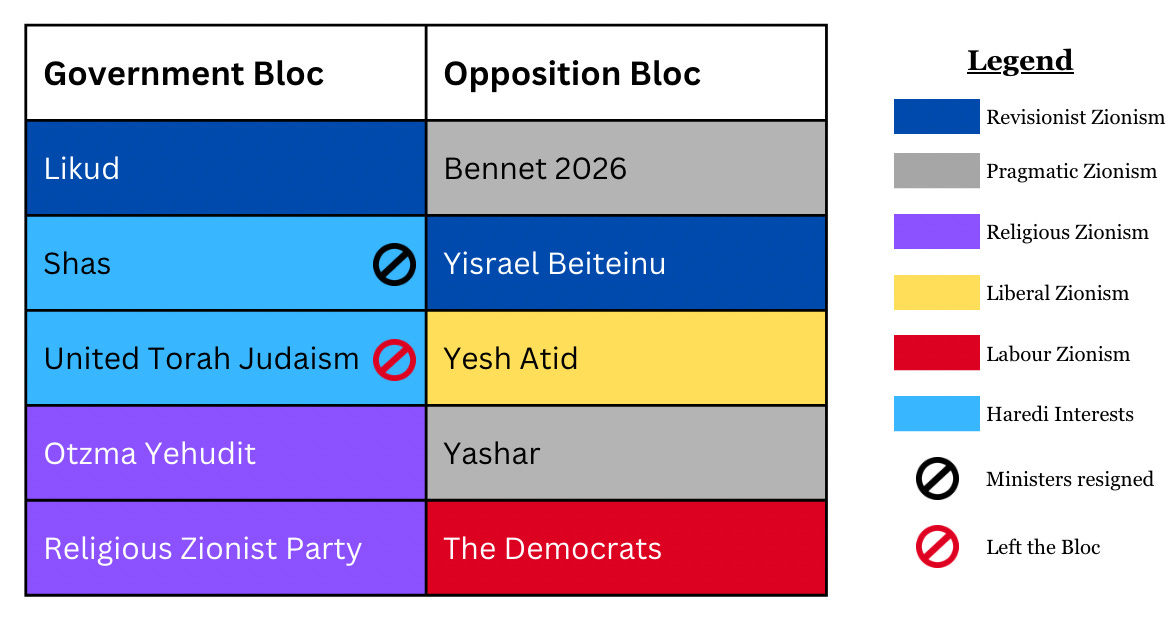
On 14 July 2025 and 16 July 2025, respectively, the ministers of United Torah Judaism and Shas resigned from their government offices in protest over Haredi conscription. United Torah Judaism left the Government Bloc entirely, while Shas formally remains part of it. Furthermore, on 16 July 2025, the only deputy of Noam left the Government Bloc.
At this point, the Government Bloc holds only 60 out of the 120 seats in the Knesset (parliament). And there are deep rifts between Likud and all the other Government Bloc parties.
On 14 January 2025, Itamar Ben-Gvir (National Security Minister) publicly threatened to resign if the government agreed to a ceasefire with the Resistance in Gaza. On 18 January, an unstable ceasefire agreement was signed. A day later, the ministers of Otzma Yehudit (including Ben-Gvir) resigned in protest and the party left the Government Bloc. On 18 March 2025, after Israel’s surprise attack against Gaza that ended the ceasefire (and killed at least 404 people), Otzma Yehudit rejoined the Government Bloc and Ben-Gvir retook his old office. On 4 October 2025, Ben-Gvir threatened again to leave the Government Bloc if the government agreed to a long-lasting ceasefire in Gaza under which “Hamas continues to exist.”
On 13 February 2026, The Times of Israel published a poll regarding the hypothetical distribution of seats if a Knesset election were to take place at that time. According to this poll, the original Government Bloc – including United Torah Judaism – would've gained only 53 seats in total (Likud: 28, Shas: 10, United Torah Judaism: 8, Otzma Yehudit: 7). Meanwhile, the Opposition Bloc would've gained 56 seats in total (Bennet 2026: 20, Yisrael Beiteinu: 11, Yesh Atid: 9, The Democrats: 8, Yashar: 8). The next regular Knesset election is scheduled for October 2026 – it can only be suspended during a state of war.
It’s a well-known fact that Netanyahu faces corruption charges from the Israeli District Court in Al-Quds – and that he can only delay this trial as long as he is Prime Minister.
There is another layer to it, namely the disillusionment of increasing parts of the Jewish community in the West with Israel and Zionism in general. Data is still limited, but an article by The Times of Israel from 5 October 2025 provides interesting insights: 32% of American Jews believe that the US is providing too much support for Israel, 39% believe that Israel is committing genocide in Gaza, 16% believe Israel’s existence is not vital for the future of the global Jewish community, and 68% disapprove of Prime Minister Netanyahu. There are 5.7 million American Jews as of 2025 (out of 15.8 million Jews globally).
Overall, the coherence of the Zionist movement, the effectiveness of the Zionist institutions as well as the integrity of the Zionist support and settler base has been eroding over the past two years. The continued existence of the Government Bloc and the Prime Minister’s very personal freedom depend on the permanent state of war as well as Netanyahu’s fragile house of cards.
Conclusion
Since 7 October 2023, the correlation of forces has shifted decisively against Zionism. The problems befalling the project today, though not existential yet, are worse than in any previous period it has undergone. The Zionist movement and Israel have reached a crossroad.
On the one hand, the current course can be maintained. This includes Netanyahu staying in power beyond October of 2026, the Government Bloc remaining intact and the permanent state of war continuing. In this scenario, Israel’s military, economic and diplomatic capacities will be depleted further and further – especially if there is another large-scale military confrontation with Iran. Israel just can’t achieve its proclaimed war aims (destroy Hamas, disarm Hizballah, topple the Islamic Republic of Iran). Sanctions will inevitably hit with the ongoing reprocessing of the genocide in Gaza as well as ongoing escalations – sanctions beyond performative action and cultural denormalization. The boycott campaign will steadily gain momentum. More and more settlers will start leaving the occupied lands. The cohesion of the settler society and its institutions as such is going to deteriorate exponentially – eventually leading to a dramatic collapse of some kind. This is the scenario Ilan Pappe predicts in his book, Israel on the Brink.
Yet, there is another possible course. This includes Netanyahu and the Government Bloc being toppled (one way or another) and the Opposition Bloc rising to power – with Naftali Bennet, Avigdor Liberman, Yair Lapid, Yair Golan or Gadi Eisenkot taking over as Prime Minister. To solve the severe problems befalling the project today, drastic concessions are necessary. A permanent ceasefire in Gaza and Lebanon must be accepted, and the proclaimed war aims need to be abandoned. The Israeli military must withdraw its ground forces from Gaza, Lebanon and the Syrian governorates of Rif Dimashq and Dara’a. The military and economic capacities can somewhat be replenished that way, but the narrative and political problems persist.
It is vital for the whole Zionist movement to shift the blame for the genocide in Gaza onto Netanyahu, Ben-Gvir and Smotrich, instead of continuing to deny it. However, in order to “cleanse” Israel of the contempt of the global public and reintegrate it into the international community, the troops and settlers must be withdrawn from the ’67 lines – somewhat analogous to the Sinai in 1982 and Gaza in 2005, but on a much larger scale. Otherwise, any Government will inevitably face sanctions. Revisionist and Religious Zionist opposition to such a course would undoubtedly be fierce, probably even armed to some extend. And certainly, such a course would contradict some of the core tenets of Zionism, as “Judea and Samaria” are considered an existential part of the envisioned “Jewish State.”
Yet, the realization of the project in the West Bank and Gaza has simply become impossible (57 years after the beginning of the occupation, there are 740.000 Zionist settlers in these parts of Palestine – in contrast to 5.6 million indigenous Palestinians). Withdrawal is the only way to somewhat restore the Zionist narrative, achieve a long-term ceasefire with the Resistance, avoid sanctions and reverse the increasing diplomatic pariah status. It’s difficult to see Naftali Bennet following such a path, should he become Prime Minister. However, Yisrael Beiteinu, Yesh Atid, The Democrats and Yashar do advocate for a “Two-State Solution,” though their current visions have little to do with the ’67 lines. But programs are flexible when pressure increases – a controlled Israeli withdrawal from the West Bank and Gaza (without normalization in return) is a real possibility during the next decade. In the short-term however, another (and potentially unprecedented) round of escalation seems inevitable.
