
The Prospects of the Zionist Project - Part 1

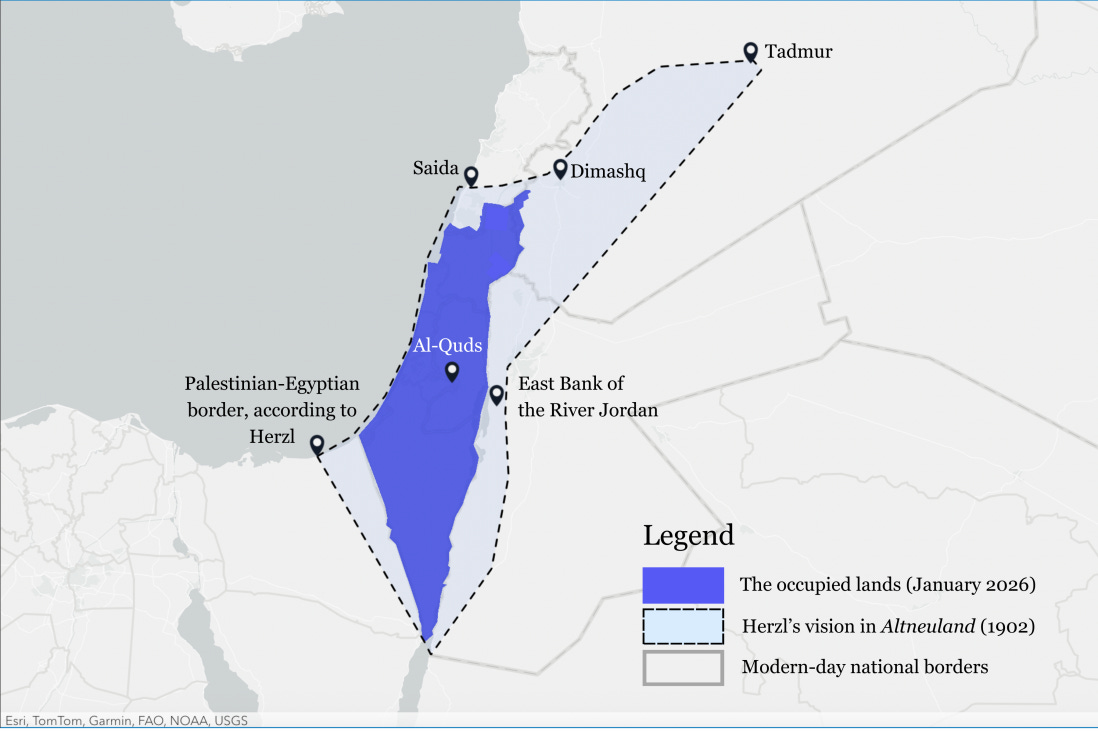
One hundred forty-four years have passed since the construction of the first Zionist settlement in Palestine. One hundred twenty-three years since the publication of Theodor Herzl’s second book, Altneuland, in which he envisioned the borders of the future “Jewish State” as follows: from the Palestinian-Egyptian border in the south, to Saida (Sidon) and Dimashq (Damascus) in the north, to Tadmur (Palmyra) in the northeast, to the East Bank of the River Jordan in the east. Seventy-seven years since the Nakba and the foundation of the Zionist colonial Entity of Israel. Fifty-seven years since the Naksa and the occupation of the West Bank and Gaza. Two years since the beginning of the permanent state of war and the genocide in Gaza.
Today Israel occupies all of Palestine, the Syrian governorate of Quneitra, parts of the Syrian governorates of Dara’a and Rif Dimashq, as well as parts of the Lebanese governorates of South and Nabatieh. However the “demographic threat” is still looming over the “Jewish state,” constantly endangering its very existence (as of 2025, there are 7.8 million Zionist settlers and 7.5 million indigenous Palestinians residing in Palestine – with further 7.8 million indigenous Palestinians residing abroad as refugees). And for Zionism as such, the future seems bleaker than ever before.
In September of 2025, Ilan Pappe published his book, Israel on the Brink, in which he provided a detailed analysis of the prospects of decolonization in Palestine (a very recommendable read). This two-part article series will approach the question from a different angle – it aims to briefly lay out the prospects of the Zionist project at this historic point in time.
There are a number of serious problems that befall the Zionist project as of today, which it will have to approach one way or another. These are:
The Military Problem
The Economic Problem
The Narrative Problem
The Political Problem
Beyond this introduction, Part 1 will cover “The Military Problem” and “The Economic Problem.” “The Narrative Problem,” “The Political Problem,” and the conclusion will be covered in Part 2.
[Author’s Note: Where detailed information is unavailable, carriers of an Israeli passport will be referred to as “Israelis”, regardless of their settler or indigenous status. Where institutions are mentioned without further clarification, they will always be Israeli. Financial data will be rounded – where reports provide data in NIS, it will be converted to USD ($) at contemporary annual average exchange rates.]
The Military Problem
According to an article by Ynet from 6 October 2025, the Ministry of Defence (MoD) had reported 1.152 soldiers and other security forces killed since 7 October 2023. According to an article by The Times of Israel from 14 September 2025, the MoD Rehabilitation Division had received around 20.000 soldiers and other security forces wounded with varying severity since 7 October 2023. According to an article by Ynet from 5 June 2025, the MoD estimated that there would be 100.000 wounded or disabled soldiers by the beginning of 2028, if the permanent state of war has not ended by then. It is a well-known fact that the conscription crisis is ever worsening.
According to an article by The Times of Israel from 22 October 2023, around 200.000 Israelis had been evacuated from settlements and villages in the so-called “Gaza Envelope” and in al-Jalil (the Galilee) after the Al-Aqsa Flood operation as well as the first exchange of attacks between Israel and Hizballah – around 50% were forcibly transferred by the Ministry of Defence.
According to another article by The Times of Israel from 1 March 2024, 100.000 evacuated Israelis were still accommodated in hotels at the time, covered by the government budget. According to a study by the Israel Democracy Institute from 25 February 2025, only 39% of the evacuated Israelis had returned to their settlements or villages by December 2024/January 2025 (despite the formal ceasefire between Israel and Hizballah, that took effect on the 27 November 2024).
According to a report by the Ministry of Foreign Affairs from 26 June 2025, Iran had fired a total of 550 ballistic missiles at the occupied lands during the Twelve-Day War (13-24 of June 2025). Though an independent assessment is impossible due to strict military censorship, the government itself has acknowledged more than 50 missile impacts on the occupied lands during these 12 days.
According to the report by the Ministry of Foreign Affairs from 26 June 2025, 32 Israelis were killed and 3.343 Israelis were treated in hospital due to drone and missile impacts over the course of the war. According to an estimate by Andreas Krieg (associate professor at King’s College London and director of MENA Analytica), the Iranian strikes caused Israel between $12 billion and $18 billion in material losses (2.1 - 3.3% of the GDP).
On 17 June 2025 (the fifth day of the war), The Washington Post published an article that estimated that Israel’s air defence system would collapse after another 10 to 12 days of war (due to air-defence missile depletion). On 22 December 2025, Ynet published an article that estimated that Iran’s missile production capabilities (if not impeded) could reach 3.000 per year.
After more than two years of permanent war, Israel has achieved none of its proclaimed war aims (destroy Hamas, disarm Hizballah, topple the Islamic Republic of Iran). At the same time, its dependency on US military aid has increased considerably. According to a report by the US Congressional Research Service from 1 March 2023, the US provided military aid worth $9 billion to Israel between 1 January 2021 and 31 December 2022. According to an article by Israel Hayom from 1 January 2025, the US had provided military aid worth $22 billion to Israel between 7 October 2023 and 31 December 2024.
The Economic Problem
According to reports by the Central Bureau of Statistics (CBS), Israel’s GDP grew by 6.5% in 2022, by 2.0% in 2023 and by 1.0% in 2024.
According to a report by the Ministry of Finance (MoF) from 21 January 2025, Israel’s Debt-to-GDP ratio increased from 60% to 69% between 6 October 2023 and 31 December 2024. According to the same report, the budgetary deficit amounted to $37 billion in 2024 (6.9% of the GDP).
According to reports by the CBS, Israel’s export value declined from $179 billion in 2022 to $157 billion in 2023. According to a report by the MoF, Foreign Direct Investment (FDI) Inflows have declined from $23 billion in 2022, to $16 billion in 2023, to $15 billion in 2024.
According to an article by The Times of Israel from 28 July 2021, the government had agreed on a military budget of $18 billion for the year 2022. According to another article by The Times of Israel from 28 April 2025, Israel’s total military expenditures were estimated to have amounted to $47 billion in 2024.
Several key liquidity rating agencies significantly downgraded Israel’s creditworthiness in 2023 and 2024.
Moody’s Investors Service had already downgraded Israel’s credit outlook from “Positive” to “Stable” in April of 2023. After the beginning of the permanent state of war, it downgraded Israel’s credit rating from A1 to A2 in February of 2024 and again from A2 to Baa1 in September of 2024 – furthermore, it downgraded Israel’s credit outlook from “Stable” to “Negative.”
S&P Global Rating downgraded Israel’s credit outlook from “Stable” to “Negative” in October of 2023. It downgraded Israel’s credit rating from AA- to A+ in April of 2024 and again from A+ to A in October of 2024.
Fitch Ratings downgraded Israel’s credit outlook from “Stable” to “Negative” and Israel’s credit rating from A+ to A in August of 2024.
According to a report by the Knesset Research and Information Center, 125.000 Israelis emigrated between early 2022 and August of 2024 (without intending to return). The number of new Zionist settlers declined from 74.000 in 2022, to 46.000 in 2023, to 24.000 in the first eight months of 2024. However, according to data published by the Population and Immigration Authority between October 2023 and June 2024, 550.000 Israelis had left the occupied lands during the first 6 months of the permanent state of war alone.
There is another factor, namely the increasing momentum of the boycott campaign. Though existing data is fragmented, it provides interesting insights. Global sales of McDonald’s, prime target of the boycott campaign, fell by 1.5% between July and September 2024, the biggest decline in four years, more than twice the size forecast by analysts (it followed a 1% drop in the April to June period). In August 2024, French insurer AXA was forced to sell its investments in all major Israeli banks. In October 2024, fossil fuel giant Chevron halted a $429 million expansion of an Israeli-claimed fossil gas field.
After more than two years of permanent war, Israel’s economy is facing an exponential process of decay. Every new round of escalation increases the overall strain and accelerates the process. Any relief can only slow the process down temporarily as long as the current war aims are maintained.
To read the second article of this two-part series, click here.
Photo: Map created by Lily Edelman-Gold
 | A guest post by
|