
Recognising care-centered economies for a just transition: Perspectives from the Global Majority (Part I)
A conversation with Neha Saigal


Neha is co-founder of Intertidal Lab and co-builder of the Climate & Care Collective in India. Her work brings an intersectional lens to climate and energy, with a focus on gender, care, and community-led solutions. She is a student of degrowth and actively supports the transition toward regenerative economies and leadership.
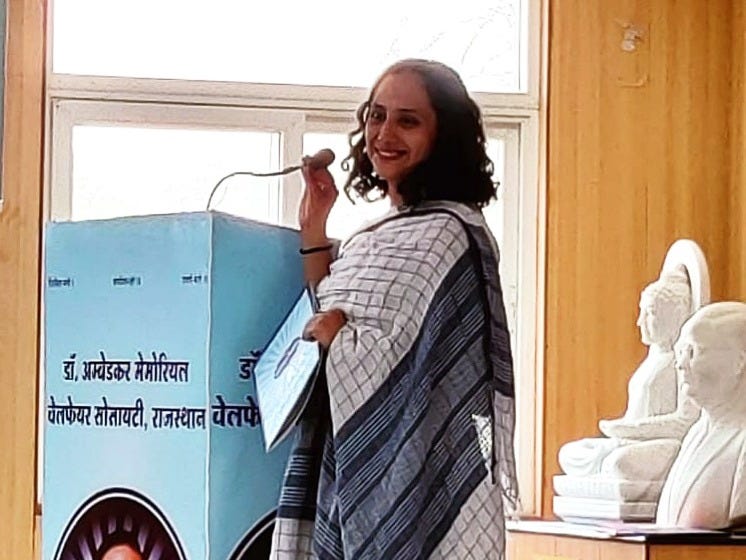
Part 1: Between re-imagining and recognizing
Gisela Ruiseco: We are heirs of that moment in the history of modernity, where paid employment was crystallized as the “real work”. Other kinds of work, like care work, became invisibilized, and if paid, poorly paid. Work directly centered on the production for the well-being of the family and community (constituting “subsistence economies“) was devalued. Feminist scholars like S. Federici, have made a superb account of this process in our modern/colonial history, which in the long run made us lose sight that these types of devalued work constitute the bedrock of our economies.
Today many defend (as also taken up by the Degrowth movement) the importance of putting care and not capital accumulation again at the center of our economies. There is a call for a deep transformation in this sense. From our late modern point of view, this transformation may seem a strange idea, and perhaps very difficult to implement. But centering on care and guiding human efforts towards attaining sufficiency and wellbeing, has implicitly been the norm for humanity. In Global South societies, such arrangements may survive to some degree.
Question: Placing care at the center at the center of our economies would involve deep transformations, both of society and of our understandings, specifically here around “work”. Neha, how would you see this and how could we actually proceed with such a transformation?
Neha Saigal: What is work? It’s a deceptively simple question, and yet one that cuts to the very foundations of how we have organized society, our families, our sense of self, our relationships, our belonging.
For better or worse, work as most of us know it has been shaped by colonial capitalism, and more recently by what some are calling techno-feudalism: systems that define work by narrow parameters, oriented toward producing for an economy that grows for its own sake, with little regard for what that growth actually sustains or destroys.
My thinking on this has been sharpened recently by time spent in parts of Eastern India, where coal mining is the lifeblood of entire communities. Global and national energy transition discourses, however necessary, are threatening mine closures, or have already brought them about. In India, a significant share of the informal workforce comes from historically marginalised communities, compounding precarity with the disproportionate burden of hazardous and exploitative conditions in coal mining. And it is the people living inside that rupture who are sitting with the hardest questions: What will work mean for us? What will we do? Who will we be?
What has drawn my attention most, though, is the labour that was never counted to begin with. In these settings, the people most invisible in dominant narratives are women particularly from Dalit and Adivasi communities whose days are organised around caring for people, homes, farms, and land, much of which emerges as incidental yet essential labour within subsistence and ecologically dependent livelihoods.This work is foundational to the functioning of society and how consistently it is dismissed as something natural, something that certain bodies and simply do, rather than as work deserving recognition, value, or protection (see also a recent article in this magazine).
It is these conversations happening in places where the very meaning of mainstream work is being forced open that have fired my imagination.
We are living inside multiple, cascading crises each triggering the next, each falling hardest on those in the Global Majority. The genocide of Palestinians. Wars driven by the United States and Israel against countries like Iran and Venezuela. The relentless pursuit of minerals and oil by capital, replicating colonial agendas in ways the whole world can now watch in real time. These are not aberrations. They are the logic of the system, playing out across a global scale.
And yet, something else is also happening. A resistance is growing. Parts of the Global Majority are not only pushing back against the old order some are daring to imagine that this order was never inevitable, that sovereignty, dignity, and self-determination are not utopian fantasies but legitimate foundations for a different kind of world.
To understand why care sits at the heart of that reimagining, we need to understand what has been deliberately kept invisible.
The ecofeminist theorist Ariel Salleh developed the concept of meta-industrial labour to name exactly this: the caring, regenerative, productive, and reproductive work performed by women, peasants, and tribal peoples work that the dominant global economy has never adequately acknowledged, let alone valued. This labour does not merely supplement the capitalist economy. It subsidises and is the hidden ground on which everything else stands.
There is no denying that the system capitalist, feudalist, extractivist has been built on this unacknowledged foundation, and has benefited enormously from never having to pay its true cost.
So what would it mean to turn that on its head?
To centre care is not simply to add it to the ledger of recognised work. It is a far more radical move. It challenges capitalism, yes but also neo-colonialism, patriarchy, and the interlocking structures of gender and racial violence that keep certain bodies in service to others. Care, understood in this expansive sense, provides an essential social good. It underpins wellbeing and sustains standards of living by supplying the very conditions that allow people to participate in society at all.
The good news is that the communities I work with in the coal mining belt of Eastern India are asking these questions have never been without answers. There is no shortage of frameworks for organising societies, economies, and politics around care. Queer ecology troubles the boundaries between nature and culture, challenging the hierarchies that place certain bodies and certain lands in service to others. Ubuntu, I am because we are, grounds personhood in relationality rather than individual accumulation. Buen Vivir, rooted in Latin American indigenous thought, offers a vision of living well in balance with community and the natural world, rather than living more at its expense. Commoning points to the centuries-old practices through which communities have collectively governed land, water, and shared resources outside the logic of private ownership.
What these frameworks share is not just an intellectual position. They are, in large part, descriptions of how communities particularly marginalised communities in the Global South have actually been organising for a very long time. Long before scholars of degrowth and post-growth in the Global North began theorising alternatives to capitalism in academic language, these ways of living and relating were already present, already practised, already defended at great cost. The danger, then, is not that we lack ideas. It is that the ideas get laundered through institutions and disciplines until they are severed from the lived experiences and indigenous wisdom that gave them meaning in the first place.
So let us bring it back to the ground. Back to Eastern India. Back to the women. Dalit, Adivasi, marginalised who are standing at this frontier right now, not as subjects of study but as people who are already asking the hardest questions about what comes next.
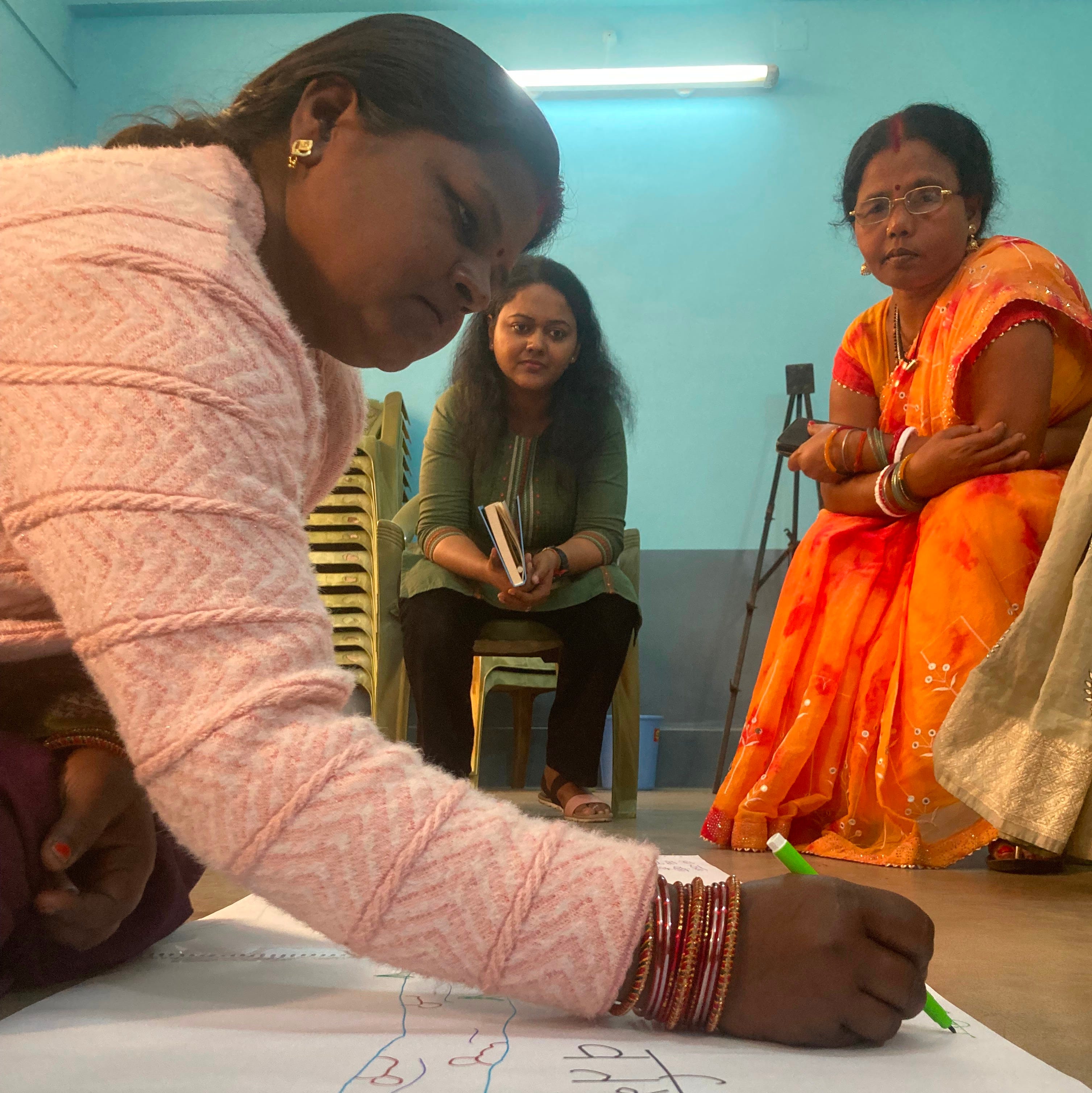
For them, the transition away from extractive, fossil-fuel-driven economies is not an abstract policy debate. It is immediate, material, and existential. And what a genuine paradigm shift would require is not simply the substitution of one energy source for another, but a fundamental rethinking of what an economy is for. This means moving beyond conversations about care work important as those are, towards imagining full care economies and caring societies: structures that do not merely recognise invisible labour but restore dignity and sustenance to it.
It means dismantling the hierarchies that rank work by its proximity to capital, and replacing them with a systems understanding that what holds life together: caring for people, for land, for nature, for the wild is not peripheral to the economy but its most essential core. Everything is interconnected. To uplift care is to uplift the web.
In very practical terms, this looks like giving communities genuine choice over the kind of work they do and the kind of lives they build. It looks like respecting and resourcing the labour of women, queer persons, and elders. It looks like building economies of sustenance from the ground up not economies of endless growth that extract from the margins to accumulate at the centre.
(Will be continued...)
 | A guest post by
|
 | A guest post by
|
Very good, looking forward to Part II.