
Decolonising work in the Global South: Rural women’s climate change adaptation narratives from India

Mainstream understanding of ‘work’ and value
What we imagine as work has profound implications for environmental resources because every activity is energy-intensive; and on social justice, particularly in terms of which activities are deemed socially (in)valuable and whose bodies, often gendered and racialised bodies, perform those activities. Under contemporary capitalism, value is primarily assigned to work that drives economic growth, while socially necessary forms of care, community, and familial labor are devalued, and the system’s hidden social and environmental costs remain unaccounted for and invisibilized. Even if societies succeed in downscaling economic systems away from growth-oriented capitalist objectives, a post-capitalist future does not automatically ensure that sufficiency-oriented work is shared equally among genders, racialised groups, and oppressed peoples across global scales. This is why gender and intersectionality (gender interlocks with other sources of oppression like race, caste, and class) are a crucial lens through which to interrogate the unequal distribution of labour, and for supporting post-capitalist and sufficiency-based activities.
A short documentary representation of this article can be found here:
In this article, I examine the rift between productive work, understood as economic production, and reproductive work, understood as socially necessary care work that regenerates life, in the context of agrarian economies in the Global South living under post-colonial situations. Here, I draw on findings from my doctoral fieldwork, conducted in 2022, in the rural regions of eastern India, specifically in West Bengal and Odisha. My research explored how rural cultivators are adapting to climate-aggravated water scarcity and droughts, and how gender and intersectionality shape adaptation labour. Adopting a narrative approach, the article highlights the voices of rural women, especially from Puruliya district, a drought-prone region in West Bengal, and other villages in western Odisha. These voices are followed by an analysis of the concept of work that is not only critical of capitalist framings of production boundaries but also takes a feminist and decolonial turn. The feminist turn centres rural women’s perspectives as embodied, because environmental experiences and sufferings are located in bodies, and situated in histories of colonial violence and ongoing imperialistic subjugation that benefit the global elite class. The decolonial perspective brings historically marginalised and post-colonial knowledges to the forefront, as well as epistemologies or knowledges that remain largely invisible within mainstream and Eurocentric critiques of capitalism, and imaginations of post-capitalist futures.
Reconceptualising ‘work’ through rural women’s lived experiences
In rural Odisha and West Bengal, the gender gap in labour was stark and openly acknowledged by men and women. Most women farmers reported performing 70-80% (field diary) of farm-related tasks, including sowing, weeding, harvesting, processing, and storing crops, while also bearing a disproportionate share of household responsibilities. During a focus group discussion with Dalit farmers across genders in Puruliya, the following conversation took place:
Dalit women: Women farmers have more workload.
Dalit men: Men are responsible for ploughing and broadcasting the seeds. After that, women do most of the farm work.
Dalit women: What do the men do? They only plough and disperse the seeds. That’s it. Women do everything. We leave at 6 in the morning and return at 6 in the evening. Men work for half the day, and women work till the evening. This is the case in the months of May, June, and July. We work for 12 hours.
- Notes from a focus group discussion with the Dalit community, traditional instrument makers, Puruliya, West Bengal, 8th March, 2022
These conversations demonstrate that both rural women and men are aware of women’s excess workload compared to that of men. Importantly, women conceptualise work in ways that extend beyond the conventional income production boundary. This perspective became more clear in my conversation with another participant from a different household in the same village in Puruliya:
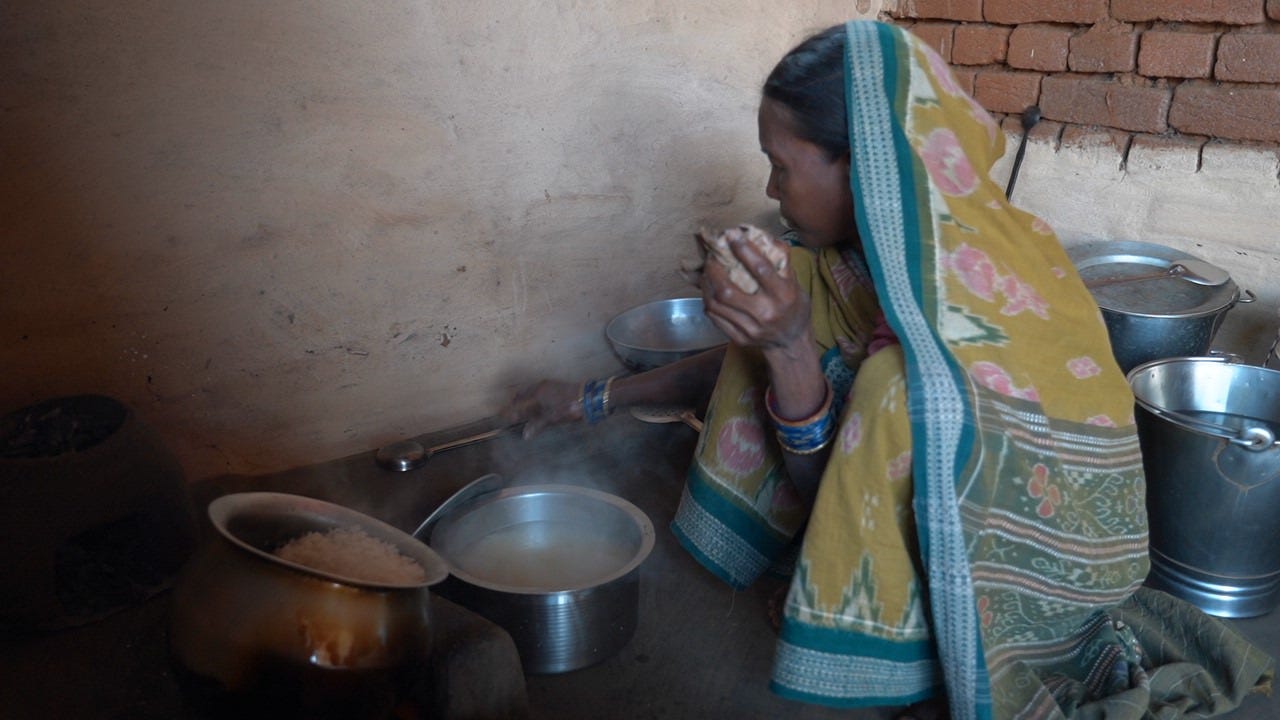
Just like husbands perform work, women also perform work. If men work outside, women work inside the home. We wake up at 5 a.m. and pray to God to protect our home. Then we do the Maruli ritual, during which we sprinkle pure water throughout the house. After that, we clean the house and the utensils. Around 7 a.m., we wash our faces and have tea, and at 9 a.m. we eat muri, flaked rice, with something for breakfast. Then we feed our children, drop them at school, and finally take a bath ourselves and have lunch at 12 p.m. These are the kinds of work we do (laughs). In the evening, we make rotis for the men. We do not like rotis; we like rice more (laughs). In the village, we enjoy rice more. For lunch, we eat rice, dal, vegetables, pickles, and one fried item such as potato fry or fish fry. On some days, we also cook fish curry or meat curry. For dinner, we eat the same food. We buy vegetables from the bazaar and the local haat (community-based market). Women do most of the cooking, but if guests come from outside, our husbands sometimes help us.
- Excerpts from a conversation with a Dalit woman from the Natua or traditional dancers community, Puruliya, West Bengal, 8th March, 2022
In this narrative, the participant redefines ‘work’ outside the capitalist and patriarchal framing of the economy, which categorises activities beyond agricultural production or those lacking exchange value as ‘non-work.’ For rural women, every activity geared toward the reproduction of everyday subsistence life constitutes work. Subsistence here implies not bare survival, but women’s collective “autonomy and agency and economic self-sufficiency” as well as a means of “resisting the global capitalist economy and its patriarchal, colonial control over women, means of production, and the land.” Labouring for water is then embedded within a bundle of everyday care activities that reproduce rural households and sustain traditional and subsistence ways of living. This labour serves multiple purposes, including rituals, cleaning, bathing children, cooking, and drinking, and is primarily managed by women on a daily basis. During periods of water scarcity, water is reused for cattle and kitchen gardens, the adaptation labour largely borne by women owing to their gender role as caregivers by default. While some tasks are shared among family members, women overwhelmingly bear these responsibilities.
The everyday labour of rural women can be summarised as performing rituals like Maruli, a predawn practice that involves fetching water, sprinkling it inside the home for blessings, followed by mixing water with gobar (cow-dung) to clean and disinfect the household. Their day then unfolds in continuous and time-consuming processes of reproductive labour: preparing meals, fetching water, cleaning, and caring for children, husbands, and family members. For poorer women, the burden is greater, because in addition to finishing their own household chores, they also work as wage labourers on others’ farms or as domestic helpers in richer households. The day concludes with final rounds of cooking, serving, and cleaning. When I asked about their workload, most women expressed that they are so occupied throughout the day that their bodies feel exhausted, barely finding time to rest. Climatic disasters threaten subsistence ways of living, pushing women especially toward conditions of severe exhaustion and bare survival.
Reimagining work beyond growth
As evident in the narratives, gendered inequality in labour persists because the capitalist economy rewards outputs and production, thereby dismissing process-based activities such as cooking, cleaning, caregiving, maintaining water security, and conserving nature as ‘non-work.’ As a result, care and emotional labour end up being absorbed within patriarchal gender roles, naturalised as women’s responsibilities, rendered unpaid, and systematically devalued.
The feminist social reproduction theory challenges the dominant framing that values production over reproduction by asserting that the labour required to reproduce families, people, nature, and communities is as essential to the economy as producing goods and services, yet remains invisibilised, unrecognised, and unpaid. The theory’s central aim is to place all forms of labour that create and sustain society at the core of economic analysis.
To decolonise work, then, is to recognise how historically marginalised women dismantle the mansplained boundaries of what constitutes labour. Their voices challenge capitalist and patriarchal market economies that privilege profit and GDP growth over care. Decolonising work requires valuing all forms of labour that sustain the daily well-being of people and the planet, and redistributing this labour equitably across gender, caste, class, and race to reduce the disproportionate burden placed on marginalised women. It also calls for expanding our understanding of the economy itself, recognising that what has long been dismissed as ‘non-work’ under capitalist-patriarchal norms is, in fact, foundational to all labours valued as productive work. Rural women’s understanding of work covers income generation, social reproduction, and the labour necessary for human survival.
 | A guest post by
|