
On “freedom”: limits and coloniality - Part 1
Our unfreedom in three scenes

The “Free world”
The “free world” is heading towards authoritarianism. Perhaps not so surprising, since it was never quite free and this so-called ‘world’ was always rather exclusive, to put it mildly.
The term originated during World War II to differentiate the allies from the fascist states. Later, during the Cold War, it was widely used to refer to the countries aligned with the USA. Could it be rather outdated today? Recently, Madrid’s mayor I.D. Ayuso announced that she would award the International Medal of the Community of Madrid to the United States for being the “leading beacon of the free world”. This happens in a historical moment when that ‘free world’ is trampling on freedoms, assassinating with impunity in different geographies, among them inside the U.S. itself!
Ayuso’s award can, of course, make your blood boil.
Actually, we are dealing with very stubborn imaginaries making up our deep seated idea of ‘the West’ as the place where ‘freedom’ has been attained. A high-value word (Mirandum), it is an integral part of modernity’s identities. It is also a highly complex concept whose actual meaning depends on which aspects get highlighted (and which obscured) in a given context.
Today, curiously, the mainstream discussion is more concerned with pointing out the dangers of potentially restricting ‘freedom‘, than with freedom itself. Thus, it indicates freedom for entrepreneurs from regulations and the government. Global freedom would then refer to the corporations that should not be restricted from extending their tentacles all over the globe, a freedom to be defended with wars, if necessary, as we see today.
We could add here, further, that bleak utopia of the ‘freedom’ to consume. A call, or rather instigation, that has become a curse for the planet and for the life it carries (and more concretely for humans, engaged in chasing a carrot that never brings ‘enoughness‘).
‘Freedom’: a thinned-out concept
Those of us socialized in ‘the west’ are actually much less free than we may think1. I would like to share a few scenes from the dawn of modernity which allow us to peek behind the veil.
Scene 1
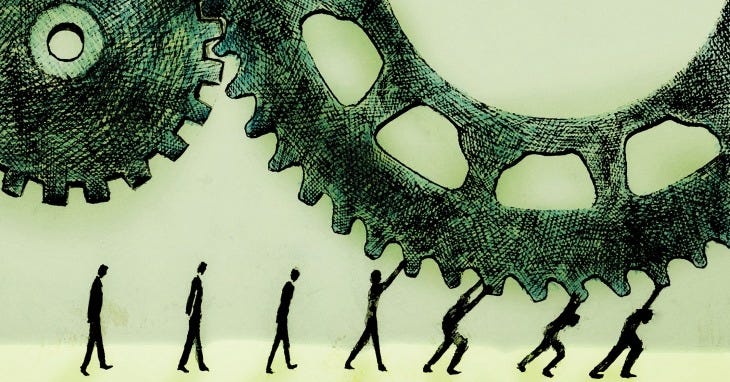
In the 18th century, as machines were first introduced in the working process, they were met with multiple riots in different geographies throughout Europe; the best known machine wrecking movement is that of the ‘Luddites’. The terrible working conditions were reason enough to riot, yet one interesting point has perhaps remained in the background. For previous generations, the production of goods had been quite autonomous, people organized themselves as to how much, and when, they worked: “Basically they shaped their work around their lives, rather than their lives around their work”.
The industrial revolution dramatically turned their world, and ours, upside down. And our relationship to ‘work’ shapes us to such a degree that even imagining otherwise is very difficult. But history can help:
Workers had a large amount of control over their own labour. They produced only enough to keep themselves comfortable and if the fancy took them they might not work for days. Even after the enclosures took away large amounts of common land they subsisted for a great percentage on what they grew in their gardens.
Today, our unfreedom with respect to this overarching aspect of our lives is taken completely for granted2.
Scene 2
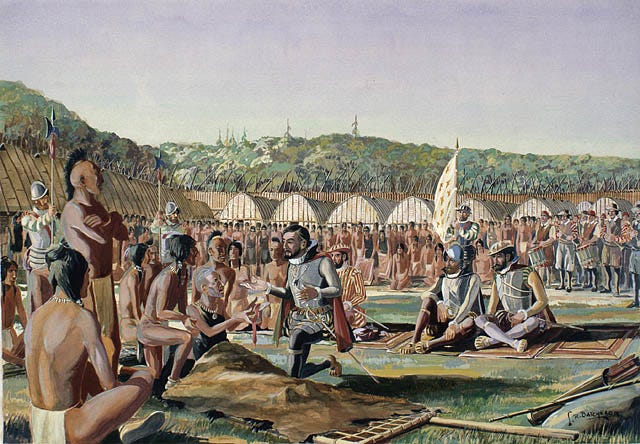
One delicious excursion: Graeber and Wengrow, in their book The Dawn of Everything, take us on a journey to recover some interesting historical episodes. At one point, they describe how the Europeans were first seen by Native Americans: as completely unfree. Making fun of them was a common occurrence. Among the Wendats (in today’s Quebec), hierarchies were understood differently as in Europe: a ‘captain’ “could give all the orders he or she liked, but no one was under any particular obligation to follow them”. And further, as Father Lallemant wrote in 1648:
...the Savages have never known what it was so solemnly to forbid anything to their people ... They are free people, each of whom considers himself of as much consequence as the others; and they submit to their chiefs only in so far as it pleases them.
This understanding of freedom, which includes a necessary ability to talk through any issue that needed to be decided, also has an interesting consequence with respect to inequality. The latter existed (although ‘possessions’ meant something different than for us), but their concept of freedom provided a soft prevention of these to harden into power-over relations.
Further, these societies took care to ensure that people would be ‘free’ of deprivation. This is a premise of freedom which finds, not surprisingly, little consideration in the ‘Free World’. As we saw further up, it was only in the dawn of modernity when people lost all access to their own means of production (see the Marxian concept of “primitive accumulation”, also S. Federici’s work). Our societies created artificial scarcity, i.e. scarcity in the midst of abundance, generating complete dependency, both in the colonies and in the centre of the fledgling Empires.
These examples can make us realize what potential we humans have beyond our present modern imaginaries. Our possibilities of being and relating to others, of building other kinds of societies, are bountiful, as Graeber and Wengrow develop in their highly recommendable book.
Modernity-coloniality
Let us stay briefly in the 17th and 18th centuries with the so-visible-yet-curiously-invisible fact that the ideas of the Enlightenment and the resulting Declaration of Human and Civil Rights did not include everyone by far. As Latin American decolonial authors, among others, have discussed, these historical developments happened at exactly the same time and were authored broadly by the same peoples who were trading with human beings (see Kant’s defence of slavery, for example).
We know this roughly and, from our ‘top of history’ point of view, we may think: Oh well, they were ‘still’ racists, feminism had not yet emerged, modernity was just developing...
However, we fall today into the same contradictions, and this is not a coincidence:
Scene 3
Let us turn to the bloody frontiers of the enriched world, to those imaginary lines which, for some, determine life or death. These are largely the same lines that were drawn during colonial times. Today we take this monument to unfreedom for granted.
Frontiers are permeable in one direction, impermeable in the other. Today, they signal the impossibility for people --many of them victims of global (environmental) injustices-- to move to where there is demand for what they offer: their labour. It is ridiculous and tragic at the same time: The sacrosanct law of the market where free floating demand and supply form a wonderful equilibrium which will bring the good to all is shattered when insisting on closing up borders. If we follow neoliberalism to its fullest, there should be no borders at all! As there are no borders for finance.
Today, as during the Enlightenment, whatever rights are declared as ‘universally valid’ have a very clear threshold below which the law of impositions and brutal interest reigns without shame...
The modern ‘we’ may actually be constituted by rather unfree peoples waving the flag of freedom. Yet within our structural unfreedom, some are more unfree than others: an intrinsic colonial aspect of modernity.
Photo 1 : The New Statesman / Photo 2: Painting: L.R. Batchelor, In Wikipedia
It is in this deep sense that I am discussing our contingent unfreedom, as part of modernity, of our deep seated cultural imaginary. The aspects in which modern societies are unfree is a vast theme which has been analyzed from many different points of view and disciplines. Here I only want to give insights into a couple of aspects that are completely naturalized, i.e. invisibilized.
And worse even, many of us have become our own ‘start-ups’, supposedly free but actually immersed in a complex dynamic of self-exploitation.
 | A guest post by
|
There is a lovely feeling when a simple observation resets your perspective. In truth, I have been wise to neoliberalism for some time but one of its basic contradictions that I hadn't twigged was this bifurcation of its approach to freedom. The cynical appeal to freedom for business and finance while staunchly preserving the confines of the state for everyone else.
For better or for worse, we have a consciousness that allows us to evaluate the costs and benefits of our actions which has allowed some to ignore the needs of others in pursuit of their own sense of safety and comfort. Gravitating to power, they curtail the freedom of others so that they themselves can operate without limit.
How far we have strayed from our roots in ground we tread.