


Vladimir Borțun holds a PhD in political science from the University of Portsmouth (2015-2019). He worked as a postdoctoral researcher in the Department of Political Science at the Autonomous University of Barcelona on a project (MIGRADEMO). Between 2022 and 2025, he served as a postdoctoral fellow in the Department of Social Policy and Intervention at Oxford, working on the Changing Elites project. In 2024, he joined St. John’s as a Lecturer in Politics. He has given interviews on CNN and various Romanian TV programs.
Vlad B.: We live in times of great geopolitical conflicts, economic tensions, and environmental crises. On one hand, it appears that capitalism is invincible; on the other hand, many have pointed out that capitalism is full of contradictions. Political parties, both on the left and on the right, seem completely oblivious to the catastrophic consequences posed by the environmental crises. Everyone wants to continue business-as-usual while attempting delusional solutions such as “green growth.” In response to this, some degrowthers have suggested that the solution is the creation of eco-socialist political parties that should aim to take power within capitalist states. Others are suggesting a bottom-up approach by creating a counter-culture that offers an alternative to capitalism by refusing to participate in it, along anarchist lines, as the Kurds are doing in Rojava, or the Zapatistas in Chiapas, Mexico. In terms of theories of change, given all these massive problems, where do you think we should place our attention, as simple citizens or as activists?
Dr. Borțun: Indeed, capitalism does appear as invincible. I think it was Frederic Jameson who said that “it’s easier to imagine the end of the world than the end of capitalism.” But that has been the case with every social order in history. Feudalism certainly appeared as invincible and was indeed so for about a thousand years. Eventually, it collapsed due to its internal contradictions. Capitalism will make no exception, although let’s hope it will not take a thousand years to do so. But there’s no reason to think that capitalism is the final stage of history or human progress. Even Fukuyama backtracked on that in recent years. The bigger question is what will come after capitalism, and the choices we are faced with are the same as always: socialism or barbarism. The latter seems to be more on the horizon at the moment: increasing inequalities, climate change, war, genocide, [and the] rise of the far right. But we need to reject the hegemonic idea that “there is no alternative.” There can and should be one, in opposition to both the neoliberal status quo and the neofascist insurgency. Here, I agree with people like Jason Hickel, Kai Heron or Jess Spear (to name but a few) who call for the establishment of eco-socialist parties that can build and fight for that alternative, which fundamentally entails a break with capitalism – a system defined by the subordination of people, communities, and the planet itself to the logic of profit maximisation. Like you say, “green growth” is simply a delusion and a dangerous one at that, as it hampers the development of a genuine alternative.
But this alternative also needs to be realistic about the need to conquer power. We cannot rely on building some kind of parallel society, as the Zapatistas have been trying to do in Mexico. I don’t want to be dismissive of those models of organisation and struggle--they certainly have their merits, but also their limitations. We cannot avoid climate catastrophe and other kinds of catastrophe unless we gain democratic control over the production and distribution of resources. That means gaining political power, which is why we need political parties. But in order to avoid the mistakes and defeats of past attempts, these parties have to be rooted in, and accountable to, mass movements present in local communities, workplaces, universities, etc. We need movement-parties.
Vlad B.: How can these eco-socialist parties solve the problems of the exploited working class and the climate catastrophe at the same time? What would be their most appropriate messaging?
Dr. Borțun: These parties need to make a better case for the green transition, which currently is not only ineffective but seems to “punish” ordinary people (workers in the fossil fuel or auto sectors, farmers, people who drive to work, etc.) and benefit corporate interests--at least, that is the prevalent perception. But there is a strong case to be made for an eco-socialist transition that would create secure and well-paid jobs in [the] renewable energy sector, new infrastructure, new housing, etc. A lot needs to be built and rebuilt for this transition, probably on a scale never seen since the post-WWII reconstruction, which saw a dramatic rise in living standards for most people thanks to near-full employment, constant rise in real wages (in line with productivity, unlike today), mass projects of public housing, the welfare state, and so on. We could have all of this again, and more, thanks to a democratic eco-socialist transition.
Another appealing aspect of the green transition would be the potential reduction in energy bills for working class households, farmers or small businesses. This is hugely important considering the rise in energy costs over the last few years, particularly in Europe. I was at the Congress of the European Greens last December in Dublin and a representative of the Možemo! (We Can!) left-green party in Croatia told us how they managed to win, and retain, power in the capital, Zagreb, by telling people how green energy would save them money. But they didn’t just do that, they also did other things not linked to the environment, such as building new public nurseries. In other words, eco-socialists need to find ways to link the green transition to the immediate material issues of ordinary people. But there’s no disjunction here: immediate material issues include the impact of climate change, which more and more people can feel acutely in their daily lives. So those who think the left should sideline the environmental agenda in favour of material ‘bread-and-butter’ issues fail to understand [that] climate catastrophe is as material as it gets – and people around the world, including in the Global North, are increasingly and painfully aware of it.
Vlad B.: A message such as “tax wealth not work” in order to pay for the green transition may be an easy sell for ordinary people. How should we go after the super-rich to make sure we get to their wealth?
Dr. Borțun: Good question! And good example to show the inherent limits of a reformist, rather than radical, approach to social change. Given the level of globalisation today, particularly the myriad of ways in which the ultra-rich can funnel their money to evade taxation, the state is weaker than ever [in their ability] to tax them appropriately. Clearly, more radical measures would be required, such as the introduction of capital control, to prevent the flow of wealth from the country. After all, the rich did not create that wealth by themselves but thanks to a complex web of people and institutions – those working for them, those buying their products or services, the public bodies paying for all the social and material infrastructure required for their business to operate (and which businesses themselves would never be capable of sustaining), etc.
In fact, an increasing share of the ultra-rich extract their wealth in rentier rather than productive ways: today, asset-values, financial claims, real estate, intellectual property and other forms of ownership generally play a larger role in wealth accumulation compared to more traditional productive investment (e.g., manufacturing), which has been severely lagging in recent years. This links back to the problem of why we cannot rely on private investment to tackle the climate crisis, for which we need large-scale investment in productive industries. Why would the billionaire class invest in these industries if rent-seeking is more profitable? This is where we need to reframe the whole state of affairs: this is wealth that the ultra-rich have extracted from society through institutional arrangements designed to benefit them. We need to take that wealth back, not merely tax it – not just because it’s the right thing to do, but an objective necessity if are to effectively tackle the existential problems we face.
Vlad B. Recently it has been announced that the 7th planetary boundary (ocean acidification) out of 9 measured was crossed. Also Earth’s first catastrophic climate tipping point has been reached. Some see conflict between these massive environmental problems and the interests of the working class. How can we save both the working class and the planet for future generations, after we have taxed the rich massively?
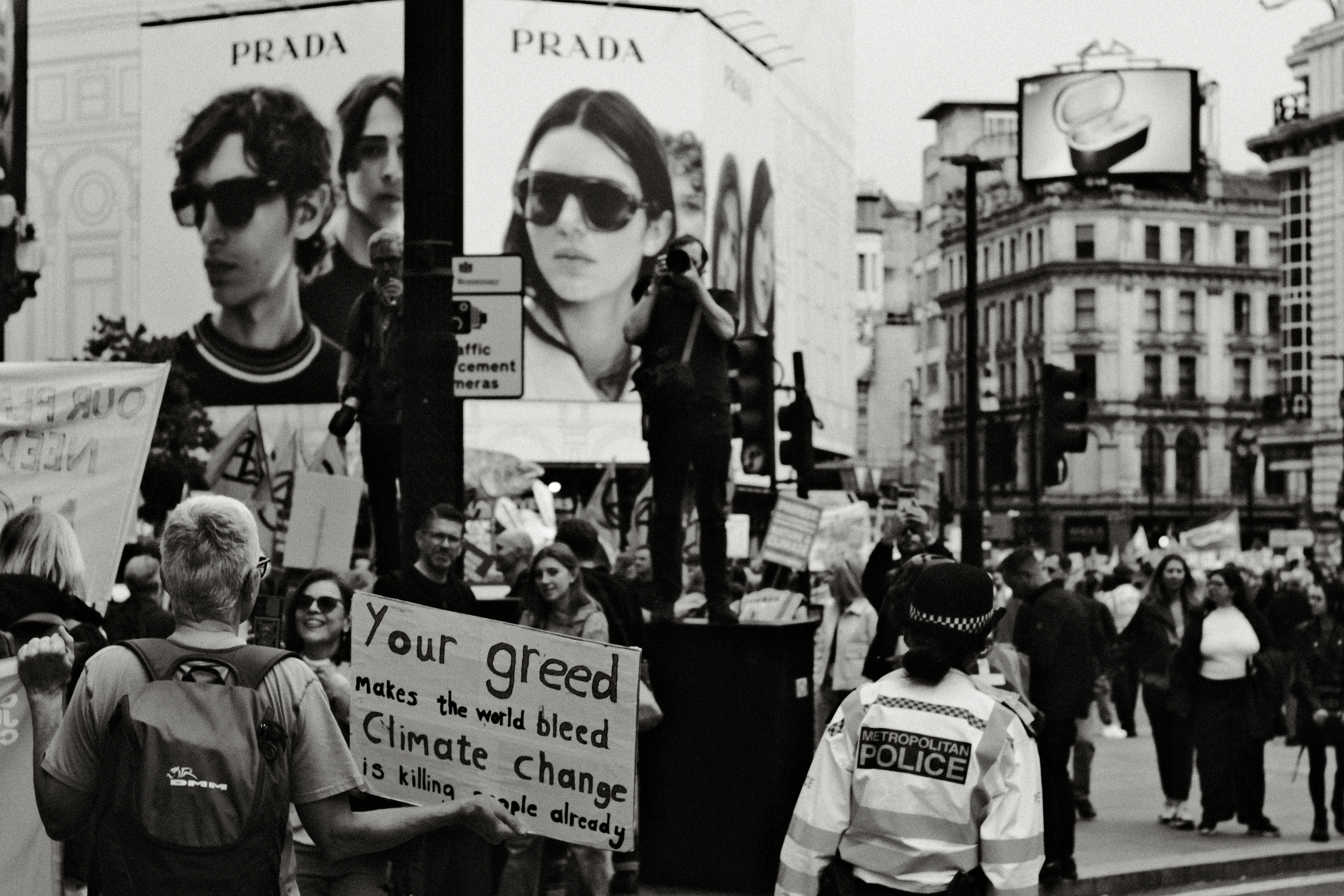
Dr. Borțun: The situation you outline is indeed very bleak. But I would challenge framing this as zero sum game: either we save the working class or we save the planet. It’s a false dichotomy on several levels. At a very basic level, the working class also lives on this planet. It breathes the same polluted air and drinks the same contaminated water. We cannot save the working class if it doesn’t have a planet to live on. Indeed, while the Southern California fires in January 2025 showed that nobody is safe from climate change, in general it does disproportionately affect working class [people], who are more likely to be working in fossil fuel-related jobs that damage their health as we speak, but who also have fewer resources available to mitigate the impact of climate change on their lives and their communities. The ultra-rich can hop on a private jet to take them to safety. Working class people do not have that option. They cannot afford the luxury of choosing private profit over planetary security. So, I think we need to reframe this and show the many ways in which climate change already affects and will increasingly affect working class people, their children, and [their] grandchildren.
We also need to point out the many ways in which, for every job lost in the fossil-fuel-dependent industries, more can be created in renewable energy, in the building of ‘green’ infrastructure, ‘green’ housing, ‘green’ agriculture, etc. In times of war, productive industries are often repurposed to serve the needs of war. Why can’t we do the same to serve the needs of the planet on whose wellbeing our very existence depends? Of course we can. Not in a capitalist, profit maximising framework, but in a system based on rational and democratic economic planning that serves the needs of people, communities, and the planet. That is why, as I said above, mere taxation is perhaps necessary but not sufficient in the long run. We need a different type of economic system and political order that can make it possible, unlike today, when those with economic power also hold political power, hence the lack of progress in addressing the challenges of climate change.
This kind of systemic transformation cannot be done without the active participation of the industrial working class in particular, who have the power to paralyse economic activity at both national and global levels, thereby holding more sway than any other social class. It also has a better level of organisation due to the collective nature of the workplace and persistent levels of unionisation (lower than before, sure, but still higher than in most sectors of the economy). In other words, not only can we save the working class only by saving the planet, but we can only save the planet by saving and empowering the working class. Our main task now, I believe, is to convince the working class that it is directly interested in taking the lead in this process of systemic change, which can deliver not only a safer planet for them and their families in the future, but also more secure and better paid jobs in the present. We can make a forceful case and that starts by rejecting the false dichotomies and ideological framing of those in power.
Vlad B.: Thank you Vladimir.
Photo credit: Zeno Hind.
