

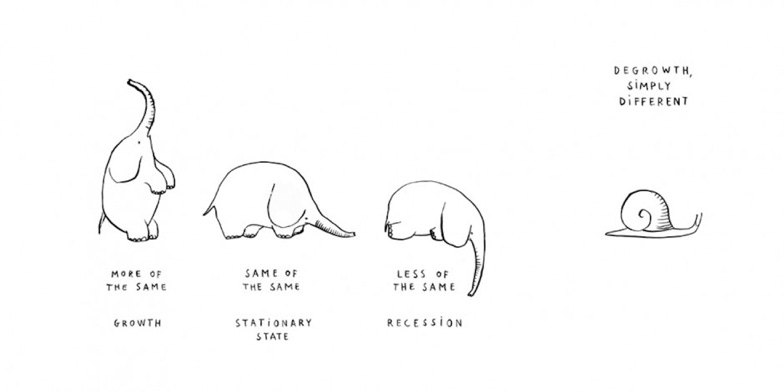
This document, started by the the editorial team of the Sufficiency & Wellbeing Magazine, outlines how we understand degrowth. For a topic as multidimensional as degrowth, we decided to format this “definition” as an open-ended list and keep it in a living document, in line with Timothée Parrique’s analysis of degrowth’s (lack of a single) definition. In the spirit of prosocial collaboration, which the degrowth movement values greatly, we welcome comments and additions to this document, which we will incorporate periodically into the existing list.
In summary, we view degrowth as an expansion of social justice to all members of society, alongside the promotion of human well-being within the limits of Earth, through a selective reduction of production and consumption to lighten ecological footprint, planned democratically in the spirit of socio-ecological justice. The following list provides more detail.
We understand degrowth as:
a social movement that aims to decolonize the global economy through by delinking Global North consumption from Global South production and neocolonial systems of extraction.
an anti-capitalist paradigm that calls for a global downscaling of production and consumption (prosumption), re-organization of economic activities to prioritize wellbeing, and redistribution of wealth
requiring a shift in worldview, from a dualist perspective that separates humans and nature, to one that embraces the value of all life
a vision of a future where humans live in harmony among all life, economic and political decisions are made democratically, and ...
a rejection of growthism
a rejection of institutions that use abusive and illegitimate debt, unequal exchange and finance to impose austerity on countries both at the core and the periphery
a rejection of ethno-supremacist organizations, projects or states
the recognition of social and environmental limits on economic systems, which needs to be assessed
the recognition that technology cannot overcome the physical and thermodynamic constraints of growth, and it cannot be the solution to all social challenges
A plural framework that acknowledges the impossibility of capitalism to satisfy human needs within planetary boundaries and with justice, as well as almost infinite ways of being.
leveraging Western scientific methods, post-scientific approaches, and ancestral knowledge in a non-hierarchical way, subject to scrutiny
recognizing the importance of expertise and knowledge, but not at the expense of democratic planning and human agency
evaluating all technology to be subject to convivial and regenerative principles
creating spaces of non-violent communication, and supporting the ongoing process of transformation, even with contradictions
recognizing and leveraging other areas of knowledge beyond beyond any particular discipline, including ecological economics, and Eurocentric contributions
accepting that it does not have all the answers and works towards difficult debates on resistance, industry, culture, migration, freedom, democracy, and war beyond the slogan
pointing to mainstream economics as a theology to justify violent implementation of capitalism worldwide
defending the unconditional and universal rights to basic services to all humans and defending the unconditional and universal rights to life of all living beings
having limits on the freedom of expression, and opposing ideas that put the rights of human collectives and/or nature at risk
being internationalist in its framework and strategies, while recognizing local sovereignty
understanding both the geopolitics of global eco-social systems but also socioeconomic class as essential frameworks to assess power relations. National averages do not explain it all.
acknowledging the disproportionate responsibility of certain national states, corporations and social elites in the pluricrisis, and not blaming humanity at large or entire populations equally
accepting that there are many paths that are legitimate and effective to achieve global justice, safety and emancipation for all, including non-humans
unconditionally opposing colonialism, apartheid, patriarchy, and racism
a paradigm that considers capitalism to be incompatible with human and nature rights, deeply undemocratic, imposes violence and should therefore be dismantled
recognizing the need to pursue personal and local transformations, but also recognizing the limits to localized strategies and the need to achieve global justice and the protections of human rights and the rights of nature
giving voice to the silenced ones, those whose ideas and livelihoods have for too long been attacked, erased or ridiculed
supporting the need for reparations and the dismantling of abusive debt and trade agreements to those countries subject to (neo)colonialism
refusing ideologies that portray humans as inherently egoistic, violent and problematic to planetary health
considering that while there are limits to population, the problem is in inequality, not absolute population at any close time horizon
pursuing more economic democracy, so people have a direct relationship to and responsibility for deciding how resources are used
recognizing the global exploitation of care work, which is mostly carried by racialised women, and a need for that work to be valued, distributed, and repurposed as such
pursuing societies that are regenerative and redistributive by design
understanding the urgent need to deal with the global under-provisioning of billions of people, reduce social metabolism in high income countries, and eliminate superfluous and harmful production, to change productive and reproductive systems to return balance to life-supporting systems and our own collective health
refusing the imposition of any religion to any population, or discrimination of any type based on religion, ethnicity or origin
considering human and nature rights to be beyond electoral processes, private property rights (if any) and in the interest of any collective
a policy toolkit that undoes the fundamental forces of capitalism (proportionality, hierarchies, and dispossession)
being the context that ought to guide the designing of moral principles for the new economy
offering the material boundaries for a compassionate spiritual philosophy without itself being a spiritual philosophy
accepting and requiring maximum limits on wealth, as advanced by limitarianism
I'm impressed by the thoroughness and thoughtfulness of this manifesto! Is there a good forum for discussion of the points in detail? I'm not sure if detailed comments here (in this thread) are useful/appropriate.
The idea is timely. Even Keynes said that economic growth must eventually stop. Here is an umbrella idea that might help to articulate the general idea for those who cannot digestive dozens of bullet points. The digestive system works through constant movement. Not growth. The sign of a healthy economy is constant movement. No stagnation or pooling of resources or money. Like water, money is cleanest when in movement. North South global economics do not have to be disconnected. Just stop the one way exploitation aspects. My substack Balanced Governance speaks to Governance inspired by loving systems.