
We need to talk about finance

Nature is priceless — it is wrong to put a price on nature: a mantra that holds true in our hearts, yet it is unworkable. Whether we like it or not, nature is being priced, and unfairly. A nuanced conversation on finance and nature is as urgent as ever.
In this post, I share what I am learning from nature finance, and I will explain why it is one of the most important things to focus on to secure our collective future.

Nature is already priced, mostly at zero
Let’s look at the prices of land in Germany. You will find in many places forestry or land for agriculture for around 3 Euros per square meter. I am using this unit of measure, not common in land jargon, as most of us are more familiar with square meters. In contrast, housing in Germany is priced between 3000 and 6000 Euros per square meter. So for the price of an average apartment, you can own 20 hectares (200.000 square meters). Housing is important but totally over priced (I will talk about this on another post), but does it make sense that the forest lands that provide essential ecosystem services (biodiversity, habitat, oxygen, rain, water, cooling), food, materials, and energy are 1000 times cheaper than an apartment?
Now, let me offer another example of how nature is priced and how that enables pollution and ecosystem degeneration. The price of releasing CO2 into the atmosphere, polluting water, depleting the soil, and killing biodiversity is close to zero. We misnamed extractive practices as “conventional,” ... and the ones that do not deplete life as ecological... the former should be prohibited or at least heavily priced, but instead committed citizens are priced with a premium for wanting products and services that do not leave our planet bare of life.
The low price of nature is the result of cost shifting, which is the transfer of a cost to others, mostly racialized citizens, non-human life forms and future generations. Polluters and those extracting value from the commons should never have the chance to not pay the exploited communities back under mutual agreed conditions. This is because unequal power relations allow it.
As the justice elements of those processes are well covered in the literature, I am going to focus on a dimension overlooked but rightly pointed out by Elena Doms in a recent talk at “Change Now.” Extractive finance follows the cheapening of nature and, contrary to their own interest, is also reducing wealth over time, making wealth creation a one-off venture, instead of managing regeneratively, to have permanent wealth.
Recently there has been a shift in some areas of the finance sector, a slow realisation that cost shifting or near-zero pricing of nature will eat up their wealth too; regenerative finance is not another green washing campaign, it is pure rational wealth management. And this is why regenerative nature finance has grown 10 fold in 4 years, and it is likely to grow even more because ecosystem degeneration exposes the contradictions of the current economic system irrationality.
The Case for Regenerative Natural Finance
If we want to secure our survival and some degree of shared prosperity, then securing ecosystem functioning is necessary, despite not being sufficient for social justice.
But let’s not forget, there is no point to aiming for a perfectly democratic system on a dead planet, so the very foundation we need to rebuild the world is the right to have access to healthy life-supporting systems. Whether your focus is on anti-colonial struggle or women rights in the textile industry, we all rely on the productivity and permanence of those systems.
There is a growing case for restoring degraded land, protecting and expanding biodiversity, restoring the water cycle, localising and implementing low-carbon energy systems, and leveraging the bioeconomy — in place of the linear, extractive industrial “take-make-discard” paradigm. Supply chain’s reliability, cost, and resilience depend on this increasingly as the planet heats up, neocolonial aggressions intensify, and ecosystem collapse moves from distant threat to near reality.
A new paradigm of finance — one that treats nature as existential infrastructure — is emerging. It puts capital to work restoring ecosystems and deploying nature-based solutions to secure prosperity, not out of moral obligation, but out of radical pragmatism. Radical pragmatism does not seek perfection, but positive transformation; it understands that change is messy and collective action incredibly complex. Two examples make this point clear:
Radical pragmatism supports a transition to regenerative agriculture, as it does not depend on expensive and unreliable external inputs; it is more nutritious, safer, and still profitable. It can function at multiple scales, and is the most viable approach to food security on an overheating planet that urgently needs soil health back.
This logic also applies to finance: holistic forestry, when fire prevention and mosaic-like landscapes bring more water to human settlements, or when they prevent destructive fires that render infrastructure uninsurable.
Natural finance can further mean an economic planning framework that recognises the rural as a core provider of essential services — restoring the dignity that the primary sector has been denied for too long.
Natural regenerative finance is not philanthropy — it is an investment for permanent wealth.
The Oxygen Conservation Model
To make this concrete, consider the example of Oxygen Conservation — a venture-capital-backed startup already restoring 25.000 hectares. Its model rests on five foundations.
First, that well-functioning land with healthy soils and intact water cycles is worth more than degraded land.
Second, that ecosystem services such as carbon sequestration can be traded to offset unavoidable emissions.
Third, that restoring built infrastructure and housing increases asset value.
Fourth, that portions of healthy land can generate low-carbon energy — biomass, wind, solar.
And fifth, that healthy landscapes attract responsible tourism.
This approach allows for speed and scale, which are great features in terms of a climate emergency. The main difference with permaculture is the heavy reliance on modern technology — as data is central to both diagnosis and impact verification of the work they do.
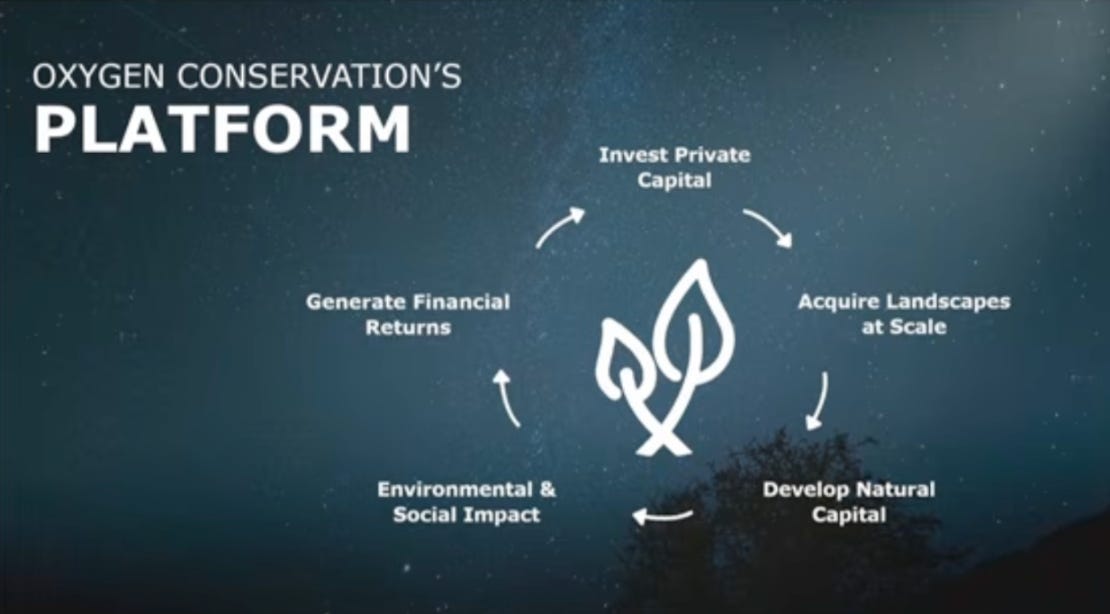
Their model of large land acquisitions from venture capital deserves scrutiny. Even if large scale land restoration and ecosystem function is achieved, it remains unclear what it means for the communities and the people. The verticality of the company and the pressure from venture capital does not secure an alternative political economy and the management of the landscape as commons.
These concerns are legitimate, but even experts on common management are skeptical that purely decentralised methods of restoration would be fast and capable of delivering regeneration on time. Without massive capital expropriation or the state’s takeover (also problematic), the decentralisation of the means of production and reproduction will likely happen in parallel and not as a prerequisite to ecosystem function preservation.
From problematisation to crisis management
My utopia draws on mass decentralisation and harmonious plural systems of production and reproduction, where public abundance and individual sobriety are the norm, with different cosmologies.
Having said that, the more I get into systems transformations, the more I realise that we need to agree on what is urgent and what is important, and what can be solved in a decade and what will take generations to change. This strategic conversation is missing, delaying more effective work for positive change.
In the last decade, enough work has been done to demonstrate the causes and responsibilities of climate breakdown. The remainder of this decade and the coming ones will require mass agency take over to lead the management of the crisis. The change in the material conditions we want to experience will only happen through collective organising and doing, not virtual narrative and vocabulary wars.
Compromise is the operative verb of doers. Progress will be measured by our capacity to increase life, resilience, and natural capacity to support collective existence — not by metrics as hollow as GDP or demonstrating that exponential growth is impossible in an infinite planet on social media.
Achieving the necessary transformation in productive and reproductive systems will require significant capital. Time is running short and there is a shortfall of 30:1 from extractive to regenerative finance.
We need massive growth of Degrowth-aligned funding. (I know, it sounds funny.)
Progressives, socialists, degrowthers — we are, and for good reasons, skeptical of capital. Centuries of extractive and exploitative finance in the economies of the global core have made this skepticism earned. But the reality is that we need capital that accounts for risk, and balances out failed projects. We can either persuade or take over — and since the latter is a fight that most are unwilling to pursue, persuasion and symbiotic work is the task at hand.
Regenerative finance shifts resources from business-as-usual toward systems that keep our life-supporting foundations solvent. Done well, it can reduce large defensive costs for both public and private budgets — but above all, it secures livelihoods and a future not to be scared about. This is a bridge across the current progressive and finance divide. Placing life at the centre, beyond cultural wars, has the potential to make collective prosperity genuinely irresistible and transfer large amounts of capital into it.
This is not an escape from the necessity of decolonizing, democratizing, repairing and improving the justice and redistributive properties of our eco-social systems. It is an opportunity for those who have the capacity to plan for the future and bring economic security in the now: a short time window that must be used to redirect finance toward regenerative ends, because finance is what channels what is done, whether we liked or not.
This should not rely on large private capital alone. Public and municipal budgets must play a role, and the bigger the better. Just taxation and responsible monetary expansion can allocate large resources to this. A very recent example with significant government leadership is the case for credit climatics in Catalunya. They have defined a standard to support credits to improve the capacity of forest to provide basic ecosystem services, such as water, biodiversity and CO2 capture. Their first credits have already been purchased by a public water utility, and those payments have brought back meaningful work in Val del Lord and Vall de la Muga, but more importantly, security against large fires and water shortages. This shows how public and private entities can work together to allocate resources to bring resilience and prosperity to our landscapes and peoples.

Regenerative finance is the biggest opportunity for rural communities
The crisis we face demands a material change in conditions for those who are custodians of agricultural land, forest systems, and watersheds. They represent a small fraction of the workforce and of finance flows — yet they are the most defining force for the future of life on this planet.
Paying forest workers not only for timber but for carbon, water, oxygen, biodiversity, habitat, beauty, and fire prevention is not a moral gesture — it is a recognition of work being done well, and the restoration of dignity and security that this work deserves.
The same applies to farmers who steward healthy soils, produce nutritious food, support insect and microbial diversity, and avoid depleting water reserves or using products that fuel either geopolitical conflict or planetary overshoot.
First bread, then philosophy — or in this case, first life-supporting finance, then philosophy.
Time to Evolve
Some say the climate movement is dead. I would say it is maturing. We need to permeate every arena of struggle and leverage each toward a transformation that secures our existence and dignity, and creates conditions for a future worth inhabiting. Finance is no exception.
The time to prove the crisis exists and explain why is over. It is time to manage it — to transition, to iterate, to fail and learn and succeed, to compromise, to negotiate, to restore, to forgive, to defend, and to win.
Virtue signalling is exhausted. Moralism without action is exhausted. Climate hysteria is exhausted. This is the moment for the doers, the builders, the revolutionaries who understand that victory is existential — and that it contains both light and darkness.
The goal is a ratio of 30:1 — regenerative capital over destructive capital. It will not happen on its own. Organise. Persuade. Execute. Our lives depend on it.
 | A guest post by
|