
Through the chronic illness looking glass (Part V)
Using chronic illness as a lens to examine how quickly life can change -- and how we should be preparing for climate disaster

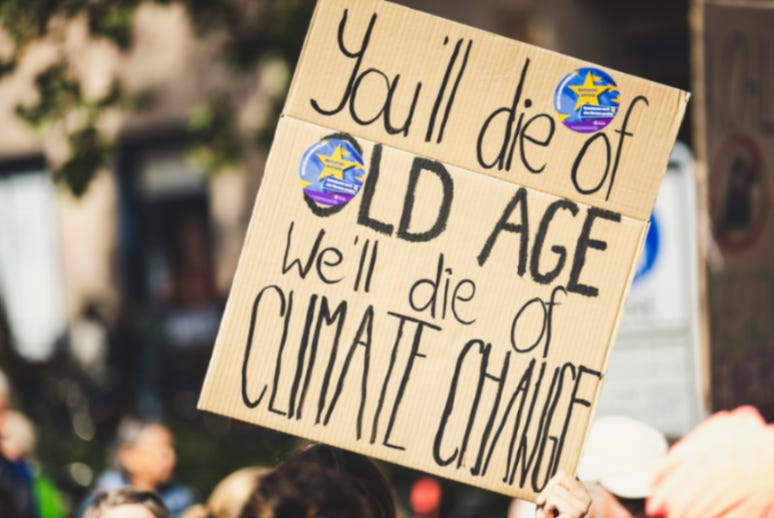
A Different Kind of Trifecta: Chronic Illness, Capitalism, and Climate Change
There are some rough lines I can draw between chronic illness, capitalism, and climate change to connect the three -- namely that our current brand of capitalism (late-stage capitalism, or growth-dependent capitalism) has wrought havoc on our planetary ecosystems, pushing and warping them to the brink of destruction. A system that assumes unlimited growth is possible with the limited resources of the Earth--and further, that relies on that growth being exponential--is inherently problematic for a closed-loop system that has limited capacity to regenerate inputs.
That constant extraction without sufficient and substantive reciprocity leads to fundamental shifts in the character of any ecosystem. In other words, it alters the scope of possibilities, similar to how chronic illness alters a person’s scope of lifestyle possibilities or activity possibilities. Those systemic shifts, when they happen frequently enough so that the system can’t recover fully between events, lead to decreased resilience and lower chances of recovery. Therein lies the first link: between capitalism and climate change.
A concrete example of this link is that pathogenic microorganisms thrive in warmth, and therefore spread more quickly and easily as the average global temperature becomes increasingly comfortable for the harmful microbial communities that carry diseases. Not only do diseases spread faster and farther, but the genes that resist antibiotics also strengthen under climate-related stress. Inter-species transmission rates are higher as the climate continues to destabilize ecosystems and disrupt existing balances--balances which, when healthy, help increase resilience capabilities and reduce spillover effects. The coronavirus family’s particularly vast “reservoir of genetic diversity” and “propensity for recombination” makes it a clear threat for proliferation and growth under increasing climatic shifts. In other words, COVID-19 was as infectious and damaging as it was (and will likely continue to plague the human population with new strains and versions) precisely because the climate change-related shifts in ecosystem structure and health cultivated conditions that were friendly to COVID-19 microorganisms, fostering its spread.
But COVID-19 isn’t the only disease that can lead to chronic illness. Other respiratory diseases such as asthma, chronic obstructive pulmonary disease (COPD), and emphysema have been linked to air pollution and are worstened by climate change. Air pollution has also been linked to cancer and cardiovascular disease. The climate crisis makes those with chronic illness even more vulnerable than they already are by increasing morbidity and mortality rates, worsening symptomatic frequency and intensity, and more. Therein lies our second link: between climate change and chronic illness.
That link works from a different angle, too. The effects of climate change--the magnitude of the potential lifestyle changes, the way we are suddenly faced with a new reality--these challenges parallel those created by chronic illness. If we can use chronic illness as a lens, and learn from those who have already navigated similar challenges, we might have a chance to prepare for climate destruction before it hits.
Before diving into the lessons I think are applicable to climate change, it’s important to explore why climate change is unlike chronic illness. Or perhaps, to put it differently, why we need to utilize chronic illness experiences to understand how to prepare for climate destruction. The answer lies in timescales.
Daily life will look different 50 years from now, and it’s hard to imagine exactly how, especially because the modeling is imprecise, but also because the future isn’t set in stone--to put it simply, we know it will be bad, we just don’t know exactly how bad. That range, between “bad” and “apocalyptic bad,” is up to us, right here, right now. But suffice it to say, we can expect certain lifestyle changes--food will cost more as soil health depletes and farms therefore require increasing inputs to artificially induce yields, vital resources like water will become increasingly scarce and therefore more expensive, housing will become even more unstable as highly-populated areas get inundated by sea level rise, many people will die because there will be more wildfires, storms, and sever weather events.
None of this includes the effects of system collapse from the loss of pollinators, or what will happen when a variety of other tipping points are reached. Life will get tangibly more difficult--we’ll get sick more frequently, our mental health will hit rock bottom (if it hasn’t already), food will taste worse and provide fewer vital nutrients, clean water will be hard to come by (which might bring enforced changes to our bathing, cleaning, and drinking habits), etc. Many of us feel like we’re barely holding it together now...just imagine it being orders of magnitude worse.
Just a blip in time
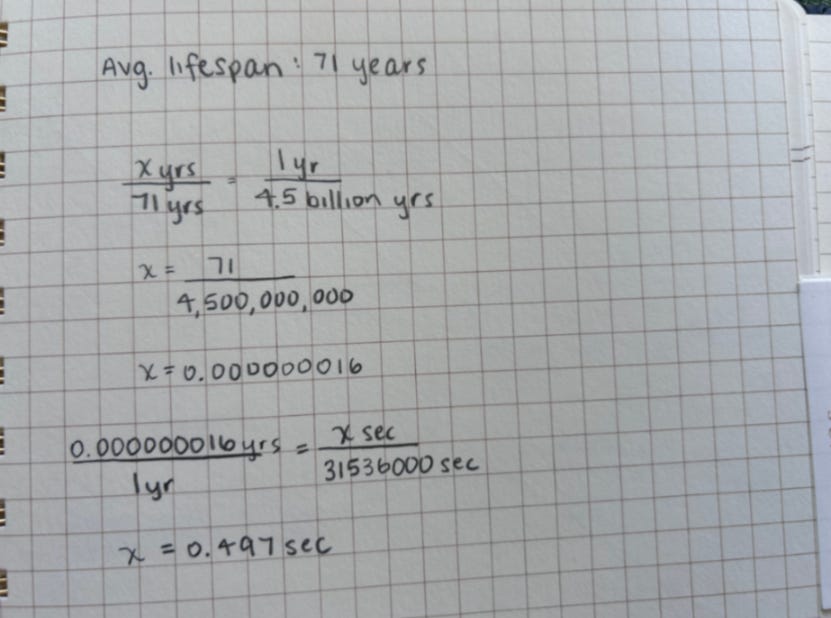
One important reason it’s hard to understand the urgency and significance of these changes is that the human lifespan is but a blip in the timeline of our planet. When devastating weather events increase in frequency over our lifetime, say from once in a lifetime to once every ten years or so, it’s still infrequent enough for us that it’s relatively easy to brush off and recover between events. Humans work--and recover--at super speed, in comparison to the Earth. But a year for the planet is like ½ a second for humans.1 Imagine someone punching you twice every second for the rest of your life. After the first few punches, ½ a second may be enough time to recover and ready yourself for the next punch, but after a minute or two there’s simply no time to recover between punches. Worse still, the punches are coming from multiple angles, just like our practices in multiple industries hurt different dimensions of the Earth’s ecosystems. Suddenly, a punch catches your nose or a rib, and it’s a big enough hit to make you stagger. Even worse, the punches are getting harder, and your ability to fight them off is waning exponentially with each additional hit.
Those who experience many life-changing events in a short period of time--or one life-changing event if it’s significant enough--are quick to tell anyone how challenging it is. Recovery takes time, and recovery is impossible if those devastating events just keep piling up. But there is no inherent inertia in those punches--they can slow down and stop. We can recover.
Humans don’t experience climate-related catastrophes as life-changing moments because, for us, they take too long to develop--there’s enough human time within these planetary moments for us to adjust and normalize any given change. At some point, though, the punches will accumulate to a point where there’s a fundamental shift--and the body goes from fight mode to survival mode. Instead of reacting and dodging and trying to find a way through, the goal becomes to protect the most valuable and vulnerable parts, the life-points. The body will be forced make tough choices--to sacrifice a kidney in order to protect the heart.
But the fact that we don’t experience these changes as sudden and emergent doesn’t make them any less life-changing or dangerous. In fact, it makes it even more dangerous because, like the frog that gets slowly boiled to death, there’s no signal to jump out before it’s too late. There will be a tipping point, but we may not be able to recognize it in the moment because our time horizon is mismatched to that of Earth’s. It’s worth taking the time to learn from those of us who have experienced our own tipping points. Collectively, we need to learn from these experiences in order to prepare for the change that’s coming--whether we can see it clearly or not.
There’s one additional link--between chronic illness and capitalism. I think it’s fair to say that the previous parts in this series have explored this connection at least subliminally--the mismatch between chronic illness needs in the workplace and a system that constantly seeks to extract every last drop of productivity from its workforce, or how capitalism fails to capture and curate joy in the way humans crave. There’s something important about the way chronic illness doesn’t fit into the capitalist model, but it’s hard for me to put my finger on it. It may be as simple as the fact that capitalist structure incentivizes efficiency and productivity in a way that chronic illness makes impossible. Or that it promotes a certain individualist lifestyle, where everything can distilled to a transaction. Its obsession with debts and profits require a certain level of record-keeping that rubs up against communal living and causes friction. But chronic illness requires community, it demands it. You must accept help when you’re chronically ill, because you simply can’t do it all on your own.
Perhaps it’s the mismatch between the two that shines light on a system that is constantly striving to optimize, organize, categorize, and perfect an entirely organic and imperfect process--the human experience. Humans don’t fit neatly in boxes, and a system that tries to force us into such impermeable spaces will naturally compel us to strain against it. Or perhaps it has something to do with the way climate solutions require a divergence from capitalism--similar to that of the way chronic illness forces you to exist outside that same system.
Whatever it is, it’s clear that these things are connected, and that truly understanding one requires seeing its relationship to the other. In exploring these connections, a few consistent themes have jumped out: the importance of care, reciprocity, and patience; the ways in which our current system is structured as a tool of suppression; and the impermanence of life. In the next (and last) part of this series, I’ll share a few of the lessons I’ve learned from this last year, and hope that you can take them with you as suggestions for how to prepare for what’s coming.
See my quick calculations below:
 | A guest post by
|