
Through the chronic illness looking glass (Part IV)
Learning to find joy when your old hobbies are no longer an option

This is the fourth of six articles exploring the connections between chronic illness, degrowth, climate change, and capitalism:
Part I: An introduction to navigating chronic illness and current events
Part II: Navigating the workplace as a someone with a chronic illness
Part III: Questioning and relearning what it means to take care of the self
Part IV: Learning to find joy again
To read Part III of this series, click here.
It’s funny, which memories stick. I have vivid memories of sitting in my ninth-grade biology class and learning about telomeres. I can’t even remember what they are, other than that they’re somehow related to DNA, and shortened telomeres can mean you’ll live a shorter life. Oh, and the notion that telomeres become shorter with stress. So naturally, I’ve been stressing about the length of my telomeres ever since—the irony is dumbfounding. I remember little else from that class, other than mitochondria being the powerhouse of the cell—but the telomeres? Man, my long-term memory snatched that lesson up and clung on for dear life. Little did I know that almost a decade later, stress would come to define my life in entirely new ways.
The natural antidote to stress is joy. But for those of us who are familiar with depression, questions like “what brings you joy?” are particularly hard to answer. Especially right now, when it feels like every day is another step towards apocalyptic collapse, finding joy in anything can seem futile and selfish. But as I’ve learned the hard way, joy is an integral part of survival. Without it, each day feels more bleak than the last, and finding the will to live is like looking for a shadow at high noon.
At this point in my life, I was desperate for some joy—but it was nowhere to be found. Part of the reason for this was that the things that had formerly brought me so much joy were now activities I couldn’t physically participate in. My avenues for joy had vanished into thin air.
Other vivid memories that have stuck around include some of my earliest: running down a sandy boardwalk in summer while my mother chased me down with sunscreen in hand; learning tennis at a day camp and deciding I hated it because I wasn’t any good; learning to ride a bicycle in the park with my dad—who insisted that the best way to learn was by trying to balance on the bike while it was stationary; the day I tried out for the club soccer team my best friend was on—it was pouring rain and I was too nervous to go alone, so she accompanied me and withstood being pelted by cold raindrops while I ran endless drills; the day I finished my first half-marathon and the feeling of my legs being somehow simultaneously numb and pulsing with strength.
So many of my memories are steeped in the athletic pursuits of my childhood because that’s who I was—an athlete. I loved the early morning practices, the pre-game jitters, and the after-school study sessions. I loved playing soccer in the pouring rain—and being unable to tell the difference between sweat and raindrops. I craved the hush that would grip a gymnasium as I stepped up to the free-throw line with the basketball in my hands, my body brimming with adrenaline.
Eventually, as I prepared for a post-pandemic collegiate soccer season that never came, I learned to dig deep and find fulfillment in the training as much as the match itself. I grew to define myself by my abilities, my athletic achievements, and the strength of character I built along the way. I challenged myself to expand my comfort zone by joining a water polo team and learning to play. Eventually, I reached a milestone that my younger self would have believed impossible: three half-marathons, one of which was on a treadmill. Every week, I looked forward to the feeling of a wind-worn throat and hands so numb I lacked the dexterity to pause my music, both of which were common after a 10-mile run. Many non-runners don’t get it—and even I was a hater once—but the queen-of-the-world feeling you get after a particularly gnarly run is unparalleled.
To be suddenly swept into this new reality, where my well-worn, familiar sources of happiness were no longer available, was devastating. Without these activities that I’ve grown to think of as part of me—running, hiking, soccer, basketball, tennis, water polo, kayaking, climbing, biking, I could go on—did I even know who I was?
I can’t say it was one thing or another that specifically got me out of this identity crisis. I definitely still miss being able to go for a run, and have lost points of connection with others by virtue of being unable to share in some of the more physical hobbies. But I’ve managed to find some pinpricks of light within all of this darkness. I’ve even been exploring hobbies that work with a more low-energy lifestyle: knitting, crocheting, embroidery, writing, reading, and so on. I’m still looking for that genuine top-of-the-world feeling, but realizing I might not find it for while and learning to be okay with that reality has allowed me to savor other moments that had previously gone unnoticed.
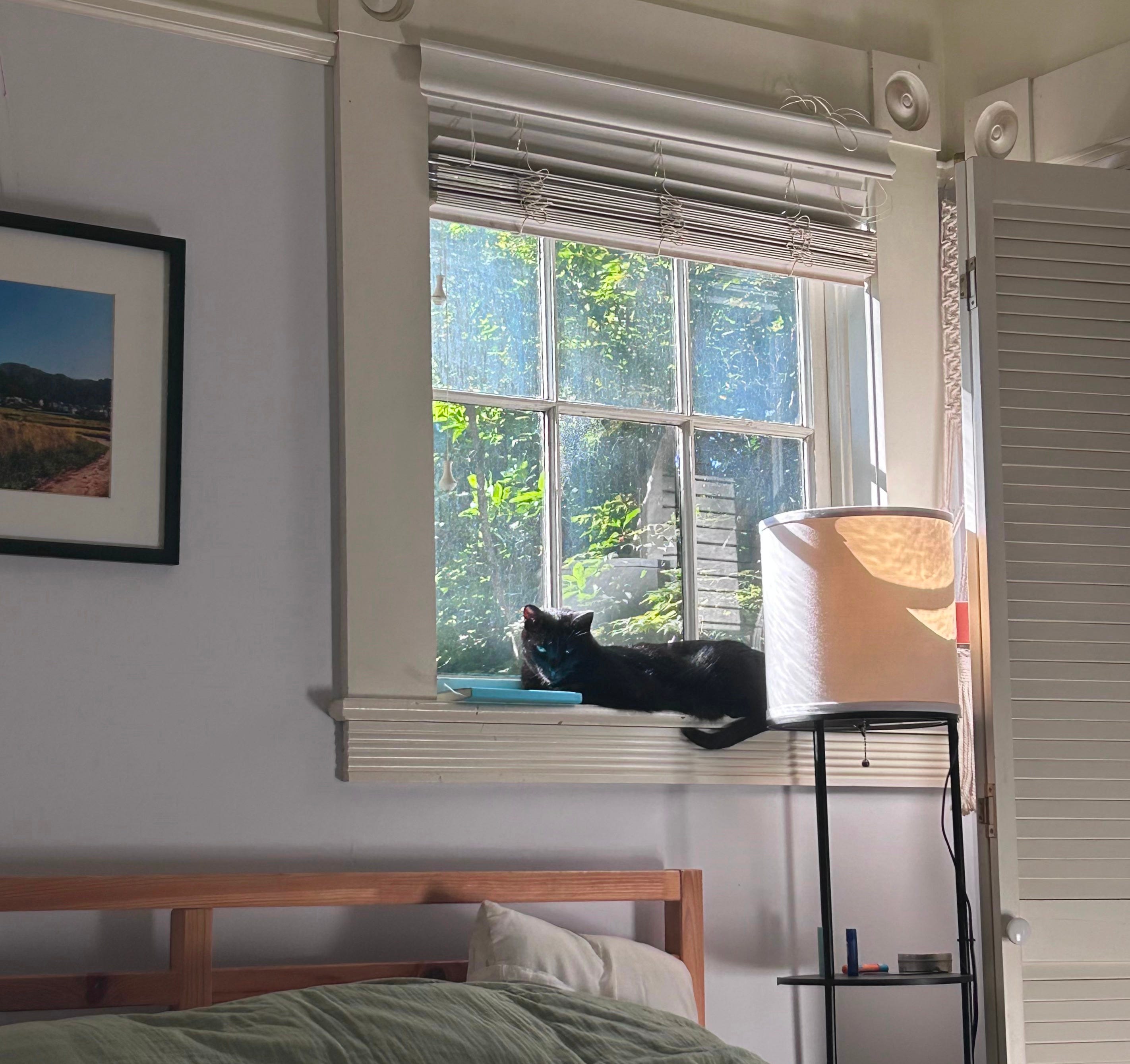
The slowed-down nature of my current lifestyle has forced me to search for joy in pockets of my life that might have otherwise been labeled as mundane. I’m learning to savor small pieces of joy, like the sweetness of a ripe, juicy strawberry from my community-supported agriculture produce box, or the low rumble of my cat’s purr as he nestles into my lap for his afternoon snooze. Or the way the sun hits the trees outside my window during golden hour, making them glow like celestial beings. The satisfaction that comes with completing a knitting project, and the pride that comes with wearing something I made with my own two hands—or seeing others wear something I made for them.
I guess my point is that joy can be found anywhere—you just have to want to see it. In the first months of my chronic illness reality, I was so occupied by the devastation that it felt wrong to search for any joy. But as time went on, and my life slowed down, I realized how important joy is for survival, and how abundant it can be if you let it. In a system driven by chaos and pain, joy is an act of resistance.
That same chaos and pain isn’t just something we experience in our own bodies; it is built into the very structures around us. In the next two parts of this series, we will look more closely at how our current system operates. By giving you a sense of what it’s been like to experience a sudden onset of chronic illness in Parts I through IV, I’m hoping you’ll trust me enough to hear me out in the next two parts, where I tie seemingly unrelated pieces together, use my experiences as a lens to examine our current crises, and impart some wisdom regarding how we might build resilience in the face of danger.
To read Part V of this series, click here.
 | A guest post by
|
Very good article. I'm sorry about your condition, but you seem to be making the right noises. There is no feeling like that after a long hard run, however, I am too old to reach that now, but like you I am finding pockets of joy in other things. Wishing you all the best.