

This is the last of six articles exploring the connections between chronic illness, degrowth, climate change, and capitalism:
Part I: An introduction to navigating chronic illness and current events
Part II: Navigating the workplace as a someone with a chronic illness
Part III: Questioning and relearning what it means to take care of the self
Part VI: Lessons to help us weather any storm
To read the previous articles in this series, click the links above.
Looking Back, and Looking Ahead
There was a silver lining to being forced to shrink my world, if you can call it a silver lining. It required that I spend time—a lot of time—noticing the details of my life. What had changed, what hadn’t, who understood, who didn’t bother to try. Who I could depend on, and who I couldn’t. What mattered, and what really, really didn’t.
No one expects their life to be turned on its head in the matter of a moment. Therein lies the cruelty of such change—it’s necessarily unexpected, impossible to emotionally prepare for, fundamentally unfathomable until it’s happened. Because some things can’t be understood unless they’re felt.
But that doesn’t mean we should all throw caution to the wind and barrel forward without regard to what the future consequences might be. If there’s anything I’ve learned in the last six months, it’s that the things that matter in times of crisis--those things matter regardless of what the crisis is. The craziest part of this Long COVID experience, for me, has been seeing the parallels to climate change. Not just in the way that infectious diseases are becoming more common, more easily spread, and more intense as the climate crisis worsens, or in the way that those of us who are chronically ill (a population that has been steadily increasing in size) are more vulnerable to climate change-related risks. The most interesting parallels are in the solutions, the antidotes, in what resilience looks like.
A lot of what I’ve learned about what matters, and how to be resilient in the face of unexpected change, is useful and relevant to any crisis, no matter the kind. Whether it’s the climate crisis, the humanitarian, financial, or medical one, I keep coming back to the same list of things that matter. Maybe it’s because these crises are interrelated, or maybe it’s because at the end of the day, the list of what it is we need in order to thrive is relatively short. Take a look at the following list, and insert whatever kind of crisis you want (climate, medical, technological, etc.), then choose another kind of crisis and see how well the list holds up. The list is by no means comprehensive, but it’s a start:
Lesson 1: The village matters. Get to know the people around you.
Knowing your neighbors, really knowing them (and not just their names—I’m talking about knowing them enough that you feel comfortable asking for a cup of sugar, or a ride to the doctor’s office for an unexpected appointment) not only provides a sense of belonging and meaning within your physical community, but those are the people who will literally, physically be there when the crisis arrives. The people you reach out to when you’re ill and can’t cook for yourself are the same people who will be there when your power goes out because of the heatwave or because the electricity bill got too expensive. They’re the ones who can offer to watch your kids for a couple hours while you interview for a job because AI took your last one. They’re the ones who might be willing to share a meal with you when the grocery stores are empty because all the farmers went on strike. And this isn’t just a nebulous village that consists of your loved ones scattered across the country—place matters. I’m talking about the people who spend their lives physically near you, the barista at your normal coffee shop, the couple that walks their dog by your window every morning, your kid’s teacher or ballet instructor. Most importantly, get to know your next-door neighbor, and the older couple on the corner, and yes, even that family with the loud kids down the street.
Lesson 2: Borrow and lend like your life depends on it. Learn to be okay with asking for help.
It’s quite literally impossible to prepare for every potential disaster, ask any doomsday prepper. When things go south and you don’t have what you need, and you can’t [insert need here]-as-a-service your way out of the mess, you’ll want to have established history of being a trustworthy borrower. Whether it’s a lawnmower, a sewing machine, an hour of someone’s time, a book, or some money, the practice of borrowing and lending has benefits beyond the obvious monetary ones. You never know when you might be in need, or what you might be in need of. Start practicing how to ask for (and how to give) now, so that if something happens, and it’s a matter of life or death, those around you will be more willing to trust you. Sharing resources also puts less stress on an already-strained system, it allows you to build trust while also getting the most (and best) use out of objects that too often sit on a shelf gathering dust. This can also lead to a whole new perception of what it means to be wealthy: communities full of individuals who understand that to be rich is to be generous, that the more you share with others, the wealthier you become. Not wealthy with piles of money, but wealthy in friends and networks of support to lean on when times are hard.
Lesson 3: Accept generosity when it comes, leave judgment at the door.
You never know what’s going on in someone else’s life. Even if it’s not reciprocated—and maybe especially when it’s not—generosity and kindness can mean a world of difference. Treat others the way you’d want them to treat you on your darkest day, and assume they’re experiencing their darkest if they don’t respond the same way.
Lesson 4: It’s not the things, it’s the people.
At the end of the day, the only things we really need—aside from the fundamentals of food, water, shelter—are to feel safe and like we belong. Both of those can be achieved through relationships with other living beings. Everything else is superfluous.
Lesson 5: Taking care creates care.
The moment you start putting effort into something, you start caring about it. Put any extra effort you can spare into the loved ones around you. Show up for them when it matters, even when it’s inconvenient. You never know when you might need them to show up for you. The act of putting effort into something (or someone) also creates a feeling of value—on both ends. Not only are you making that human (or more-than-human) feel valued, but you’re contributing to a sense of self. You’re showing up, you’re putting in the effort, you’re proving you care. It creates a bond with a strength that may surprise you, and may show up at some point to remind you that you matter, too.
Lesson 6: Rest and joy are forms of resistance, and we must resist like never before—because our lives depend on it.
Find the things that bring you real, lasting joy. Savor the good moments, even if they’re small. Rest deeply, and fully, when you can. Deep joy, the kind that comes from community, love, support, etc. can’t be co-opted by capitalism—it’s anathema to its very existence. Rest, too, is a demand for patience from a system that wants to convince you that your needs are inconvenient, damaging, or even lazy.
The challenge
What makes these lessons difficult to realize isn’t that they are impossible to do -- in fact, you might find that your neighbors are friendlier than you think. It’s in prioritizing these things before the crisis hits. Creating a strong community, testing the strength of your relationships, ensuring you have access to the resources you might need (and that they’re located locally)— these are all to-do list items that fall through the cracks, set aside for a less-busy day that never comes. But when disaster hits, and you’re suddenly faced with navigating a life that looks wholly and irreconcilably different, those tasks are the ones that will be the difference between meager survival and flourishing.
If you’re the kind of person who craves concrete steps, and you feel a little disappointed by my list of amorphous lessons, here are a couple ideas to get you started:
Does your community have a physical notice board where members can share local events, post flyers asking for/offering help, etc? If not, make one!
Do you know your neighbors well enough to ask them to cat-sit for you? If not, invite them over for dinner.
If you want to get to know more than just your direct neighbors or a few individuals, try setting up a “Chair and Share”! All you need to do is decide on a place & time, print some flyers, and bring a chair.
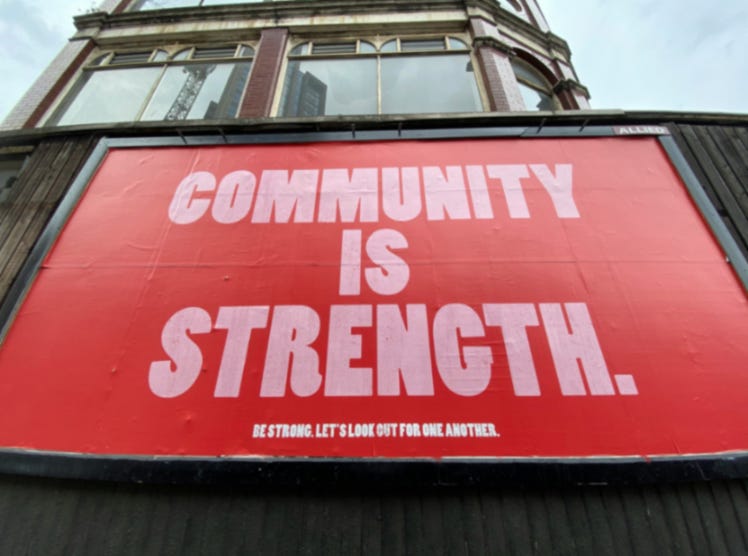
As it turns out, you don’t have to individually prepare for every potential crisis under the sun. With strong, resilient communities, we can weather any storm that comes our way. Without them, we’re screwed.
