

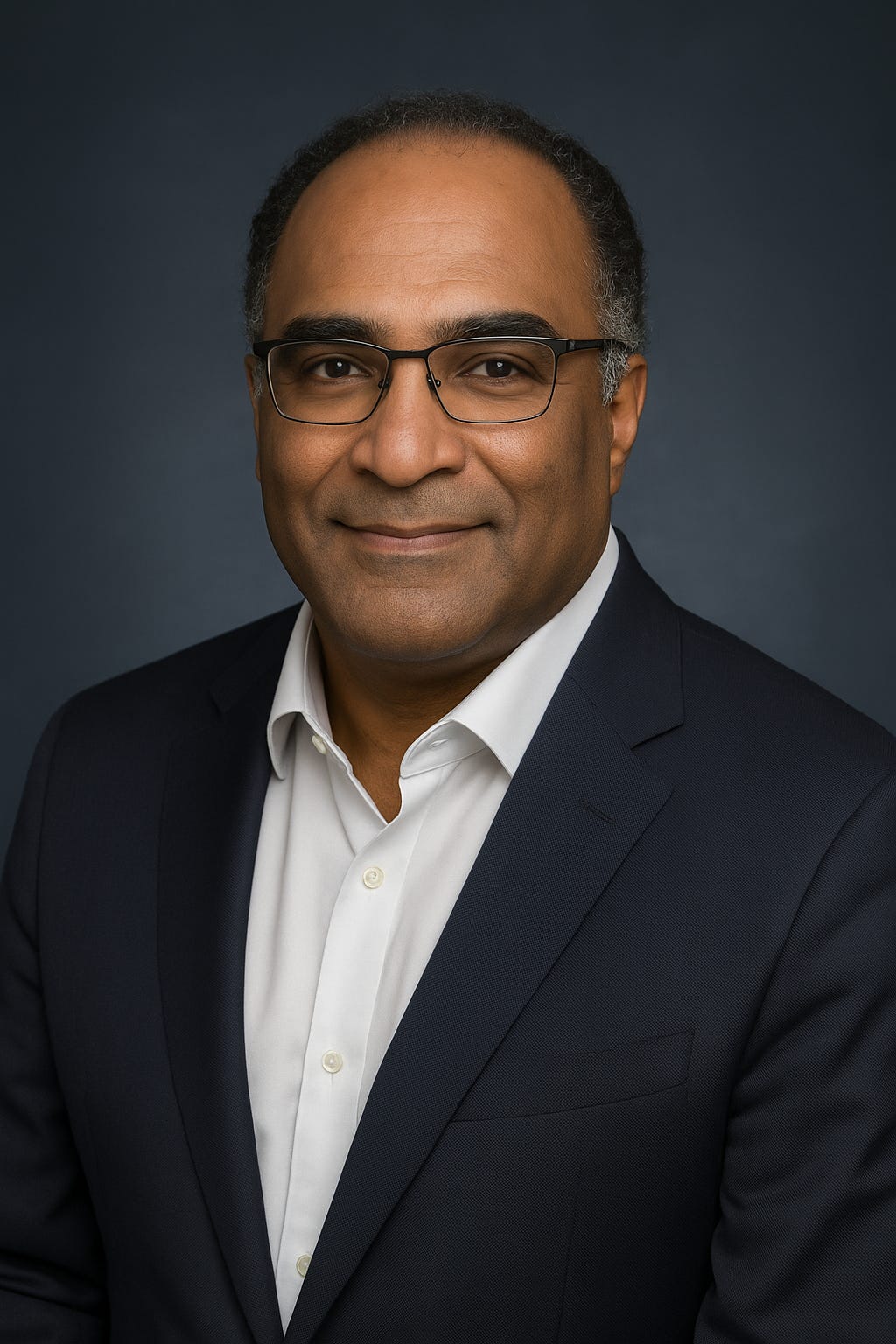
Ray Shellmire is the Vice-President and Community Engagement Director of the Portland Black Community Development Consortium (PBCDC). PBCDC’s mission is to redress the racial wealth gap through developing a wealth-building infrastructure in the Black community using a Restorative, Regenerative, Circular and Sustainable Business Model.
I recently sat down with Ray Shellmire to discuss the Renewable Energy Collective, a limited liability corporation he co-founded with insurance broker and non-profit consultant Terry Glenn Robinson. Based on our talk, the following is my analysis of the collective’s project through a degrowth lens. The collective’s goal is to mitigate climate change while empowering the Black community of Portland, Oregon, USA through expanding ownership of rooftop solar. This, in turn, is step one in a larger project of reshaping culture around reciprocity and sustainability, which Shellmire grounds in the African cultural teachings of ancient Kemet (Egypt). To use a common academic expression, Shellmire is working to “decolonize imaginaries,” to replace narratives inherited through colonial oppression with life-affirming values rooted in African cultures. So far, the project is making good strides in actualizing cultural and economic self-determination, yet it is still in the early stages of the material supply-chain dimension that decolonial work demands. In their seminal paper, “Decolonization Is Not a Metaphor,” Tuck and Yang (2012) observe that a focus on mental decolonization can obscure the work of material decolonization. To ensure that material decolonization is advancing, I recommend the further development of an actionable plan for supply chain decolonization.
Shellmire believes that socioeconomic transformation must be grounded in cultural and personal transformation. He describes the Kemetic worldview as comprising four core principles: Asar (Osiris) representing prosperity, Maat representing justice; Ankh representing life-centeredness; and Atum representing the interconnection of all creation. Shellmire identifies Asar as most directly focused on economic activity:
The way of Asar is to collectively generate abundance and prosperity and share it. It gives us a way to govern ourselves in a way that supports us all economically.... We know these principles work because, when we look back at the ancestors and the incredible society that they had, we know they did great things. So our thing [at the Renewable Energy Collective] is to bring that technology, that knowledge, those principles into contemporary times and see if we can have brothers and sisters, if you will, others, folks who would like to aspire to those same principles and practices.... The collective work that we're doing is to have everyone and everything prosper.
For Shellmire, the first step to actualizing this vision is to build community around these shared principles:
That [transformation in practices] only happens if people are willing to take some time out, away from the current life that they're experiencing right now, because it's distracting us from that. We're busy doing versus being, and we're not doing the kinds of things that will allow us to be our best, you know? So first we have to get people just thinking about what their potential can be and their unlimited abilities are, and then we can start doing some things around that...
Moreover, Shellmire notes, people are generally more open to transformation when it is materially incentivized:
A lot of times it's really hard to do what's right unless there's some economic gain for folks to do it, and so our work has been really trying to get folks to see that there are ways to do good and do well at the same time.
These are valid points. Practices are, indeed, grounded in values (explicit or tacit) and, thus, truly sustainable and reciprocal practices must arise from valuing sustainability and reciprocity. Likewise, it is psychologically unrealistic to ask people to put significant time and energy into projects that provide them with little tangible advantage. Such altruism is particularly unfair to expect of people already carrying an intergenerational burden of oppression. At the same time, too narrow a focus on the local community’s prosperity can obscure damaging economic relationships with people(s) and ecosystems exploited across international supply chains.
The Renewable Energy Collective partners with Infinity Solar, a limited liability company with an estimated annual revenue of $10.73 million (USD), operating in five US states. As with most businesses, their website provides no clear information about their supply chains, material footprint, emissions, or the labor practices of subcontractors. They describe themselves as “committed to sustainability” and state that they have produced 17,000,000 watt hours of solar energy, but this is not contextualized in terms of the costs of producing solar panels. I reached out to the company for information about their supply chains, but as of writing this, have received no reply. To judge by their website alone, one would imagine that rooftop solar is produced solely by their company for their customers: no raw materials, no international supply chains, no negative eco-social impacts. As neoclassical economics puts it, these are “externalities”: they are textually, mentally, and morally erased.
As currently practiced, solar panel production is a damaging industry. Ethical Consumer rates firms’ ethical business practices on a scale of 0-100, where 100 is ideally ethical. Of its reviewed solar companies (which do not include Infinity Solar), the most ethical, GB-Sol, rates 80%, with 60/100 in climate impacts, and 60/100 in solar panel materials. The next most ethical, UKSOL, plummets to an overall rating of 52. What I perceive in the Renewable Energy Collective, as it currently stands, is an admirable drive to change worldviews and, ultimately, the world, that could benefit from more focus on its impacts on communities and ecosystems in the Global South. As of now, it has the “metaphor” more than the “decolonization.”
When I raised the question of supply chain justice with Shellmire, he answered:
Unfortunately, we’re not—I mean us, being Aboriginal African folks from the diaspora—we’re not in control of that right now. So we still have to utilize what’s available to us to get ourselves into position to begin to make some changes around that. And that’s why, economically, it’s so important to support us in this area so that we don’t just repeat, we overcome these shortcomings, we have enough economic power to go to folks ourselves and create our own supply chains that are more reciprocal than exploited....
One of the things I want to do, not just in South America [where a great deal of silver is appropriated for solar] but in Africa as well, is the same thing [i.e. build reciprocal, sustainable relationships]. Because there’s a lot of exploitation, we had better bridge with them to do business and commerce in a different way and do it from this [Kemetic] perspective.
Undeniably, a small portion of Portland’s African American community is not in control of international supply chains. Likewise, the Infinity Solar certainly has limited control.
Building economic power at the grassroots level is a smart move and partnering directly with Global South partners in non-exploitative relationships a good aspiration, but to realize the goal of decolonization, these moves must be accompanied by a concrete plan for supply chain decolonization. The plan will have to flex with changing circumstances, but it should include measurable actions that can be started now.
Three types of actions could be described as rhetorical, informational, and material, where rhetoric and information must directly tie to material action.
Some Rhetorical Actions:
Advertise supply chain and environmental justice for the Global South as core goals on the website, along with actions taken to support this.
Expect partners, such as Infinity Solar, to do the same. Express surprise if they aren’t readily willing to.
In discussing values in a variety of settings, foreground the need to overcome the economic imperialism of the North over the South.
Ask to speak to the shop stewards of subcontractors’ unions. They don’t have unions? Express deep concern at this. Ask to speak to workers. Ask over and over. Normalize it.
Some Informational Actions:
Where possible, speak with environmental justice groups in countries where environmental conflicts over solar commodities are common.
Help/demand/expect partners to use SEIA’s Solar and Energy Storage Supply Chain Traceability Standard and transparently report their findings. A one-year license is a reasonable $200 (USD).
Listen to and amplify stories and environmental justice demands from workers and activists in the Global South. The Environmental Justice Atlas is a valuable tool.
Cost out how much solar capacity must be built in order to have the power to begin directly negotiating with Global South partners. (With chagrin, I asked ChatGPT for help identifying tools for doing this.)
Some Material Actions:
Build local, grassroots economic power: Renewable Energy Collective is doing this!
Consistently use an equitable decision-making tool to make those affected by supply chains visible. If they can’t be directly consulted, as such a tool requires, what must happen to change this? Begin to take those actions.
Creatively work to minimize material impacts. For example, focus not only on more solar panels but on multifamily houses, better insulation, retrofits to optimize passive energy, etc.
As local economic clout increases, refuse to do business with entities that do not have a measurable, advancing plan, with a timeline, for decolonizing their operations.
There is much to celebrate in building local economic independence through renewable energy and in the empowerment of marginalized communities through transformative, decolonial narratives. At the same time, for reciprocity and sustainability to be realized, all relationships must be reciprocal and material throughput scaled to fit within the Earth’s biophysical limits. Mental and material decolonization must go hand in hand. The surest way to achieve this is to embed concrete steps toward material decolonization at every stage of the process.

A very interesting theme, confronting a very difficult question: How to promote from the Global North a path towards supply chain and environmental justice for the Global South? Private initiatives as the one you defend are necessary, and "decolonizing our imaginary" also, as most people sitting on an "imperial way of life" are hardly aware of it, and of course, would see no need to change it. Difficult subject, needing much more action, at all levels of societies. Thank you for this article!