


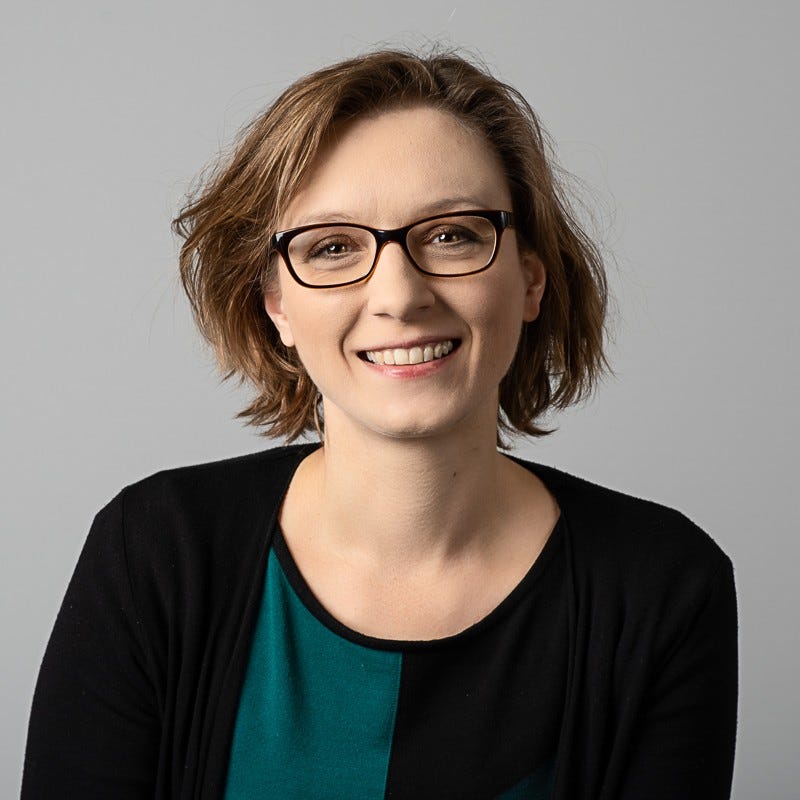
Lisa Herzog works at the intersection of political philosophy and economic thought. She has held her position at the Faculty of Philosophy at the University of Groningen since 2019. Between 2021 and 2025, she was the Directer of the Center for Philosophy, Politics and Economics, and since January 2023, she is Dean of the Faculty of Philosophy.
Vlad Bunea: You write in your new book, The Democratic Marketplace, that Western societies have to reform their economic systems or they will lose their democracies. These reforms would mean the end of capitalism, as we understand it. Some attempts to reconcile capitalism with democracy have been made, such as the bicameral firm, but they still maintain the overwhelming power of the owners of capital. Should we replace “one share, one vote” with “one worker, one vote” as the first step in phasing out capitalism and democratizing our economy?
Lisa Herzog: It would be a good first step to democratize companies, because this would involve large parts of the population from the start. But I want to add two things. The first is that while voting – as in “one worker, one vote” – is important, I am also interested in other democratic practices. Voting belongs to representative democracy: you vote for others who represent your interests. In the workplace, we should also think about participatory democracy, where people directly participate in decision-making. The two can go together and work at different levels, but the latter is particularly important for normalizing democratic practices from the ground up.
The second thing is that democratizing only workplaces is unlikely to be enough. For example, while there is some empirical research that more democratic firms do better on social and environmental counts, we cannot rely on that mechanism alone. Moreover, if the markets in which democratic firms operate are not well-regulated by democratic legislation, competitive dynamics might push them to continue exploitative practices against outsiders.
VB: A deep commitment to equality as a moral foundation of a New Economy aims at some universal values shared by all humans. Capitalism has been marketing freedom as a universal value quite successfully, while it has polluted (rivers, land, air), pillaged (the weak, the poor, the defenseless), oppressed (workers), stolen (wages, labor, land, resources), lied (about prosperity, about its successes) all in the name of this freedom. How would equality look like in a democratic economy?
LH: Equality would mean, first and foremost, the protection of the weak, and of their ability to lead a self-determined life. In that sense, I don’t object to the ideal of freedom, but would rather argue that a substantive – not just formal! – notion of freedom, for all members of society, must imply very different economic institutions that what we have today. How free are you, really, if you have to work two or three jobs to keep your family alive, and you constantly have to worry about the future? But I would also make the more controversial claim that if your freedom rests on the exploitation of others, this is not genuine human freedom (editor note: emphasis added).
But your question also raises interesting issues concerning non-human life and the biosphere. One strategy of dealing with this is to say that practices such as pollution and pillage very often do treat other human beings unfairly, e.g. by depriving them of their subsistence. So you remain in anthropocentric framework, in which human life is what counts, but take seriously the fact that human life depends on non-human life and is deeply interwoven with it. The other strategy is to part ways with anthropocentrism and to acknowledge the intrinsic value of non-human life. Personally, I have great sympathies for the second view, but politically speaking, it might be wiser to choose the first strategy, because you can get more people on board.
VB: Do you think the idea of qualified random selection of managers (also known as sortition, or lottocracy), in which managers are selected at random from a public and open pool of qualified candidates for a limited term and endowed with limited functional power, has the potential to undo discrimination, abuse, and exploitation in the workplace?
LH: I think it is a very interesting strategy, but I wonder whether it will be enough to get rid of all problems in workplaces. You probably need additional checks and balances, for example anti-discrimination law, especially for workplaces in which there are entrenched hierarchies along sexist, racist or classist lines. You wouldn’t want the fight against discrimination to depend on whether a member of a minority gets randomly selected, right?
Other than that, I think lottocracy can be interesting, but in many workplaces, one might also go for a simple logic of rotation: everyone who is qualified for a role takes it over at some point, but not in a randomized lottery, but also taking into account what people’s situation in life is, whether they currently have other projects or responsibilities, for example. This presupposes a certain level of trust: people need to know enough about each other to share such information. But in many workplaces, that is indeed the case. In many university departments, for example, where leadership roles can be distributed in mutual consultation, you wouldn’t make the person who urgently needs to finish that big project, or whose elderly parents need a lot of care right now, head of department, they can do their turn later on. In that sense, taking some more information than you’d have in sortition into account can be a good idea.
VB: Linking high responsibility in a job with a high salary seems ethical, but we should also consider limits on wealth an incomes as advocated by limitarianism. Having only monetary rewards for high responsibility cheapens and trivializes the social and moral dimensions of responsibility. It also reinforces the idea that money is the only way to measure high skill, high effort, and high stakes such as the work of a surgeon. Do you think new forms of workplace democracy should also advocate for limitarianism as part of their objectives?
LH: Workplace democracy, as I understand it, starts from a view of work as a joint project. In such a joint project, value is produced together, and everyone’s contribution matters for it, everyone depends on the others. It follows almost trivially from that picture that salaries should not be too far apart, neither at the bottom nor at the top. That’s a view I held already before the term “limitarianism” was introduced by Ingrid Robeyns, but I fully endorse it and I’m glad that it gets uptake.
Logically, in a democratic workplace, one would start from an equal baseline and then ask: what are reasons to give some people somewhat higher incomes? For example, have they worked particularly hard this year? Or have they undergone extra training that should be honored? Or have they taken on a particularly difficult or unpleasant task? It wouldn’t be a logic of incentives, but of compensation for what Gerry Cohen called the “special burdens” of certain jobs. If that were the general logic of compensation, then I think some extra compensation for high responsibility can be justified, and it would not morally demean or trivialize it. But ultimately, I think the reward for taking over roles with high responsibility is the recognition you get from your colleagues – and the same holds for other difficult tasks.
VB: You attempt to pacify the green growth and the degrowth / post-growth camps, which have been on opposing sides of a fierce debate for quite some time, by suggesting that they should join forces and focus on democratizing the economy. Even if we had full economic democracy (which many green growthers would reject because it goes against the interests of capital), it is still not guaranteed that we would not overproduce and overconsume beyond the capacity of the planet. How do you see the democratization of the economy, beyond capitalism, in relation to ecology and the limits of Earth?
LH: Yes, I see such an urgency to fight climate change and other environmental problems that I really hope some of the academic quarrels could be put aside in favor of more joint action in the areas of overlap. How far this can go will ultimately depend on the precise position different people hold, of course. For example, we don’t know whether all green growthers are wed to the interests of capital, my sense is more that they belief in the power of markets and entrepreneurship, but those could also play some role in a non-capitalist system. But putting that question aside – the elephant in the room is whether a more democratic economy could stop the fatal dynamics that plunder the planet and destroy the climate. I see arguments on both sides here. On the one hand, such an economy would be more egalitarian, and the kinds of lifestyles of the super-rich, which are extremely climate-unfriendly, would simply not exist. The economy would be stirred into the direction of satisfying human needs, not the whims of a few billionaires. Also, the power of fossil fuel and other companies would be democratically constrained (assuming, that is, that we could succeed in also reining in malicious practices such as one-sided lobbying, the dependence of politicians on donations, etc.).
On the other hand, would democratically empowered citizens be willing to make the sacrifices that would be necessary for getting to an economy within planetary boundaries? Or would they short-sightedly want to keep increasing their consumption? In principle, I think that human beings are capable of coming to agreements to stop collectively irrational behavior, also on an international scale. But if you look at historical examples, it has often happened after major catastrophes – that’s not a reason for optimism.
Another problem is that in the past, the benefits of the fossil-driven economy have been so extremely unfairly distributed. It’s understandable, up to a point at least, that countries, or specific groups within societies, that have been treated unfairly until today, and continue to be so treated, might reject calls for equal treatment, and instead require that they get more opportunities for consumption. Philosophically, I can understand this, but politically, I expect that this might make negotiations much more complicated.
VB: If profit-making, as a core incentive, is not compatible with the limits of Earth to sustain life, what new economic incentives could we imagine under economic democracy?
LH: Interesting that you raise this question – that’s one of the dimensions of a future economy I would be less worried about. If you look at the history of human kind, you see that human beings can be motivated by so many different things: material benefits, to be sure, but also professional recognition, honor, religious visions, revolutionary ideas, the love of their country... And not just motivated to work a little harder, also motivated to bring really great sacrifices, including, in the most extreme cases, their own lives. In fact, the tendency of human beings to be so excited about something they take to be a greater good has a very dark side, it can fuel wars, civil wars, genocide... Some early defenders of free trade, for example Montesquieu, thought that it was much better if people hankered for money than if they hanker for “glory” and then do all kinds of crazy, harmful things! That may be too optimistic a view about the pacifying effects of trade, but it is a healthy reminder that other motives are there as well, and not not always for the better.
But I am worried about another, related issue: how to create good governance structures that keep economic activities tied to their functionality – including the possibility of stopping certain things that simply don’t make sense any more. For example, you might have certain technologies that become redundant if more environmentally friendly alternatives get developed. But people and organisations don’t easily make such switches, habits are strong, and it can become a matter of one’s identity, as individual or group, to stick to the old. The market, despite all its problems, has a way of telling people: sorry, this product is not needed any more. That’s brutal, and I think as societies, we’ve done a very bad job at acknowledging that brutality and dealing with it. But unless you assume that a future economic system will become completely static – which, in many areas, e.g. medicine, is not desirable – then how do you find ways of making such transitions? And how do you make sure that those who have really innovative ideas about how to improve things don’t get discouraged early on because there is a sense that they cannot convince enough people to try out something new? Fair treatment and good care for the “loosers” will be essential, otherwise you risk rejection of everything new, no matter how good it would be. And that’s a kind of stasis that not even the most fervent post-growthers would want!
VB: Thank you Lisa.
Thumbnail photo credit: Alan Villasenor