

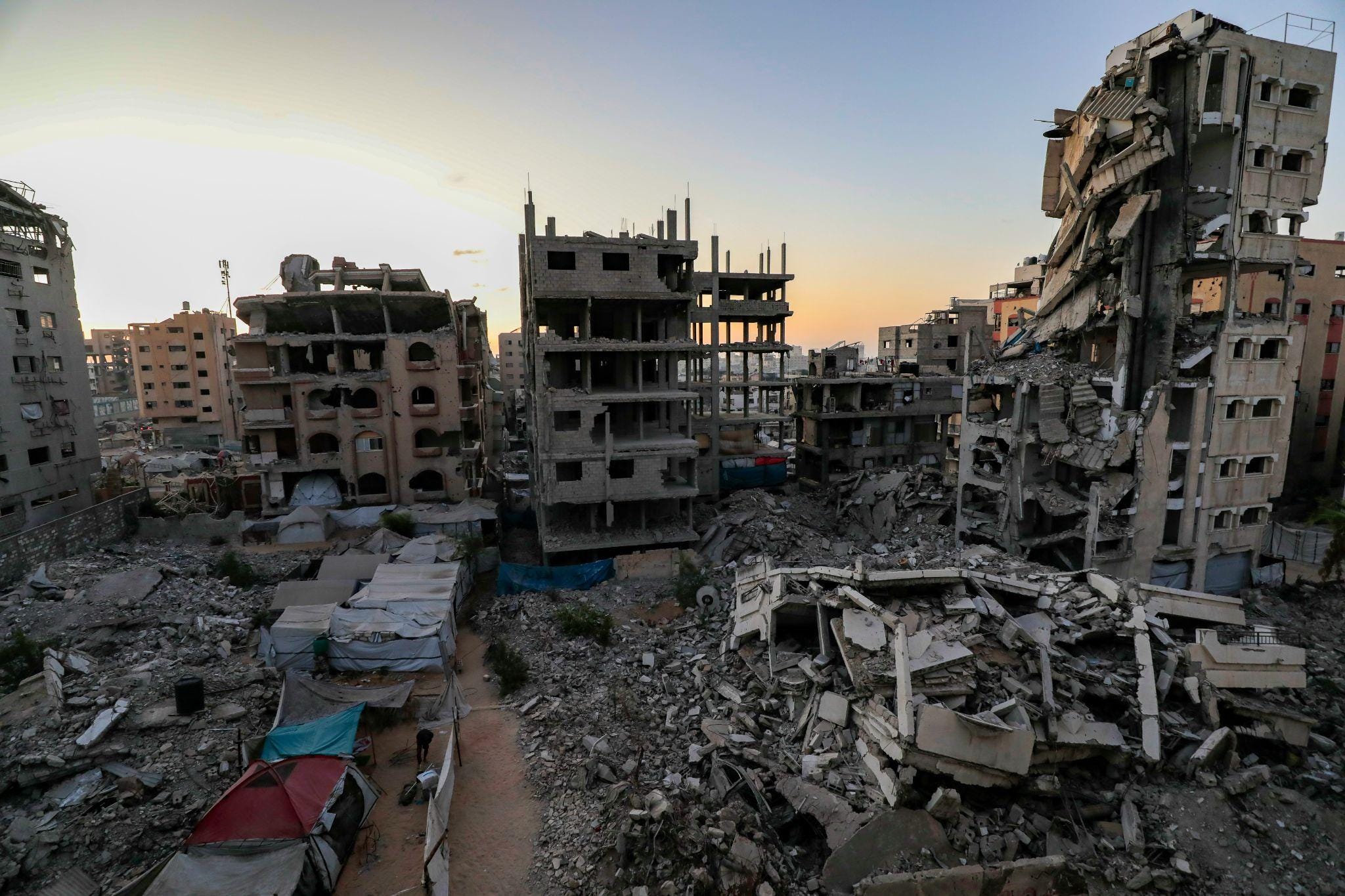
The Board of Peace makes the most sense when you stop reading it as diplomacy.
Diplomacy is supposed to be a slow apparatus of mutual constraint, a way for states to bargain inside a shared fiction that no one can simply rewrite the rules. What we are watching instead is the emergence of a governance interface designed to thrive in a world where the old constraints are deemed too expensive for power to tolerate. And the new fuel source is visible from space.
Climate change is an accelerant, poured into already brittle social and economic systems. Resource shortages, crop volatility, water stress, and extreme heat play out within contexts shaped by histories of enclosure, debt, inequality, and state legitimacy that already created intense fragility. In that terrain, political disputes become material. They become logistical. They become struggles over movement, work, land, and survival.
The numbers are already telling us what the next decade’s increase of baseline global instability looks like. The Uppsala Conflict Data Program (UCDP) recorded 61 state-based conflicts in 2024, the highest number since 1946, and eleven of these reached the “war” threshold. ACLED’s estimates put conflict deaths in 2024 at around 233,000. The United Nations High Commissioner for Refugees (UNHCR) reports 123.2 million forcibly displaced by the end of 2024. Those are the contours of a world in which instability has become the norm.
Add the climate layer, and we get a different kind of map. Not simply hot versus cold, or wet versus dry, but stable versus brittle. The World Bank’s Groundswell work projects up to 216 million internal climate migrants by 2050 without decisive action. And the research literature illustrates that climate extremes and resource stress measurably elevate the risk of violence across multiple scales, especially where institutions are fragile and livelihoods are precarious.
Capital’s Reaction?
So, how does Dominant Capital (which I’m borrowing from the concept as explained by Nitzan & Bichler in their seminal work, Capital as Power) react to a world with an increasing number of conflict points? It does what it always does. Capital turns hazard into revenue by monetizing the management of instability. That is what makes the Board of Peace so dangerous in a world that desperately needs degrowth. It is an attempt to capture “conflict management” and use it as fuel for a new capitalist growth engine.
There is a pattern here that we have seen in other domains. Disaster capitalism emerged as a way of reorganizing disaster response into contracts, procurement chains, financing vehicles, and private governance that flow upward. War economies persist because war becomes an infrastructure of accumulation. Security becomes a service. Reconstruction becomes an asset class. And when you frame it all as requiring careful management, stabilization becomes a revenue stream.
Conflict is not merely a tragedy
In a growth-locked system, conflict is also a frontier. The Board of Peace is an institutional attempt to formalize that frontier. It is a way to say that the old model, where states pretend to solve conflicts through liberal institutions, is too slow and too politically costly. The new model is governance as an interface that utilizes membership by invitation, pay-to-play tiers for members, a centralized interpretive authority, immunities that blur accountability, and an enforcement layer that makes the interface real.
Even if parts of the charter soften in negotiations, the core logic remains. It is a coordination architecture designed to outlast public consent.
The architecture matters because this kind of ‘stability business’ has endless demand in an overheating world, manifesting as border shocks, food and water stress, and displacement. And where there is predictable instability, there is predictable demand for “solutions.” If we then contrast this with what real stability entails, the potential for exploitation becomes stark. Liberal, neoliberal, and oligarchic depictions of “stability” get flattened into something that can be implemented and managed through enforcement and contracts, which usually means negative peace, in Johan Galtung’s terms, meaning the absence of overt violence, the restoration of order, and the suppression of visible disruption. But the research tradition that follows from that distinction is clear that durable stability is closer to “positive peace” and to resilience embodied by the slow, relational infrastructure that lets people resolve conflict without coercion, absorb shocks without collapsing into new violence, and adapt without losing the social fabric that makes life governable from within. From a slightly different but parallel angle, legitimacy research in international politics informs us that orders that rely primarily on coercion are brittle and expensive, and they either collapse or they have to generate legitimacy to reduce how much force they need for compliance. So when an institution treats “stability” as a business model, it almost has to prefer the flattened version that eschews local complexity and context, because the durable version is not, and can never be, a corporate-style deliverable.
The trick that the Board of Peace is designed to pull off is definitional: recast political conflict as a technical problem, sovereignty as friction, and legitimacy as a box ticked by recognition rather than consent.
States used to be the main switching stations through which capital routed extraction, discipline, and logistics, because the state was the market’s political form, the place where force could be made to look like law, and where continuity could be performed as legitimacy. But the state has become a noisier surface. The contradictions that were once easier to manage inside liberal scripts now rupture more often into public view. Elections introduce discontinuities that cannot be fully priced in. Courts slow down projects long enough for coalitions to lose momentum. Outrage forces reputational and regulatory costs that make certain moves harder to execute cleanly. Coalition governments fracture. Nationalist movements surge as unpredictable volatility. Even the liberal institutional layer, which once served as a smooth wrapper for global order, now adds friction, delay, and exposure at precisely the moment when the system is confronting cascading shocks and cannot afford to be seen hesitating. So the project becomes obvious: Find a governance layer that can keep the machinery running even when the democratic surface becomes unstable, and do it in a way that still borrows legitimacy from the old world.
A board model fits that need almost too neatly. It recasts governance as administration, compresses decision gates, and produces continuity by structure rather than consent. It intervenes as ‘stabilization,’ treating dispossession as disorder. And when it does intervene, it does not need to declare itself an occupation or a conquest. It can call itself stabilization, as though the problem were merely disorder rather than dispossession, and as though the only thing missing was competent management. Once you see it in those terms, the implications of a transition to degrowth stop being abstract, because degrowth is not simply a policy agenda that can be politely slotted into that kind of machine. It is the refusal of the machine itself.
Why Degrowth is the Answer
Degrowth is not just a demand for less consumption. Degrowth means dismantling the growth compulsion that monetizes harm. Under climate stress, a growth-locked system will seek to profit from conflict through finance, security, reconstruction, and surveillance.
So, degrowth can’t be a polite policy tweak inside an interface protected by immunity. In such an interface, participation becomes internalization, where we end up learning to accept enforcement and administration managed by capital as ‘stability.’
Degrowth requires the opposite movement. It requires non-participation in the conflict market.
Non-participation means refusing the coordination channels that convert communal stress into extractable revenue. It means building local and regional resilience that reduces the supply of crises that can be harvested. It means re-routing resources and dependence away from the infrastructures that make communities legible as assets to be managed. See James C. Scott’s work, Seeking like a State, to understand how states have historically used legibility to make resources and communities governable and exploitable.
If conflict is being positioned as the next growth market, then degrowth becomes something sharper than critique. It becomes a refusal in the literal sense of declining to supply the conditions that make crisis profitable, declining to let very normal social tensions and human vulnerabilities be converted into a revenue stream for distant managers. What is needed is the slow, unglamorous work of building local capacity that is real enough to hold when systems strain.
That begins with resilient and robust community-building. This entails food sovereignty that focuses on staples, access, and land relations. We will need water governance that is collective and accountable, and energy descent strategies that reduce exposure to fuel shocks and price coercion, without pretending that green growth will save us from the hard constraints of ecological limits. We will have to foster mutual aid that hardens into durable provisioning, into routines and institutions that keep working after the first burst of solidarity fades. These communities require repair cultures and local fabrication capacity that cut dependence on brittle supply chains and predatory procurement. And ultimately these communities will have to cultivate commons-based dispute practices that can metabolize tension before it becomes a weapon, and resource-sharing norms that make scarcity harder to manipulate into resentment and violence. This is how we reroute coordination itself, so that when pressure rises, communities do not default into the kinds of exploitable unresolved tensions that a conflict economy requires for growth.
The goal is to create enough local stability that the external “stabilization industry” cannot justify itself as necessary.
Because that is the quiet logic behind the Board of Peace as a conflict-growth mechanism. It doesn’t need total control, only persistent instability that keeps the market renewing.
Degrowth, then, is a counter-coordination project.
We are entering a period where climate change and resource constraints make conflict more likely, because the current system organizes scarcity in ways that produce desperation, exclusion, and competition. The data already reflects rising conflict intensity and displacement, and climate stress is a measurable risk multiplier in vulnerable settings.
A Board of Peace built to govern this landscape is a business model.
Degrowth is the refusal to feed it.
