
Sufficiency: from growth and overshoot to enoughness
Interview with Toni Ruuska


Toni Ruuska (D.Sc.) is University Researcher and Adjunct Professor of Sustainable economy at the University of Helsinki. He is the co-editor of Sustainability beyond Technology (Oxford University Press, 2021) and the author of Reproduction Revisited: Capitalism, Higher Education and Ecological Crisis (Mayfly Books, 2019). In his research, Ruuska seeks to find avenues for alternative agrarian political economies. Theoretically he is involved in ecological Marxism, political ecology, and (eco)phenomenology.
Vlad Bunea: Sufficiency: From Growth and Overshoot to Enoughness (2025), which you edited with Tina Nyfors, looks at sufficiency from several angles. What is the difference between sufficiency, enoughness, degrowth, and wellbeing?
Toni Ruuska: In the book’s introduction, Tina and I argue that sufficiency is an ethos of enoughness, which also points to bottoms and ceilings. Based on this approach, it is possible to argue for minimum and maximum affluence, for instance. Personally, I see that degrowth is the journey out of the state of overshoot for the over-consuming class, and sufficiency is the destination. Wellbeing is definitely a baseline for sufficiency, as we need to be well to be good.
VB: The book builds on the formula human-induced environmental Impact = Affluence x Technology x Population (I = A x T x P), a version of which was introduced over fifty years ago by Paul Ehrlich and John Holdren. Ehrlich, Garrett Hardin and others are known to have advocated for sterilization to address overpopulation. Of course, your book takes a strong position against these brutal measures, but meanwhile you are not shy to talk about the population question. Why is population important when we talk about sufficiency and enougness?
TR: The population question is perhaps the hottest potato in the book. At the same time, we did not want to give it more weight than it deserves, which is precisely the reason why we deal first with affluence and technology. I’m also happy that you were able to grasp our position on population, that is, a strong position against racist and discriminating population reduction measures, while being aware that there are well over 8 billion humans on this planet. Although it is certainly true that only a small percentage of humans contributes the most to the ecological overshoot, it is still difficult to claim that the population question would not be a sustainability problem or a question of sufficiency. In any case, our claim is modest: we should, at least, be able to talk about population in an inclusive and just manner, and as a pillar of sustainability and sufficiency.
VB: Tina Nyfors and Lassi Linnanen propose in Chapter 4 that the ultrarich overconsuming humans (richest 1%) which are those with an income of 220.000 euros per year would need to shrink their carbon footprint from the current range of 55-300 tons of CO2e per year to close to zero, and very quickly, to reach a level of sufficiency. Clearly, most of these humans won’t do this voluntarily. What do we do then?
TR: I agree, the ultrarich won’t let go of their fortunes voluntarily. This is, of course, the very same problem that countless degrowth activists, including myself, are struggling with. In a more sane and fair society, compared to capitalism where wealth is privatized, too much privatized affluence would be socialized for common good. To me this is hardly a radical statement. Why should some have so much at the expense of others?
VB: As indicated in the book, 28% of all humans are overconsuming, 40% are already at levels of sufficiency, while 32% are struggling below these levels. Some of them, however, desire very much the level of affluence of the over-consuming humans. How do we tell them they cannot have it if over-consuming humans do not change their habits first?
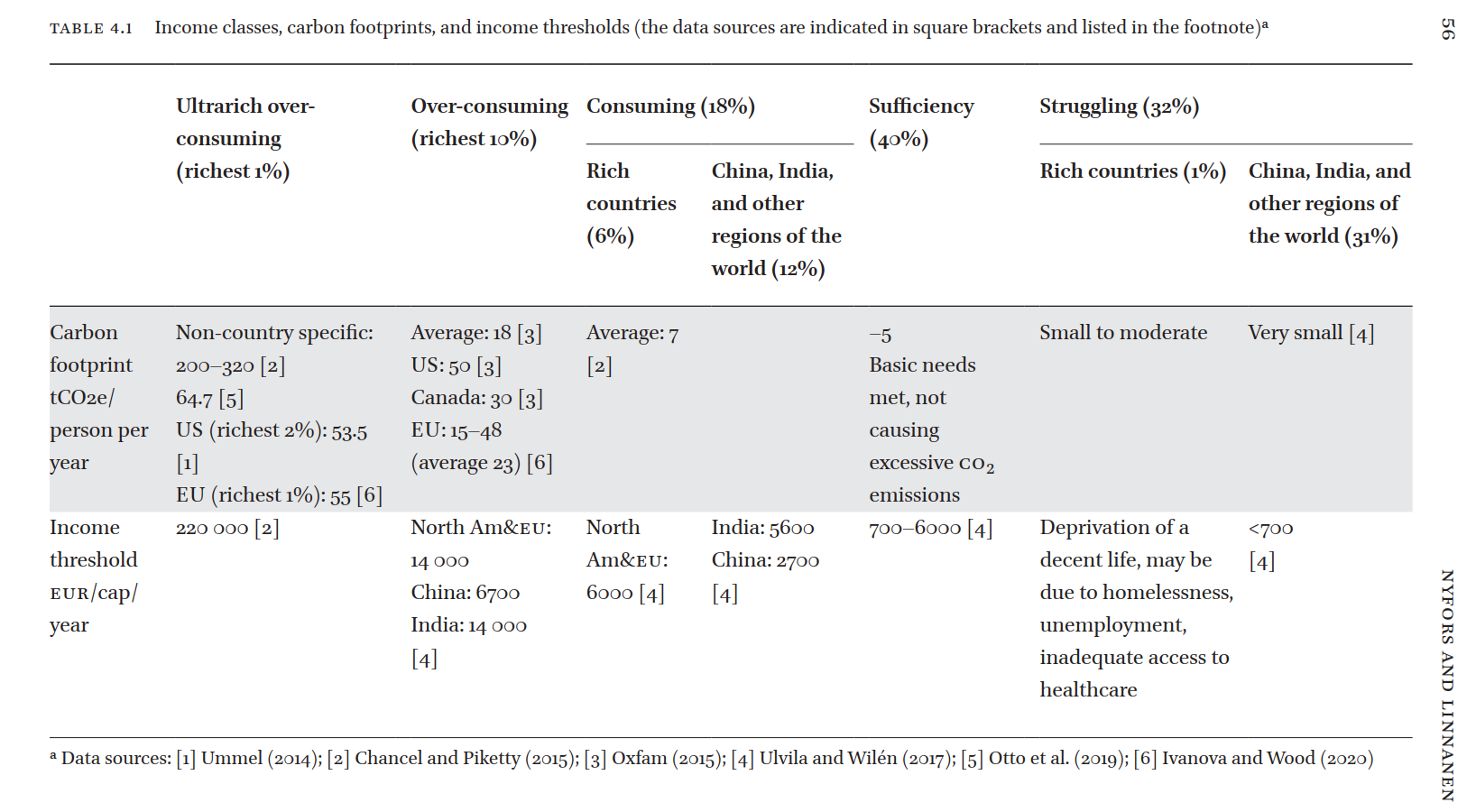
TR: Social justice and redistribution are key questions for sufficiency-driven change, like Tina and I write in the conclusions of the book. Social inequality is a historical phenomenon tied to colonialism, imperialism and capitalism, which are based on oppression and extractivism. Contrast this to the ethos of enoughness, like we do in the book, and we land in one of the core arguments: ecological ceiling means degrowth for the overshooters, while a socially just bottom means redistribution and empowerment for those whose basic needs are not met today. Again, a more sensible society would have enough for everyone’s need, and thus redistribution is a vital condition for social justice and sufficiency.
VB: The authors of Radical Abudance claim that the needs of up to 10.4 billion people might be met without transgressing various planetary boundaries such as ozone depletion, biodiversity loss, soil erosion, and of course CO2-equivalent emissions. Is this compatible with the I = A x T x P formula?
TR: Future speculations are tricky and difficult to falsify. Rather than this, the point of the book is to argue that with sufficiency in affluence, technology, and population it is much easier to tread carefully on this precious planet. However, sufficiency means different things for each of the three factors, as sufficiency is guided by the notions of diversity, social justice and wellbeing.
VB: How can immigration be made compatible with a planetary-wide ethic of sufficiency?
TR: Humans seem to be nomadic by nature, so personally I do not see how immigration is related to sufficiency. Humans need to move around. However, the means of transportation are matters of sufficiency, as is well argued by J. Mohorčich in his chapter.
The best example of "degrowth for the overshooters" I know of is the evolution of the Japanese Tea House. Prior to the 16th century, the Japanese Tea Ceremony was a signature of affluence in Japanese society, with the ceremony taking place in ORNATE and EXPENSIVE Chinese-styled architectures. Then, in the mid-16th century, a Buhddist Monk named Sen no Rikyu popularized "wabi-cha"--a style of the ceremony that emphasized rustic simplicity, tranquility, and extreme minimalism. The Tea House itself was reduced to a small structure, built with natural materials, entered through a "crawling-in entrance" that promoted humility and equality of social-status. The Tea Ceremony within was executed with simple, worn and rustic containers, scoops, and cups--and the whole experience was wrapped in a garden space representing the sanctity of nature. Miraculously, this celebration of rustic simplicity became the new signature of Japanese "affluence."