
Stability Beyond Growth: Implications for Businesses Today

Modern political-economic systems are structured in ways that make stability easier to sustain under conditions of growth, and more difficult when growth is weak. As constraints on growth intensify, future stability may need to be maintained without continuous expansion—with implications for businesses today.
Growth Is Under Pressure
For more than a century, expansion has helped stabilise modern economies. It has sustained jobs, corporate profits and public finances, and is the bedrock of political legitimacy. Long-run growth is the norm: business strategy, financial markets and fiscal policy all assume that output will keep rising.
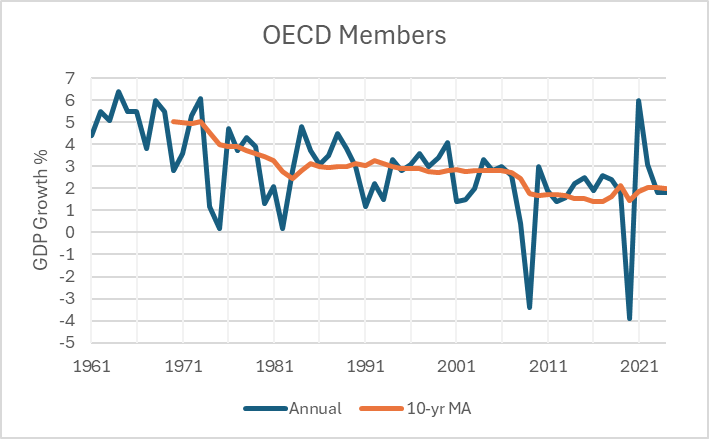
But in high income nations, assumptions about the rate of growth are under structural pressure from long-running environmental, productivity and societal factors. Annual GDP growth in the OECD group of nations has been slowing for decades, with the ten-year moving average clearly showing a structural downshift in growth capacity from ~5% in the 1960s to ~2% in the 2020s, indicating not just temporary deviations due to shocks, but changes in the economic regime (see figure 1). The ~3% average growth rate of the late 20th century is often assumed to be the norm, leading to expectations that today’s weaker growth will rebound. But the longer-run pattern suggests growth is normalising downwards.
If the rate of economic expansion continues to decline, how might the frameworks through which stability is produced and maintained change—and how will firms maintain profitability, resilience and legitimacy under those conditions? The implication is that firms and economies will face tighter structural constraints and macroeconomic, political and institutional norms may evolve in response.
Some large companies are already experimenting with answers. They maintain performance today while testing business models, governance structures and strategies that would be robust under tighter structural constraints. These include shifting definitions of success, re-balancing capital allocation away from expansion and testing resilience-oriented operating models. Their moves suggest that an economy designed to thrive under constraints is plausible and that firms preparing for different measures of success may gain an early advantage.
Why Growth Is Now Under Pressure
Modern growth economies reinforce themselves. Investment in productivity raises profits, enabling reinvestment. Credit expansion stimulates demand, which increases asset values and collateral, allowing even more lending. But now these reinforcing cycles are under a number of structural pressures.
Ecological limits: Climate change, biodiversity loss and resource degradation are increasingly affecting infrastructure, agriculture and supply chains. These pressures introduce systemic risks that are difficult for markets to price.
Demographic shifts: In OECD nations, the share of people aged 65 and over has doubled since 1960, and may almost double again by 2050, with long-term implications for public finances and economic growth, even with better aging and longer working lives.
Energy constraints: The renewable transition is infrastructure-intensive, requiring large upfront investment. Meanwhile, pathways for hard-to-abate sectors are uneven and the scalability of negative emissions technologies is uncertain. Fossil fuels remain important to global energy supply, but are exposed to episodic shocks and geopolitical risks (like COVID-19 or the Iran war). As a result, energy systems may experience periods of tighter conditions and price volatility, constraining growth.
Productivity slowdown: Productivity growth has been slowing in advanced economies for decades, with capital largely flowing into real estate and financial assets. This raises debt, reduces employment opportunities and introduces systemic risk into financial markets.
Weakening legitimacy: The rate of return on capital (wealth stocks) has outpaced the rate of economic growth (production flows), while workers capture a shrinking share of productivity gains. Widening wealth and income gaps are associated with lower levels of institutional trust and can weaken the political legitimacy of the system.
Geopolitical fragmentation: Globalisation relies on relatively frictionless cross-border flows, which surged in the 1990s as the Cold War ended. But following the Global Financial Crisis and COVID-19, “slowbalisation“ (a structural slowdown in globalisation), tighter capital controls, shifts in migration patterns and rising geopolitical tensions have contributed to a more fragmented global system.
These pressures aren’t going away, despite several clear gains. Yes, several higher-income economies have achieved partial decoupling of territorial carbon emissions from GDP growth—but the pace and scale of global decoupling required to meet internationally agreed climate and ecological targets exceed current trajectories. Yes, AI, digitisation and automation promise revolutionary efficiencies—but practical realisation often falls short of the hype surrounding technology.
For executives, this signals a need to rethink how business resilience can be maintained should the economic regime downshift further.
Strategic Implications For Business Leaders
If economic growth becomes harder to sustain in the long term, the implications for business strategy are profound, particularly for larger, publicly listed and capital-intensive firms. These have long relied on expanding markets to secure revenues and justify investment. In a slow growth environment, competitive advantage will depend less on scale and throughput and more on resilience, resource productivity and institutional legitimacy. Navigating this shift will require leaders to operate across multiple economic horizons simultaneously.
Six strategic implications stand out:
Plan for a world where growth is less reliable. Treat a “post-growth” mindset shift as a plausible scenario, and include it within long term planning. (See more on this below.)
Make resilience a source of competitive advantage. Scale, efficiency and just-in-time production can become fragile under conditions of resource constraint and geopolitical disruption, whereas reliable supply chains, durable products, long-term customer relationships and balance sheets able to absorb volatility are advantageous.
Treat resource productivity as a strategic priority. Managing energy, materials and environmental impacts is shifting from compliance to strategy. Firms that use resources most efficiently, and use fewer of them, will gain structural advantages.
Expect growth to become more selective. Some sectors, such as those related to wellbeing and ecological resilience, may expand rapidly. Others may face structural limits. Strategic positioning within this changing landscape will matter more than scaling.
Focus on workforce stability, job quality and fairness to enhance retention, capability and legitimacy through transitions in employment dynamics.
Lead across multiple economic futures. Firms will need to maintain performance within a growth-oriented system, while experimenting with business practices suited to a more constrained economy and putting structurally stabilising stewardship and social missions in place.
What Makes Economies Stable
Economic stability is widely understood as a precondition for sustained growth, partly shaped through policy, but also by deeper structural and institutional conditions. However, the relationship is bidirectional: growth also plays a mediating role in sustaining stability. Modern economies have become institutionally conditioned by expectations of continued growth, with growth helping to manage several key tensions. Conversely, prolonged low growth can make these tensions more difficult to contain.
Macroeconomic stability: growth eases macroeconomic constraints—it can absorb labour and ease public debt.
Political stability: growth enlarges the revenue base, which may improve distributive outcomes, reducing social tensions and helping maintain political legitimacy, albeit without fully resolving underlying inequalities.
Institutional stability: core institutions, such as corporate governance, labour markets, financial systems and fiscal systems, have evolved under assumptions of ongoing growth. Growth helps validates these assumptions, while slowdowns can expose tensions and reduce institutional coherence.
These relationships are not universal but are sufficiently characteristic of advanced economies to suggest that growth is both an outcome of stability and a mechanism by which stability is maintained. This dependency is shaped by institutional design and by a deeper institutional logic that embeds growth assumptions.
As long-term ecological, social and productivity constraints intensify, growth may no longer reliably perform its stabilising role. The central challenge becomes: how do economies remain stable when expansion slows?
One emerging answer is the “post-growth” framework. Post-growth reframes the objective of advanced economies from pursuing growth to, instead, maintaining good living standards for all while respecting ecological limits.
Contrary to common misconceptions, post-growth does not call for indiscriminate economic contraction. Growth may still occur, but it is no longer the organising principle. Rather, post-growth asks how public policy, capital markets, corporate governance, labour systems and social protections can be redesigned so that prosperity and stability do not depend on ever-increasing material throughput. Success is measured not by the pace of expansion in the short term but by resilience and robustness in the long term. Fair resource distribution, reliable provisioning of essential goods and services and production practices aligned with environmental ceilings are the stabilising features of a post-growth system.
The Business Challenge Is Navigating A Changing Economic Logic
While policy regimes can change rapidly, as seen in the market-oriented reforms of the late twentieth century, deeper economic transformations unfold more slowly. During the Industrial Revolution, industrial capitalism gradually displaced agrarian economies over decades, with old and new systems coexisting in a long hybrid phase as labour, institutions and capital adapted. The same dynamic is likely in a transition from a growth-dependent economy to one that remains stable without relying on continuous expansion.
Business leaders are already familiar with one tool to navigate such transitions: the Three Horizons framework. Widely used in corporate strategy, it helps organisations manage innovation alongside core operations: defending today’s business, experimenting with emerging opportunities and preparing for longer-term transformation.
Applied to economic change under intensifying constraints on growth:
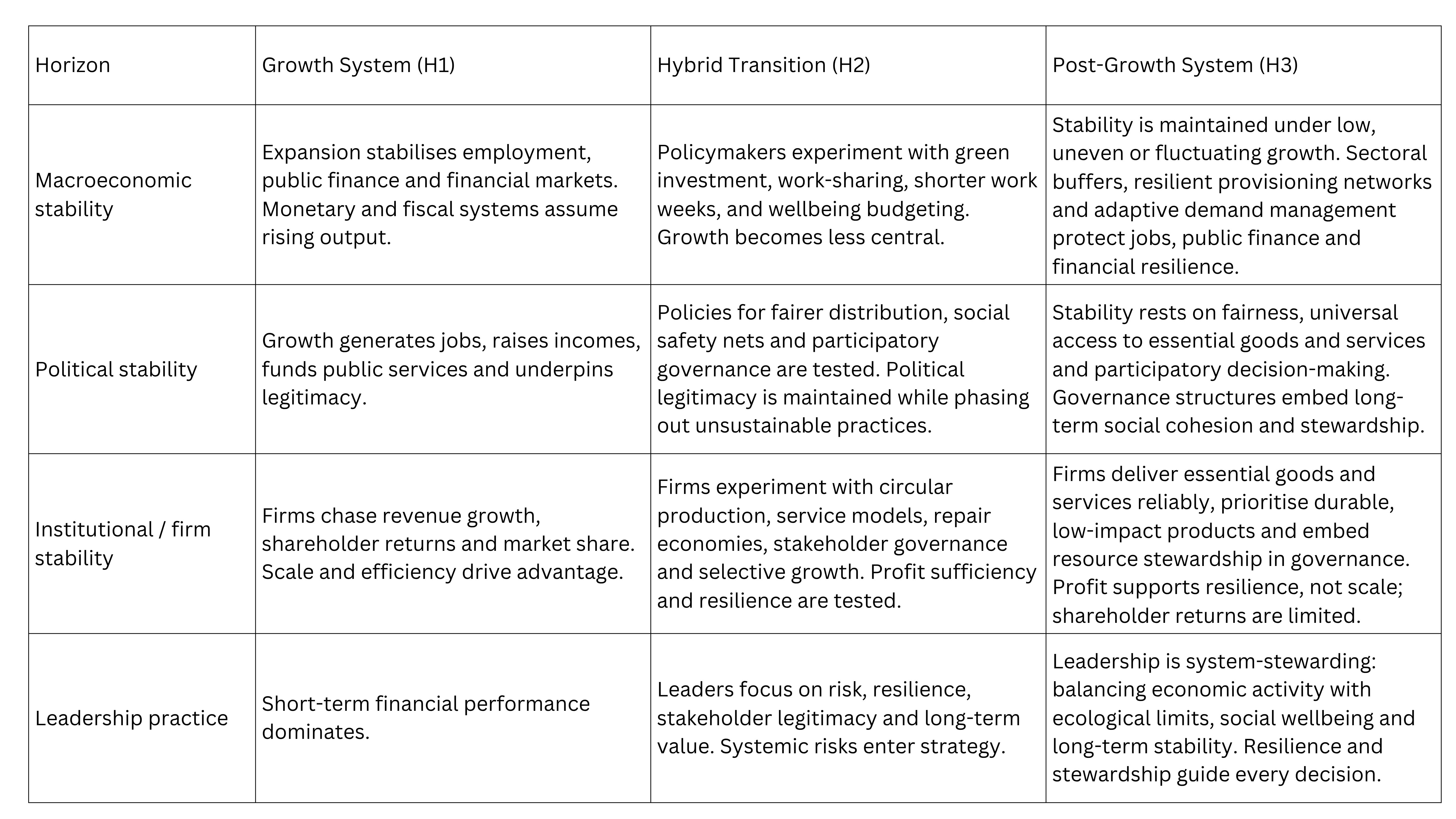
Horizon 1: the existing growth-based economy. Continues to underpin employment, investment earnings and public finance, remaining essential to stability even as its limitations become visible.
Horizon 2: the hybrid transition space. Institutions experiment with circular business models, shorter work weeks, alternative success metrics and governance innovations, while gradually phasing out unsustainable practices.
Horizon 3: the emerging post-growth model. New institutions, technologies, governance and business models begin at the margins among pioneering firms, policymakers and communities, gaining influence as structural pressures reshape the broader system.
Table 1 applies the Three Horizons framework to macroeconomic policy, political stability and firm strategy, as well as leadership practice. It shows how stability may be maintained by cautiously continuing with today’s growth-based economy while experimenting with innovative approaches and preparing for the possibility of a post-growth future.
For leaders, this creates a distinctive challenge, with each horizon representing a simultaneous priority: sustaining current performance, piloting emerging practices and embedding the structures and mindsets that may define long-term stability.
Early Signals From Business
Some large firms are already operating across the three horizons simultaneously, maintaining performance within the growth economy while experimenting with practices aligned with tighter ecological constraints or meeting essential needs and ensuring governance is oriented toward long-term social and environmental stewardship.
Patagonia still competes as a premium global apparel brand. But it has introduced practices that challenge conventional fashion economics, including repair services, resale programmes and product designs intended to last longer. It is owned by a purpose trust and environmental nonprofit, embedding resource stewardship and profit sufficiency into the company’s governance. (Doughnut Economics case study.)
Triodos Bank operates as a regulated commercial bank, but directs capital toward renewable energy, social housing and cultural enterprises. Its governance structure emphasises transparency and long-term impact, limiting speculative financial activity and aligning investment with social and environmental goals.
Bosch is a major industrial manufacturer. It uses a design-for-environment approach to build longevity, repairability and recyclability into products. It offers repair services and recycles production waste. Earnings are reinvested into R&D or distributed to its owner, a charitable trust that supports social issues.
These examples suggest a post-growth shift is considered plausible, and that readiness for new measures of success could create long-term advantage.
Conclusion
For more than a century, economic growth has helped stabilise modern economies. It has supported jobs, corporate profitability and public institutions. But long-term structural pressures are raising questions about whether expansion can continue playing this role indefinitely. A post-growth logic is beginning to emerge. It seeks stability from resilience through fairness, stewardship and institutional design.
For business leaders today, choosing between growth and post-growth is not the challenge. It is learning how to operate through a transition in which both logics coexist. Success will increasingly depend on a dual capability: delivering performance in today’s growth-dependent economy while preparing for a future in which stability no longer depends on growth.
 | A guest post by
|
Thanks for this interesting article Jennifer. I'm interested to learn more about the early signals from businesses - this could potentially be another article taking a deeper dive into these business case studies!