
Pain and rage revisited (Dolor y rabia revisitadas)
... and one story

Spanish original further down
Today
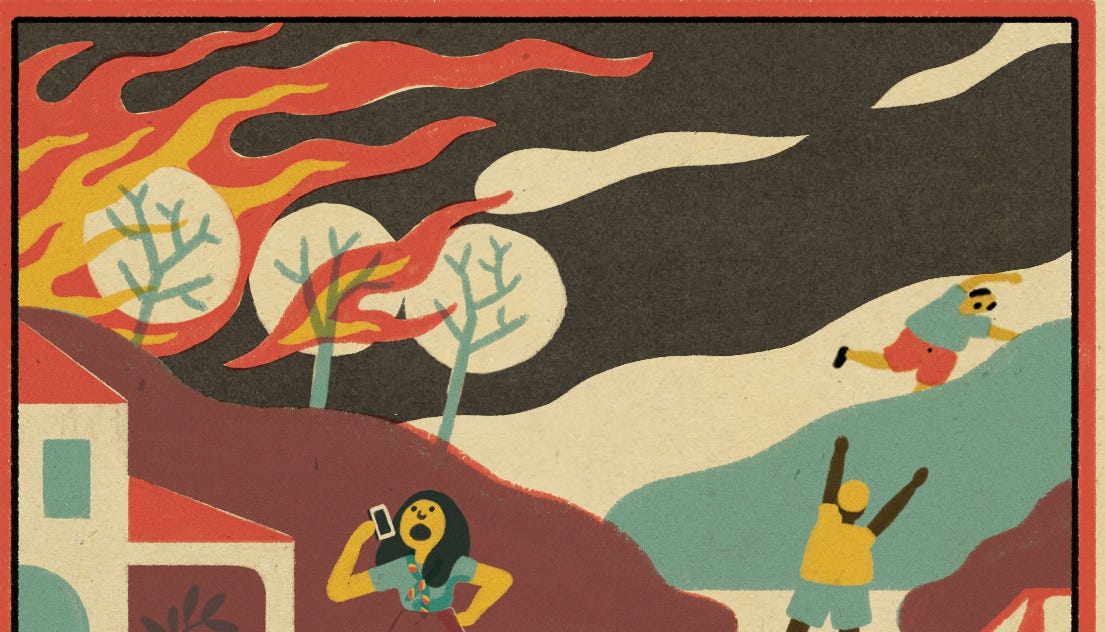
I’m sitting here writing on a July morning in Barcelona, and just by daring to open a window, I can already tell that the temperature outside is already suffocating. Fires are raging in Spain and elsewhere. It’s frightening. Many who still view global warming as something abstract must have realized by now that it’s for real. And I’m speaking from Europe. In other places, these terrifying temperatures have been a reality for years.
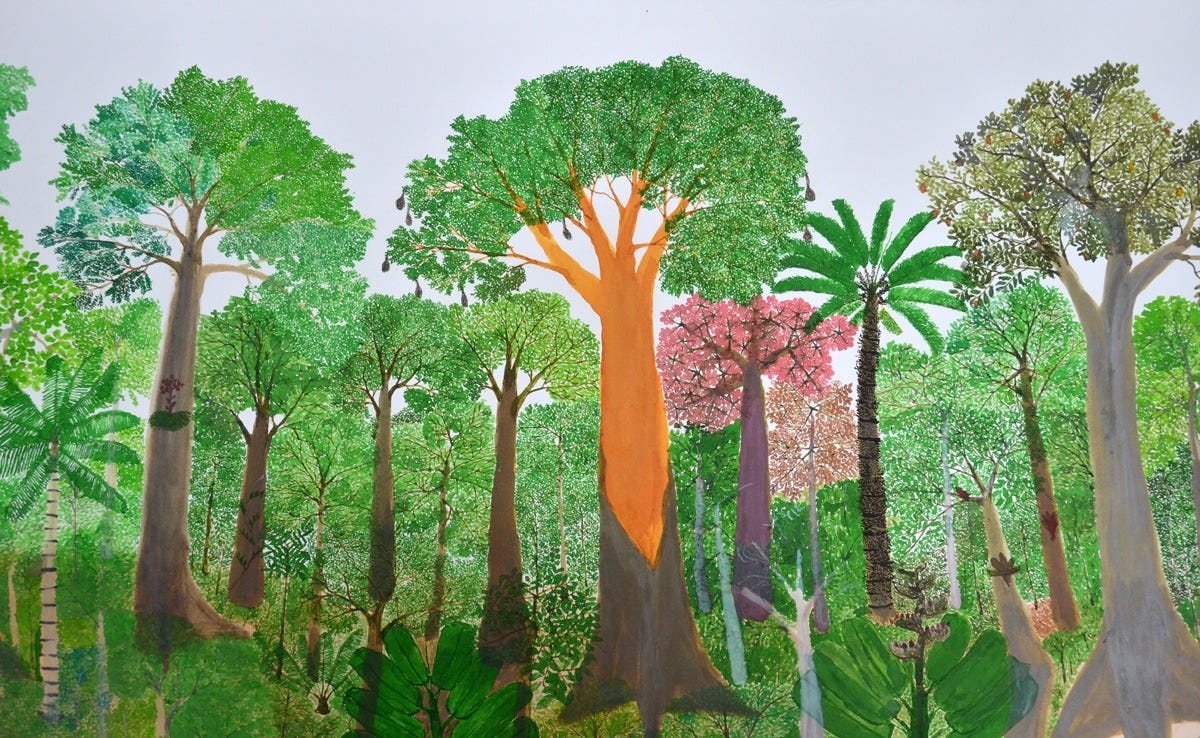
We have destroyed something valuable, unique—or perhaps it’s more accurate to say: something sacred. The Holocene—the geological epoch characterized by a delicate, almost magical balance (I recommend Stephan Harding’s book Animate Earth as an engaging introduction to the wonder of planetary balance), which has accompanied and facilitated human life over the past millennia—is veering toward an unknown course. I am drawn to religious language to express the shameful and unacceptable large-scale destruction and mistreatment of life, and the arrogance required to crush a miracle so far beyond our understanding.
We’ve been warned for a long time, but it did little good. We haven’t been able to position life above other priorities. It’s a momentum of overproduction and overexploitation, using methods that poison, kill, and ravage—a momentum from which it seems almost impossible to break free. For we are immersed in a narrative: that of “the economy,” understood as having a single priority—that of increasing profits. We invoke “inevitability” when speaking of markets and invisible hands, forgetting that behind the long process of destruction there has been a multitude of decisions that led us to this point of polycrisis. At every moment there have been alternatives, and there continue to be.
White people do not understand that what they take from nature, they must give back to it
Abel Rodríguez
Our path once seemed like progress—and to many, it still does; the colorful gadgets are blinding. Some are caught up in the drive to have more and more, driven by the anguish of individualistic societies. The majority, however, is mired in real and growing scarcity that is, moreover, artificial—for in truth, as humanity, we have enough. We have never produced so much, nor have we extracted so much from our planet. And the so-called laws of perpetual growth still aim to multiply extraction and production, as if that were what would finally bring us redemption...
The promises of development in the Global South—in the sense of “catching up” to what we have deemed desirable: the U.S. model, or wastefulness as a way of life—are not being fulfilled and cannot be fulfilled. We’d need several planets for that. Nor is rampant production in the North on track to offer a better standard of living for everyone—quite the opposite. For in the neoliberal era of the past 40 years, GDP growth has been diverted—in a form of “socialism in reverse”—toward those who don’t need it.
And, of course, there is a great deal of discontent. And so, as humanity, we elect boors who falsely scorn the system (talking about “la Casta” --Milei, or “the never” --De la Espriella), boors who know how to harness the rage of frustration and turn it into hatred against a specific group. To keep the deadly system running. My home country, Colombia, is putting the next destructive boor on the global map...
Do we have to go through this to react and build something new?
A Story
I’ll move on to a short story, “The Fox’s Fire” (experienced in a session with Storytailors), which shook me to my core. Although, significantly, it wasn’t until I’d slept on it that I realized its effect…
It begins like this:
A man is walking alone through the countryside, returning from work, and passes by a garden protected by a wall. He sees that it is a wonderful garden, full of life… and catches a glimpse of a glowing ball inside that fills him with curiosity. And without a second thought, he manages to climb the wall and enter. A bold and daring soul. Well, what he does inside the garden is daring, as he realizes that he has indeed found something very special. There’s a fox that seems to be dancing with a ball of fire, which comes and goes with its breath. He recognizes the ball—thanks to the traditions of his village—as the elixir of life, and without further ado, he seizes it by swallowing it whole!
As we listeners learn later, the ball of fire will grant him extraordinary powers that will make him very rich.
But let’s stay with this first scene, because I want to draw attention to the fact that the character didn’t hesitate to climb over the wall, wander around, and take possession of something very special. He naturally took it as his right! (Now, revisiting this story, Trump’s daughter’s recent “discovery” of an island in Albania comes to mind…). The problem—and here I’m stepping away from the story itself to share my own experience of it—is that not only he, but I too, at first, accepted everything he did. And even as evidence mounted that his course and actions were harmful and unethical1, I continued to listen benevolently, hoping, perhaps, to find some meaning in it all...
Throughout the story, the fox waits patiently for the moment when the treasure returns. He seems to trust that things will return to normal.
As I said, it took me one night to feel the injustice, for the outrage to really sink in. And the thing is, it hurt me then—with rage. I was hurt by the brazenness, insensitivity, and ignorance of the man who walks in and tramples the garden, taking the liberty of stealing the treasure. The void he leaves behind hurts.
The story then leads us to reflect on the “hero’s” excessive haste and his inability to come to terms with the treasure. For although he manages to amass a great fortune, he grows weary, and in his later years he turns to excess and alcohol… That is when the fox recognizes the right moment and, indeed, is able to take the treasure back and return it to its rightful place.
Our Garden
Perhaps my anger stems less from the overbearing bully’s abuse and more from the power of inertia—within me as well. An initial acceptance contrasts with the moment of indignation, the experience of that deep sadness. This fleeting experience suggests that some part of me is usually trapped in a conventional mindset that tends to accept things as they are.
After all, the suit-and-tie bullies exude confidence and purpose; they command respect. Surely many of those with decision-making power have been unaware of the unsustainability of the system they promote, riding on the back of progress. And perhaps, it is not about finding “villains.” After all, patriarchy, developmentalism, comfort, destruction, submission to apparent authority—all of that is also within me, within all of us....
However, we have entered an era that makes such unawareness difficult to explain away as innocent—at the very latest since the genocide in Palestine. We have “leaders” who are increasingly less respectable, openly defending the continuation of this deadly system through bloodthirsty methods.
Excess—the outrageous obscene enrichment of a few thanks to a system that claims to continue defending the indefensible—is reaching its limit.
It must now be time to marvel deeply at the Garden, and at the mysterious existence that we, as humanity, are destroying. And to feel that we must take action and reclaim the stolen treasure.
On this topic and the importance of our limited perspective, a book by Ursula K. Le Guin comes to mind: The Word for World Is Forest, which allows us to see the alienated world of a character very similar to the one in this story. It is quite interesting how his interactions with other characters are misinterpreted and distorted, thereby confirming his own reality, rendering him unable to see the harm he is causing.
Dolor y rabia revisitadas
… y una historia
Hoy
Estoy sentada escribiendo, en una mañana de julio en Barcelona y ya se nota, con solo atreverme a abrir una ventana, que la temperatura afuera está asfixiante. Oímos que hay grandes incendios en diferentes geografías. Asusta. Más de una persona que aún veía el calentamiento global como algo abstracto, ya este año se habrá dado cuenta de que es en serio. Y yo hablo desde Europa. En otros sitios las temperaturas de espanto ya son vivencia desde hace años.
Hemos destrozado algo valioso, único, o tal vez es más adecuado decir: algo sagrado. El holoceno, la era geológica caracterizada por un delicado y casi mágico equilibrio (recomiendo, para adentrarse de manera amena en la maravilla del equilibrio planetario, el libro “Tierra viviente” de Stephan Harding), que ha acompañado y ha facilitado la vida al ser humano durante los últimos milenios, está girando hacia un rumbo desconocido. Me nace irme a un lenguaje religioso para expresar la desvergüenza de la inadmisible destrucción y maltrato a gran escala de la vida, la soberbia necesaria para aplastar un milagro tan superior a nuestro entendimiento.
Hemos estado avisados desde hace tiempo, sirvió de poco. No hemos podido respetar la vida por sobre otras prioridades. Se trata de una inercia de sobreproducción, sobre-extracción, con métodos que envenenan, matan, arrasan, una inercia de la que pareciera casi imposible zafarse. Pues estamos inmersos en una narrativa: la de “la economía” entendida como teniendo una única prioridad: la de aumentar ganancias. La que esgrime “inevitabilidad” hablando de mercados y manos invisibles, haciéndonos olvidar que detrás del largo proceso de destrucción han habido una multitud de decisiones que nos llevaron a este punto de crisis múltiple. Y en cada momento han habido alternativas, y las sigue habiendo.
El hombre blanco no entiende que lo que le quita a la naturaleza tiene que devolvérselo
Abel Rodríguez
Nuestra ruta parecía progreso en un momento, y aún se lo parece a muchos, los artefactos de colores obnubilan. Los unos están enroscados en tener más y más, desde el desamparo propio de las sociedades individualistas. La mayoría está sumida en verdadera y creciente escasez que además es artificial --pues en verdad como humanidad tenemos suficiente. Nunca hemos producido tanto, ni hemos extraído tanto de nuestro planeta. Y las supuestas leyes del crecimiento perpetuo aún pretenden multiplicar la extracción y producción, como si eso fuera lo que por fin nos traerá la redención...
Las promesas del desarrollo en el Sur Global, en el sentido de “alcanzar” lo que nos ha parecido deseable: el modelo del Gran Hermano americano, o el despilfarro como modo de vida, no se cumple ni se puede cumplir. Necesitaríamos varios planetas para ello. Tampoco en el norte la desaforada producción va rumbo a ofrecer mejor nivel de vida a todos, más bien al contrario. Pues en la era neoliberal de los últimos 40 años, el crecimiento del PIB se desvía en socialismo al revés hacia el que no lo necesita.
Y, claro, hay mucho descontento. Y entonces como humanidad elegimos patanes que mentirosamente desdeñan al sistema (hablando de “la casta” o “los nunca”), patanes que saben recoger la rabia de la frustración y convertirla en odio contra algún grupo en concreto. Para mantener al mortífero sistema funcionando. Mi país natal, Colombia, está poniendo el siguiente patán destructor en el mapa global... ¿Hay que pasar por esto para reaccionar y construir algo nuevo?
Un cuento
Paso ahora a un corto cuento, “El fuego del zorro” (vivenciado en una sesión con la recomendada Storytailors), que me hizo tambalearme internamente. Aunque, significativamente, fue solo después de consultarlo con la almohada que me di cuenta de su efecto...
Comienza así:
Un hombre va caminando solo por el campo, volviendo del trabajo, y pasa por un jardín protegido por un muro. Ve que se trata de un jardín maravilloso, lleno de vida... Atisba adentro una bola brillante que lo llena de curiosidad. Y sin pensarlo más se las arregla para trepar el muro y entrar. Un ser intrépido y atrevido. Pues lo que hace dentro del jardín es atrevido: se da cuenta de que en verdad ha encontrado algo muy especial. Hay un zorro que parece danzando con una bola de fuego, que va y viene con su respiración. Reconoce la bola, gracias a tradiciones de su aldea, como el elixir de la vida, y sin más, se apodera de ella ¡tragándosela!
Como los oyentes escucharemos más adelante, la bola de fuego le dará poderes extraordinarios que lo harán muy rico.
Pero quedémonos en esta primera escena, porque quiero llamar la atención a que el personaje no dudó en que podía traspasar el muro, pasearse por allí y apoderarse de algo muy especial. ¡Él se entendió naturalmente en su derecho! (Ahora revisitando esta historia me viene a la mente el “descubrimiento” de la hija de Trump de una isla en Albania hace poco...). El problema, y aquí me salgo del cuento en sí para entrar en mi propia vivencia de él, es que no solo él sino yo también, en un comienzo, acepté todo lo que hacía*. Y aunque se fueron sumando evidencias de que su rumbo y acciones eran dañinas y poco éticas, yo seguí escuchando benévolamente, esperando, tal vez, algún sentido en todo ello...
El zorro durante toda la historia, esperará con paciencia a que llegue el momento en que el tesoro retorne. Confía aparentemente en que las cosas volverán a su cauce.
Como ya dije, necesité una noche para sentir el atropello, para que la indignación me aterrizara. Y el tema es que entonces me dolió, con rabia. Me dolió el desparpajo, insensibilidad e ignorancia del hombre que entra y pisotea el jardín, y se toma la libertad de robarse el tesoro. Dolió el vacío que deja.
El cuento después nos lleva a reflexionar sobre la excesiva rapidez del héroe, y su incapacidad de asimilar el tesoro. Pues aunque llega a amasar una buena fortuna, se cansa, y en su madurez llega al hartazgo, al alcohol... Ahí es cuando el zorro reconoce el momento adecuado y, en efecto, puede tomar de nuevo el tesoro y retornarlo a su sitio.
Nuestro jardín
Tal vez mi rabia se debe menos al abuso del arrollador y más bien al poder de la inercia, también en mi... Una aceptación inicial contrasta con el momento de indignación, la experiencia de esa tristeza profunda. La fugaz vivencia indica que alguna parte de mí estaría usualmente atrapada en una convencionalidad que acepta.
Pues los pisoteadores de saco y corbata exudan seguridad y propósito, convocan respeto. Seguramente muchos de los que tienen poder de decisión han sido inconscientes de la insostenibilidad del sistema que promueven, cabalgando sobre el lomo del progreso. Tal vez no se trata de encontrar “malvados”. Pues, al fin, el patriarcado, el desarrollismo, la comodidad, la destrucción, la sumisión a la aparente autoridad, todo eso también está en mi, en todos nosotros....
Sin embargo, hemos entrado en una era que dificulta el explicar la inconsciencia buscando visos de inocencia: a más tardar desde el genocidio en Palestina. Tenemos “líderes” cada vez menos respetables que defienden abiertamente la continuidad del sistema mortífero con métodos sanguinarios.
El hartazgo del exceso, el obsceno enriquecimiento de algunos gracias a un sistema que pretende seguir defendiendo lo indefendible, llegan a su límite. Debe ser ya la hora de maravillarnos profundamente ante la misteriosa existencia que estamos destruyendo como humanidad. Y de sentir que hay que moverse y recobrar el tesoro tomado.
*Sobre este tema y la importancia del punto de vista que tomamos me salta a la mente un libro de Ursula K. Le Guin, The Word for World is Forest, que nos permite ver el mundo enajenado de un personaje muy parecido al de este cuento. Lo interesante es que todo lo que le sucede, y lo que vive con otros personajes, lo malinterpreta, lo desfigura, confirmando su propia realidad, incapaz de ver el mal que hace.
 | A guest post by
|