
Navigating the just transition: An interview on the IDN and beyond with Juan José de Blas

“It is undoubtedly easier to maintain ideological purity by working for a purely renewable company, but the hardest part of the transition is ensuring we bring everybody along and leave no one behind.”
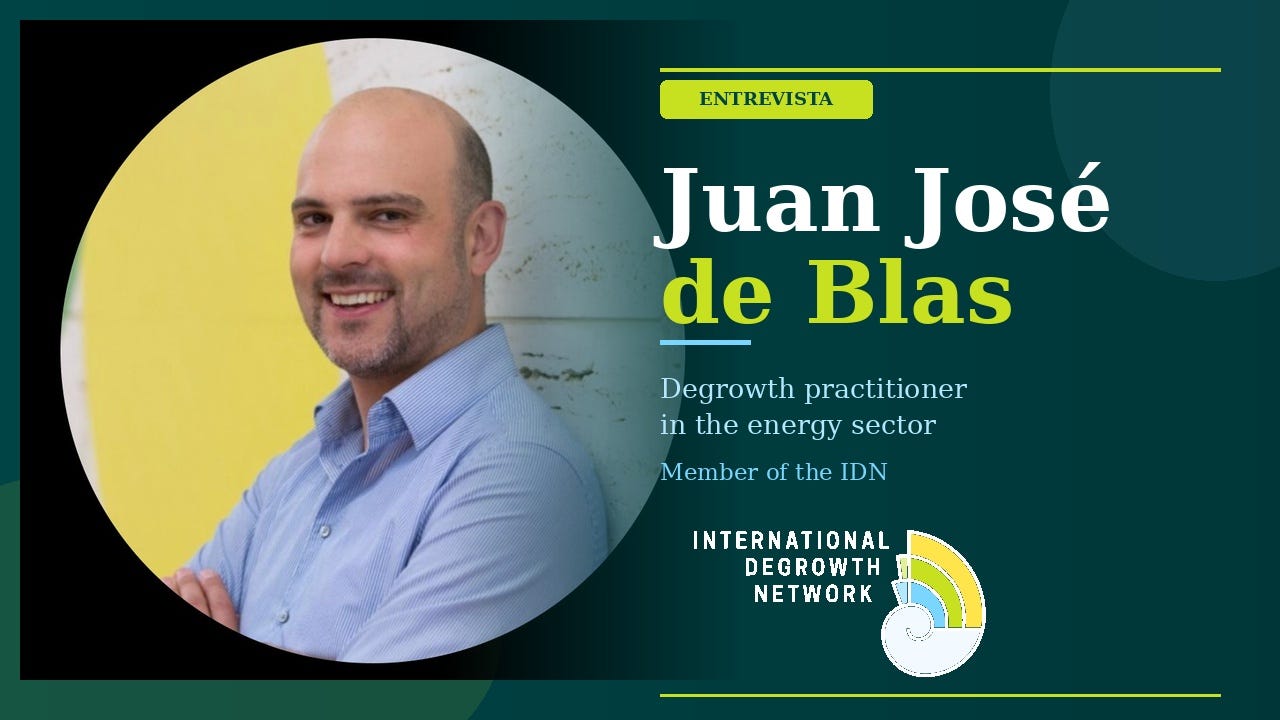
Juanjo lives in Germany and is currently working on making the just energy transition a reality within a major utility company. Originally from Spain, he embraces a grounded, narrative approach to activism, balancing his corporate career with a profound dedication to international sustainability. Through his collaborative efforts within the International Degrowth Network (IDN), he aims to elevate local ecological initiatives to a global scale, ensuring that no worker is left behind in the shift away from fossil fuels.
Alan: Hello, and thanks for joining us. We are very happy to have you in the magazine. To break the ice, could you introduce yourself a little bit? Tell us about your background, how you got involved in the International Degrowth Network (IDN), and what the IDN actually is?
Juanjo: Thanks for the invitation, Alan. I am originally from Spain, but I have been living in Germany for fifteen years now. I currently work for an energy company in a commercial role offering sustainable energy solutions to industrial customers. My company still operates coal and gas assets but [is] heavily working in new solutions future ready towards carbon neutrality in a just transition manner. Fortunately, working conditions in Germany are quite good, which means I have the time in the evenings to dedicate to activism. Like many idealists, I wanted to work toward a better world and have a more substantial impact. I was previously involved in a political party in Spain because, at the time, my German did not feel strong enough for local political activism. However, I was always deeply interested in sustainability, and I quickly saw degrowth as a clear and necessary pillar of our future. While we can transition away from fossil fuels by electrifying society, I feel that without degrowth, we are simply moving the problem from one area to another. The next critical crisis will revolve around the extraction of critical minerals needed for that electrification. I knew I was not naturally gifted at local networking, so I decided to join the International Degrowth Network to help build this movement on a broader scale.
Alan: It is interesting that you have not done a formal academic master’s degree on degrowth. How did you originally get to know about the movement?
Juanjo: It was actually through Hugo Abad. I was participating in another network initiative in Spain at the time, Red Decrecer para Vivir, and I was also still active in the political party Podemos. This new initiative started in Spain, and Hugo was heavily involved. Once, he mentioned that there was this international association holding a meeting and invited whoever wanted to join. Because I have a very international mindset, I joined that very first meeting, and I simply stayed from then on.
Alan: For those who do not know, can you explain what the International Degrowth Network is? Could you share a little bit about the core concept and the specific goals the organization is pursuing?
Juanjo: It is quite interesting because while I have my own personal view, the network truly represents a collective of different perspectives. As the name suggests, it is primarily a network. By definition, degrowth can often consist of highly localized initiatives focused on local supply chains and regional ecological solutions. However, when you only work locally, you might miss the larger view. The IDN adds incredible value by allowing these local communities to network with others who are facing the exact same problems and exchanging effective solutions. Beyond sharing information, some challenges demand a broader perspective. A regional water crisis is one thing, but decarbonizing society requires a massive global effort. Changing municipal or city-level laws is fantastic, but sometimes you need to elevate the fight to a national or international level. This is where an association like the IDN brings that higher-level coordination to grassroots local initiatives.
Alan: How is the network organized? This is especially important for local organizations that may want to connect. How can someone become part of the IDN and contribute to its working groups?
Juanjo: You can easily join in our website. The website is quite intuitive, and you can join either as an individual or as an organizational member. We follow a set of shared principles and operate with a very flat structure organized into circles. There are two types of circles. The first type is geographic; currently, our most active circles are in Europe, America, and Asia. The second type is thematic. Because the degrowth movement remains quite academic, we have many people interested in research. We also have a transformative learning circle for people who are new to degrowth and want to learn how to apply it. The practice circle was one of the first ones I joined because I was eager to put these ideas into real-world action. We also have circles dedicated to communications, facilitative infrastructure, and organizing. Finally, there is a general circle that serves as a forum where coordinators from each specific circle join together to share what they are doing and make common, democratic decisions.
Alan: In order to get in contact with the broader IDN, attending the assembly would be a great option, right? Does this happen online and link up with the international degrowth conferences?
Juanjo: Yes, exactly. When you join via our website, you get access to a platform called Matrix Element. This is where we hold our main daily discussions because, unfortunately, our members are from all around the world, making regular in-person meetings impossible. Sometimes lucky members who live in the same city can organize local meetups, but digital interaction is our primary method. However, we absolutely take advantage of the international degrowth conferences. We typically prepare our global assembly one day before the conference begins, allowing whoever can travel to finally meet in person and build stronger interpersonal bonds.
Alan:Can you highlight one concrete initiative or action that you have been involved with in the IDN so people can grasp the real-world activity happening within the network?
Juanjo: Like many activists, I get involved in a lot of different stories and initiatives. In the IDN, we are actively finding our niche and determining where we add the most value to the broader movement. We see many individuals coming to us because they realize that green growth and the circular economy are not enough; at the end of the day, it is still capitalism, and if a project does not generate profits or reduce costs, it simply is not implemented. The most impactful recent initiative we launched is the Degrowth Events Fund. Last year, we successfully funded around fifteen events with approximately €1,000 each, distributed all around the world, particularly in the Global South. It is incredibly rewarding to see degrowth reaching countries where it was previously absent. After receiving this initial funding, small groups can host an event and subsequently formalize into permanent organizations. For example, after these funded events, groups like the Tokyo Snails emerged in Japan, and other groups formed in Taiwan and Zimbabwe. The group in Zimbabwe even managed to invite their Minister of Environment to their event, achieving an impressively high level of impact. We are running the same initiative again this year, with the application deadline falling on April 19th.
Alan: It is remarkable that despite the Euro-centric origins of degrowth, you have managed to reach countries outside the global core. However, many progressive groups struggle to engage the working class or attract diverse profiles beyond academia. How can we bring in more working-class people who might be entirely depleted of hope?
Juanjo: I totally agree that this is very difficult. I recognize my own privilege here; I have a secure job with good conditions, and because I do not have children to care for, I can dedicate my time after 5:00 PM to activism. I sometimes feel a bit guilty defending the rights of others from this comfortable position. Many working-class individuals have their energy completely depleted by the end of the work day, and after taking care of their families, the last thing they want to do is sit at a computer and organize for an association. A major barrier we face is the lack of a clear, accessible message. If I try to explain degrowth to my parents using terminology like ‘Global South’ or ‘just transition,’ I completely lose them. Working-class people are genuinely interested and want to understand these concepts, but we must explain them in a language they actually use, rather than relying on complicated academic jargon.
Alan: This brings to mind reflections on left-wing alliances in Spain. It has been noted that exhausted working-class people do not want to read complex political theory after work; they prefer to watch entertaining programs that subtly embed austerity propaganda. What are your thoughts on the formats and spaces we are creating for them?
Juanjo: It is a vital reflection. If you are exhausted, you do not want to be lectured about how terrible the world is; you want to hear a message of hope and have fun. We definitely need to utilize the power of culture, art, and humor to share our message. Many people who would never have engaged with political theory were deeply moved and brought into the fold simply through the power of an engaging story and entertaining art. There are some progressive entertainment programs emerging in Spain that provide a good platform, showing that there are joyful, creative ways to change the world.
Alan: Your personal story is fascinating because you maintain a hybrid position, navigating the contradictions of corporate work while engaging in systemic critique. How do you reconcile your activism with your paid work in the fossil fuel industry?
Juanjo: Many people suffer from these exact contradictions. At the beginning of my career, I felt much more guilty about working for an energy company that operates coal and gas assets. However, I now see the intense, practical efforts required to execute a genuine just transition. If you simply close a coal power plant that employs 400 workers and wish them good luck, you destroy that region. Instead, my teams have spent years working out what kinds of sustainable industries we can attract to these regions to guarantee a viable future for those communities. It is undoubtedly easier to maintain ideological purity by working for a purely renewable company, but the hardest part of the transition is ensuring we bring everybody along and leave no one behind. It can be difficult when interacting with colleagues who have worked in coal their entire lives; coal brought significant improvements to society in the past, and they do not always understand why they are suddenly viewed as the bad guys. Sometimes I feel like I am swimming against the current, but I firmly believe that to change the system, we need people pushing for transition from everywhere, even from within the existing structures.
Alan: Regarding unpaid activism, what is your experience? Do you think activism should be professionalized and paid to ensure broader participation?
Juanjo: This has been a very big discussion internally at the IDN. As our network has grown—registering as an NGO in France, setting up a bank account, and registering within the European Union to receive project funding—the need for professionalization has become obvious. Volunteers do incredible work, but their availability is highly volatile. Life happens; volunteers face health issues or family problems and suddenly have to step away. If you want to deliver advanced, professional outcomes, such as effectively coordinating the Degrowth Events Fund, you need to pay people to dedicate their time fully. While some fear that paying a few individuals might demotivate the volunteers, we need to find a balance where paid staff handle specific coordination while volunteers maintain their unique spaces to contribute. A great example is the Research & Degrowth collective in Barcelona. They started as an unfunded collective, but once they secured EU funding, their impact skyrocketed. The depth of their workshops, their political connections, and their integration into municipal decision-making processes all drastically improved once they could operate professionally.
Alan: These are very tough times globally. What gives you hope about the future and keeps you motivated?
Juanjo: I try to be positive, but like many people, the news sometimes leaves me feeling paralyzed. I occasionally question if what we are doing at the IDN is enough given the rapid pace of global deterioration. Ironically, one thing that gives me hope is that the destructive decisions made by right-wing figures like Trump might actually be accelerating the collapse of an unsustainable system, which in turn galvanizes our movement. Furthermore, I am deeply encouraged by the increasing number of people who are realizing that current green capitalism is part of the problem and are looking toward degrowth as the logical solution. Finally, the alarming rise of the extreme right serves as a stark reminder that right now is the absolute most critical moment to defend human rights and international law. If I truly believe in these principles, I have to fight for them, and that clear conviction drives me forward.
Alan: To close, we always try to give a platform to individuals who are not typically in the media landscape. Is there someone specific you would like to platform today?
Juanjo: I initially considered suggesting Rutger Bregman, who wrote the excellent book Moral Ambition, or the activist Yayo Herrero, but they already receive a significant amount of media attention. Instead, I would like to highlight a friend and colleague named Celeste, who is based in Sevilla, Spain. She is a fantastic local activist who is deeply connected to degrowth principles. She organizes local environmental cleanups in her community and is also heavily involved in political activism, fighting for progressive left-wing parties in the regional elections of Andalusia. I highly recommend speaking with her, and I want to thank you, Alan, for the impressive work you are doing with this magazine.
Click the link to watch the video interview:
 | A guest post by
|