
Lessons in resistance from the West Bank

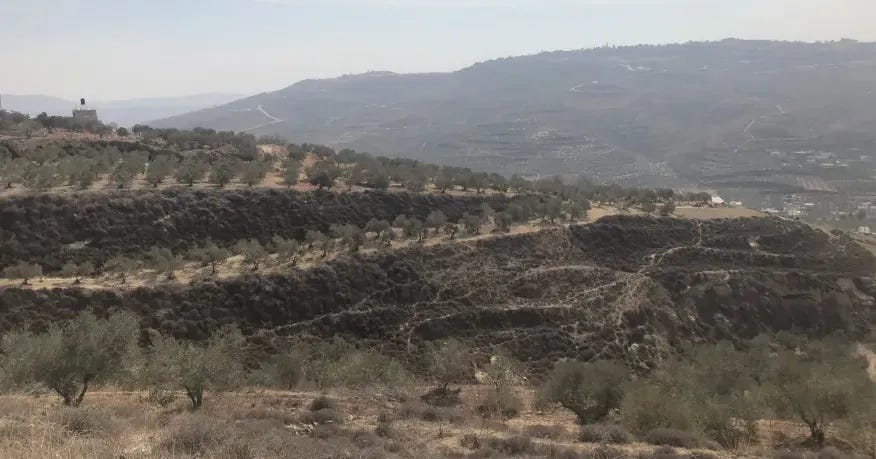
We crowded around the tree, raking our fingers along the stems and hearing the olives thunder onto the tarp below. On the other side of the valley, the soldiers kept firing tear gas, and the canisters were landing closer.
Before long, we retreated with burning throats and sputtering coughs. The farmers grabbed the olives we had collected and put them in the truck as the soldiers and settlers took position at the top of the hill.
They ordered the farmers to go home. The reply-
“This is our home.”
After a short standoff, the soldiers began firing tear gas canisters directly at our bodies and we left the olive groves.
This was my first day volunteering in the West Bank. The benign, pleasant work of harvesting zaytoun in the sunshine contrasted sharply with the violence of soldiers suited up like stormtroopers.
The surreal reality of everyday life for Palestinians living under Israeli occupation had wasted no time in making itself known.
Over half a million dunums (50,000 hectares) of land in the West Bank is planted with olive trees and an estimated 96,510 families rely on olives for the whole or part of their livelihoods.
The season begins with the first September rain and involves the whole community.
Distant relatives are summoned to help, the harvest doubling as a family reunion. Children can be seen picking sticks out of piles of olives next to their mothers and aunties. And the more ambitious take a turn at wielding handheld harvesting machines.
The work is slowed down with frequent breaks for strong coffee and sweet tea, making sure everyone enjoys being out on the land and in each other’s company.
But these days, olive picking is not something everyone is comfortable bringing children along to. Many farmers want to work quickly and are hyper vigilant to any unusual sounds that signal attackers are on the way.
History did not begin on October 7, but it was a turning point for people in the West Bank. One man went so far as to tell us that before that day, “life here was better than life in America”.
Before October 7, Palestinians could seek recourse from the occupying army if they were attacked by settlers, and the offenders were sometimes arrested. Now, settlers carry out their attacks under the protection of soldiers.
And with Gaza and more nearby examples such as Jenin and Tulkarem showing what Israel is willing to do in clear view of the international community, fear is rising.
This year there were 340 documented attacks against farmers during the olive harvest, forming part of the 2,350 attacks across the territory in the month of October alone.
*
Against this backdrop of escalating violence, some Palestinians say that now, more than ever, is the time for mass resistance and risk-taking.
One of these people was our coordinator for the olive harvest, and through him I found answers to a question I’d been thinking over since I arrived:
What, if anything, is the connection of the Palestinian struggle to struggle in my home country?
This is a blatantly self-centred question, but one that is almost inevitable to ask as an international volunteer. We all went knowing that, inshallah, we would soon return home. And I wanted to bring back more than the olive oil and za’ater in my backpack.
I wanted something that could guide me in the coming years as I try to play a part in building a better, more just world.
One of the first things our coordinator said was that we have come to live together as a family, to learn from Palestinians, and for them to learn from us. He said,
“We are under occupation, but you are also under occupation by your governments.”
With this perspective, he diverged from a certain ‘common sense’ understanding. Many Palestinians see Europe as a perfect place and dream of immigrating there.
Understandably, life without the Israeli occupation seems free and blissful. As one man put it, with all the problems he and his community face, he can’t imagine going to another country to help other people with theirs.
He concludes that life in Europe must be so good it leads people to look for problems elsewhere, since there isn’t much to do at home.
There is some truth to this. The pain of Palestine is so great it is sending shockwaves around the world. And the suffering in the besieged enclave of Gaza is more intense and universal than anything we are likely to have seen in Europe.
In short, the ‘common sense’ view says that the only problem Palestine faces is the Israeli occupation. If this was removed, life would return to an ideal state.
Instead our coordinator maintained that-
“We are under three occupations. The Israeli occupation, the Palestinian Authority occupation, and the capitalist occupation.”
For him, all three of these things stand between his people and their land. The Israeli occupation just does it most visibly and aggressively.
While Britons can’t relate to the Israeli occupation, we can relate to living under a government and feeling like it is not serving us. And we can relate to the disenfranchisement of living under capitalism, disconnected from ourselves, our land, and each other.
*
Our problems are not worse than those people face in Palestine, but they are insidious in how difficult they can be to confront.
In the West Bank, the struggle against the occupation is physical. Will you move or stay on the olive groves? Will a family under attack by settlers hold ground or move closer to the village?
In the UK, things are more murky. Physical confrontation is less common in a society that vaunts its freedom, relying on coercion more than violence to keep people acting within narrow limits that serve the interests of the powerful.
The UK is a society built on colonial plunder that keeps a majority of its citizens just slightly too comfortable to protest too much.
But as wealth inequality deepens, draconian anti-protest laws are enacted, and fascists take to the streets in defence of their fading colonial privilege, it seems like power is being forced to show its face more often.
Another thing I learned in the West Bank is that resistance works better when people have something worthy of defending.
Witnessing the connection Palestinians have with their land pointed me towards a certain hole inside of myself– a product of immigration, who grew up on a council estate in an area my family had no significant connection to.
The land, the soil, in providing the conditions for all life, is the start and end of the game of power. And while we are estranged from our land, resisting this or that atrocity will only carry us so far.
 |
|
You raise a very salient point about what ground we stand upon and defend by resistance. Most often in Britain it appears to be an abstract idea that is unconnected with the land but rather tethered to some wooly feelings of entitlement and comfort.
Our disconnection from the land as a nation (apologies to all those who retain this!) is a demonstration of the extent to which we have been absorbed by Capitalism and it's shifting tenets. The story of 'civilisation' that Capitalism spins to make us the heroes of technological advance has drawn us into a virtual world that has captured our agency and substituted it with a dependence rebranded as leisure. Meanwhile, it extracts the energy it requires from us maintaining a facsimile of exchange and maintaining scarcity to encourage us to scramble for the opportunity to be sucked dry.
Resistance is not to be found in punching the fog of illusion that surrounds us but in exiting the system and reconnecting with the reality of growing food for our own consumption, connecting with place and people as the foundation of our lived experience. This may lead to physical confrontation at some point but as least we would be fighting for something worthwhile.