
La democracia colombiana y otras curiosidades/ Colombian democracy and other curiosities
A propósito de las elecciones presidenciales del 31 de mayo

(For english translation see further down)
Puede ser acertado decir, como lo hace un lema reciente de marketing, que Colombia es el “país de la belleza”. Belleza, exuberancia, riqueza de climas, de agua, de vida, de diversidad.
Al tiempo Colombia se ha considerado por momentos un Estado fallido que no logra proteger a sus habitantes de la violencia. Y es que la violencia ha vuelto, a pesar del tratado de paz del 2016 (dirigido a resolver el conflicto armado que tiene lugar desde los años ’60) y sus reconocidos aciertos.
Quiero aquí, con unas cuantas pinceladas, acercarme a la complejidad de ese país “de las soledades” como decía G. García Márquez: un vasto territorio compuesto por zonas y gentes muy diversas, de geografías accidentadas, aisladas o parcamente pobladas.
Algunas particularidades históricas
¿Será que Colombia es un país intrínsecamente violento, como muchos de sus habitantes se preguntan? Bueno, no, la violencia tiene raíces. Más bien se podría decir que se trata de una nación con una brutal historia como “colonia de asentamiento” que nunca curó sus profundas heridas, y que, en conjunto con una complejidad de factores históricos, ha normalizado la violencia. Por ejemplo, la presente tenencia de tierra, una de las más desiguales del mundo, es una continuación del despojo colonial a los habitantes originarios y un factor determinante en la prolongada guerra civil.
La complicada geografía es otro factor a considerar: Históricamente, se formaron ‘archipiélagos de poder’ centrados en la región andina y diferentes zonas perifŕica quedaron abandonadas para beneficio de quien pudiera aprovecharse de ellas, dentro de lógicas colonial/raciales. Hoy, el país, asentado sobre esa estructura, ocupa su lugar como “frontera de extracción “ en el capitalismo globalizado, como he desarrollado en otra parte.
La revolución independentista fue en parte una maniobra de los “criollos” para librarse de las innovaciones que pretendían las reformas borbónicas: Desde España había “una voluntad explícita de desmontar el entramado de redes políticas” que entorpecían el paso a una gobernabilidad moderna (Parecidas al presente “caciquismo” que impregna las “soledades” del golpeado país).
Después de la independencia, los criollos (descendientes de europeos nacidos en América) simplemente suplantaron a los peninsulares, dejando la estructura social colonial intacta. Se entendieron a sí mismos como los únicos capaces de liderar a un país “semi-salvaje” hacia la civilización, en clara distinción de un Otro racializado. Las nociones de ciudadanía que se crearon ignoraron la omnipresente problemática de la raza y del desprecio al Otro, y la nación se forjó en un entramado de relatos hegemónicos propios de la “colonialidad del poder” (A. Quijano).
Esta “carga del hombre blanco” tuvo consecuencias para el modo de entender la democracia: Aquel que difiera de este proyecto de país se ha podido considerar enemigo interno e incluso en ocasiones se ha podido entender como sujeto a ser eliminado.
Espectros políticos
A mi país lo he sentido siempre como habitando a la derecha del espectro político, asentado en una aceptación del status quo. Efectivamente, se dice que en 200 años de vida republicana, Colombia jamás había tenido un gobierno de izquierda, una anomalía que invita a detenernos. Hoy, en tiempos del pensamiento único neoliberal de “no hay alternativa” esto casi parece normal, pero que ésta anomalía ocupe toda la historia republicana de un país, es definitivamente extraño.
Esto es, hasta el gobierno que ahora llega a su fin, el de Gustavo Petro. El filósofo Santiago Castro-Gómez señaló en su momento que el “estallido social” (2021), el preámbulo a la elección de Petro, se dio en parte por a una apertura de los jóvenes hacia el resto del mundo por medio de las redes sociales. Dejaron de leer la realidad según se la presentaba su muy conservador país.
Sí ha habido líderes de izquierda muy importantes que probablemente hubieran sido elegidos si no hubieran sido asesinados, como J.E. Gaitán (en 1948) y L.C. Galán (en 1989). Estos son solo los más salientes de numerosos magnicidios (también los ha habido en la derecha). Además, un partido de izquierda, la Unión Patriótica, fue casi totalmente exterminado, por los cual la Corte Interamericana de Derechos Humanos condenó al Estado en 2023 por violencia sistemática.
Estos hechos dicen mucho sobre lo que ha sido la democracia en Colombia. Todo demócrata, incluso el más conservador, tendría que aceptar que el gobierno de Gustavo Petro constituye un importante quiebre en esta historia de democracia con cojera.
Hoy hay otro espectro importante, un ‘coco’: En muchos ambientes del país suramericano se equipara toda defensa de la izquierda a una apología del “terrorismo”.
El caudillo de derecha, A. Uribe Vélez (presidente 2002-2010), acuñó el término “terroristas” para la guerrilla, activamente suplantando la denominación “guerra” al conflicto armado que azotó al país, opacando las acciones criminales de los otros bandos: (narco-)paramilitares, y militares.
La izquierda (y no la derecha) quedó pertinazmente asociada a la violencia. Curiosamente, y es significativo, la mayoría de los colombianos en general perciben y aseguran que en la guerra interna las guerrillas causaron más muertos que los paramilitares --incluso asegurando que los últimos fueron un ‘mal necesario-- aunque la realidad sea la contraria. Ahí entra una clara injerencia de los medios, del modo en que se narró la guerra y la influencia del uribismo con su modo sui géneris de formar país, con una exacerbación de nacionalismo construído contra un enemigo interno.
Hoy, para las elecciones del 31 de mayo, en la campaña contra la izquierda se aprovecha este rechazo generalizado a las guerrillas (como también se intentó hacer en las pasadas elecciones), por ejemplo con noticias falsas sobre la cercanía de Cepeda, el candidato del partido de Petro, con la guerrilla de las FARC .
Por otra parte, el candidato de la extrema derecha, A. de la Espriella, se posiciona como defensor de “la seguridad”. Éste candidato, el segundo en votos según encuestas, ha dicho de los “señores de la izquierda”: “a esa plaga hay que erradicarla”(!). De nuevo, históricamente otra vez: un llamado al exterminio de la contraparte. Esta horripilante frase ha causado revuelo en el país, pero no el suficiente, pues al mismo tiempo sus seguidores crecen, o sea, consideran aceptable este tipo de llamado al odio y la violencia. De la Espriella es un feroz representante de la alt-right, y hoy la peor pesadilla que enfrenta Colombia, aunque sus votantes no se den cuenta (como los arrepentidos de votar a Trump).
Por otro lado, la patriarcal derecha uribista, hoy a pesar de sí misma coqueteando con ser más inclusiva, con candidata femenina y un candidato a vicepresidente gay, pareciera que se mueve hacia el centro. Allí la ha empujado también el mencionado tumor que brotó a su derecha. En todo caso ambas derechas siembran miedo (”cuatro años más de izquierda arruinará al país”), ese altamente eficiente motor en mover votantes, como ya sucedió cuando los colombianos en ligera mayoría votaron NO al tratado de paz.
El legado de Petro
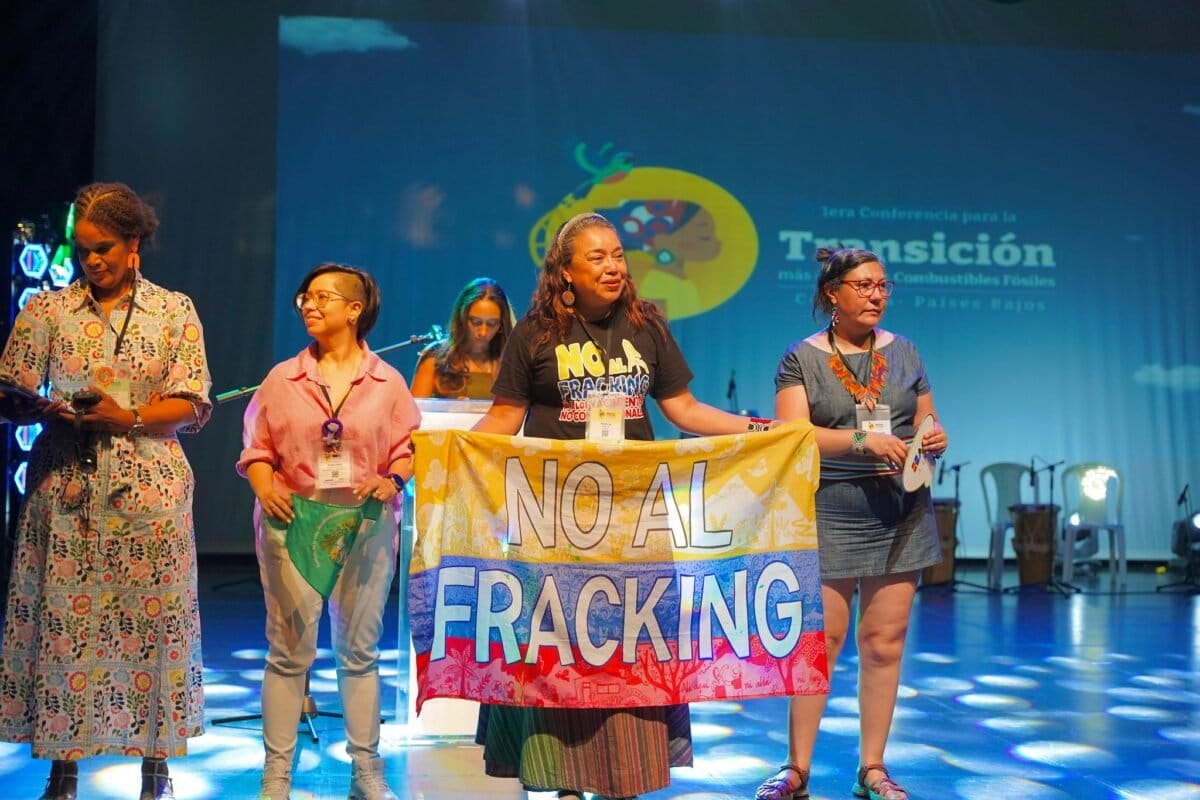
La izquierda muestra hoy una preocupación por continuar con los programas del tratado de paz, trabajar contra la alarmante desigualdad, y un continuismo ambientalista por ejemplo al defender un No al fracking. También, al igual que hace 4 años, la fórmula vicepresidencial de Cepeda es una líder social de una minoria étnica: Aída Quilcué.
Gustavo Petro ha sido un fenómeno de la izquierda latinoamericana pues en lugar de dedicarse al extractivismo, tuvo un importante enfoque ambientalista. Hay que resaltar la dificultad de que un país en solitario se dedique a “hacerle caso a la ciencia” con la amenaza de dejar al país sin medios, sin inversionistas, y con la fuga de los super-ricos. Y en efecto, el intento de mover el país hacia una transición energética ha estado lleno de reveses y críticas.
Las derechas amplían el miedo de que, al poner trabas al aprovechamiento de combustibles fósiles y alejando inversiones extranjeras, el país caerá en la ruina. Lo cual podría ser un problema real sin un cambio profundo en el sistema global de dependencias (Ver aquí sobre problemas de adoptar ideas Decrecentistas en países periféricos). A Petro le tocó actuar en solitario, y así no se puede...
Pero volvamos al tema democracia y acabemos con otro posible legado que deja el presente gobierno: ¿Podría haber hoy más consciencia de que es lícito y saludable (¡y posible!) que sectores de la sociedad tengan intereses y visiones distintas a las tradicionales de la élite, y que pueda haber un diálogo nacional que permita éstas distintas voces e, incluso, que lleguen a gobernar?
Ésta consciencia sería necesaria para ahondar en procesos democráticos y decoloniales. Algo imprescindible para forjar bienestar para todos en una sociedad tan rica en muchos sentidos pero tan apaleada por su pesada carga colonial-moderna.
Colombian democracy and other curiosities
Regarding the presidential elections on May 31
It may be accurate to say, as a recent marketing slogan does, that Colombia is the “country of beauty.” Beauty, exuberance, a wealth of climates, water, life, and diversity.
At the same time, Colombia has at times been considered a failed state that has not protected its inhabitants from violence. And indeed, violence has returned, despite the peace treaty of 2016 (geared at solving the armed conflict starting in the 1960’s) and its recognized successes.
Here, with a few brushstrokes, I wish to zoom into the complexity of this country “of solitudes,” as G. García Márquez put it: a vast territory composed of highly diverse regions and peoples, with rugged, isolated, or sparsely populated landscapes.
Some historical peculiarities
Could it be that Colombia is an intrinsically violent country, as some consider? Well, no, violence has roots. One could say that it is a nation with a brutal history, a “settler colony” that never healed its deep wounds, and which, combined with a complex set of historical factors, has normalized violence. The current distribution of land, one of the most unequal in the world, is a continuation of the colonial dispossession of the indigenous peoples and a key factor in the protracted civil war.
The highly complex geography is also a factor to be considered. Historically, “archipelagos of power” were formed centered on the Andean region, while various peripheral areas were left abandoned for the benefit of whoever could exploit them, in accordance with colonial/racial logics. Today, the country, built upon this structure, occupies its place as an “extraction frontier” within globalized capitalism, as I have discussed elsewhere.
The war of independence was in part a maneuver by the “criollos” (descendants of Europeans born in the Americas) to rid themselves of the innovations sought by the Bourbon reforms. From Spain, there was “an explicit desire to dismantle the web of political networks” that hindered a modern governance. (Like present-day “caciquismo” that pervades the “solitudes” of the battered country).
After independence, the criollos simply supplanted the “peninsulares“ (born in Spain), leaving the colonial social structure intact. They saw themselves as the only ones capable of leading a “semi-savage” country toward civilization, in clear distinction from the racialized Other. The notions of citizenship that were created ignored the issues of race and contempt for the Other. Colombia was thus formed inside a web of colonial/modern hegemonic truths and power relations (the “coloniality of power”, A. Quijano).
This “white man’s burden” had consequences for the way democracy was and is perhaps still understood. Anyone who disagrees with the priorities of the elitist civilizatory vision can be regarded as an internal enemy... and, from some sectors, as someone who should be eliminated.
Political Spectra
I have always perceived my country as residing on the right side of the political spectrum, grounded in an acceptance of the status quo. Indeed, it is said that in 200 years of republican history, Colombia has never had a left-wing government—an anomaly that invites us to pause and reflect. Today, in times of neoliberal monolithic thinking, the idea of “there is no alternative” could almost seem normal, but for this anomaly to span the entire republican history of a country is definitely strange.
That is, until the government now coming to its end—that of Gustavo Petro. An analysis by philosopher Santiago Castro-Gómez noted that the “social upheaval” (2021), during the prelude to Petro’s election, occurred in part due to young people’s openness to the rest of the world through social media. They stopped interpreting reality as it was presented to them by their very conservative country.
There have been very important left-wing leaders who probably would have been elected had they not been assassinated, such as J.E. Gaitán (in 1948) and L.C. Galán (in 1989). These are just the most prominent of numerous magnicides (including some on the right). Furthermore, a left-wing party, the Patriotic Union, was almost completely wiped out, for which the Inter-American Court of Human Rights condemned the state in 2023 for systematic violence.
These realities speak volumes about what democracy has been like in Colombia. Every democrat, even the most conservative, would have to accept that Gustavo Petro’s government represents a significant break with this history of a limping democracy.
Today there is another significant specter, a “bogeyman”: in many circles across the South American country, any defense of the left is equated with an apology for “terrorism.”
The right-wing strongman, A. Uribe Vélez (president 2002–2010), coined the term “terrorists” for the guerrillas, actively replacing the term “war” for the armed conflict that ravaged the country, thereby obscuring the criminal actions of the other sides: (narco-)paramilitaries and the military.
The left (and not the right) became stubbornly associated with violence. Curiously, and significantly, most Colombians generally perceive and assert that in the internal war, the guerrillas caused more deaths than the paramilitaries—even claiming that the latter were a “necessary evil”. But the reality is the opposite. This is where there is clear media interference, in the way the war was narrated and the influence of “Uribism” with its unique way of explaining the country, and exacerbating nationalism built against an internal enemy.
Today, for the May 31 elections, the campaign against the left is capitalizing (as it tried to do in the past elections) on the widespread rejection of the guerrillas, for example with fake news about the closeness of Cepeda, the candidate of Petro’s party, to the FARC guerrillas.
On the other hand, the far-right candidate, A. de la Espriella, positions himself as a defender of “security.” This candidate, who is second in the polls, has said of the “gentlemen of the left”: “that plague must be eradicated.” (!) Once again: a call for the extermination of the opposition to the status quo. The statement is horrifying and has caused some uproar, but not enough, because at the same time his followers are growing—in other words, they consider this kind of incitement to hatred and violence to be acceptable. De la Espriella is a fierce representative of the alt-right, and today Colombia’s worst nightmare—even if his voters don’t realize it (much like those who regret voting for Trump).
On the other hand, the patriarchal, traditional ‘Uribista’ right, which today—despite itself—is flirting with being more inclusive, with a female candidate and a gay vice-presidential candidate, would seem to be moving toward the center. It has also been pushed there by the aforementioned tumor that sprouted to its right. In any case, both right-wing factions sow fear, a highly efficient engine for mobilizing voters, as happened when a slight majority of Colombians voted NO to the peace treaty.
Petro’s Legacy
The left today shows a commitment to continuing the peace treaty’s programs, working against the alarming inequality, and environmental continuity—for example, by advocating a “No” to fracking. Also, just as four years ago, Cepeda’s vice-presidential running mate is a social leader from an ethnic minority: Aída Quilcué (3).
Gustavo Petro has been a phenomenon on the Latin American left because, rather than pursuing extractivism, he adopted a strong environmentalist approach. It is important to highlight the difficulty for a single country to commit to “listening to science” when doing so risks leaving the country without resources, without investors, and facing an exodus of the super-rich. And indeed, the attempt to steer the country toward an energy transition has been fraught with setbacks and criticism.
The fear that by hindering the use of fossil fuels and driving away foreign investment, the country will fall into ruin, is of course amplified by the right. And without a profound change in the economic system and global dependencies, the situation is difficult (as are the challenges of adopting degrowth ideas in peripheral countries). Colombia was left to itself during Petro’s tenure, and that is a non-starter...
But let’s return to the topic of democracy and conclude with another possible legacy left by the current government: Could there be greater awareness today that it is legitimate and healthy, (and possible!), for different sectors of society to have other interests and visions than the traditional elite ones, and actually participate in a national discussion and form governments?
This awareness would be necessary to deepen democratic and decolonial processes. It is essential for forging well-being for all in a society so rich in many ways yet so battered by its heavy colonial-modern burden.
 | A guest post by
|