
Just a shot away?: Degrowth, cliodynamics, and violence in the USA

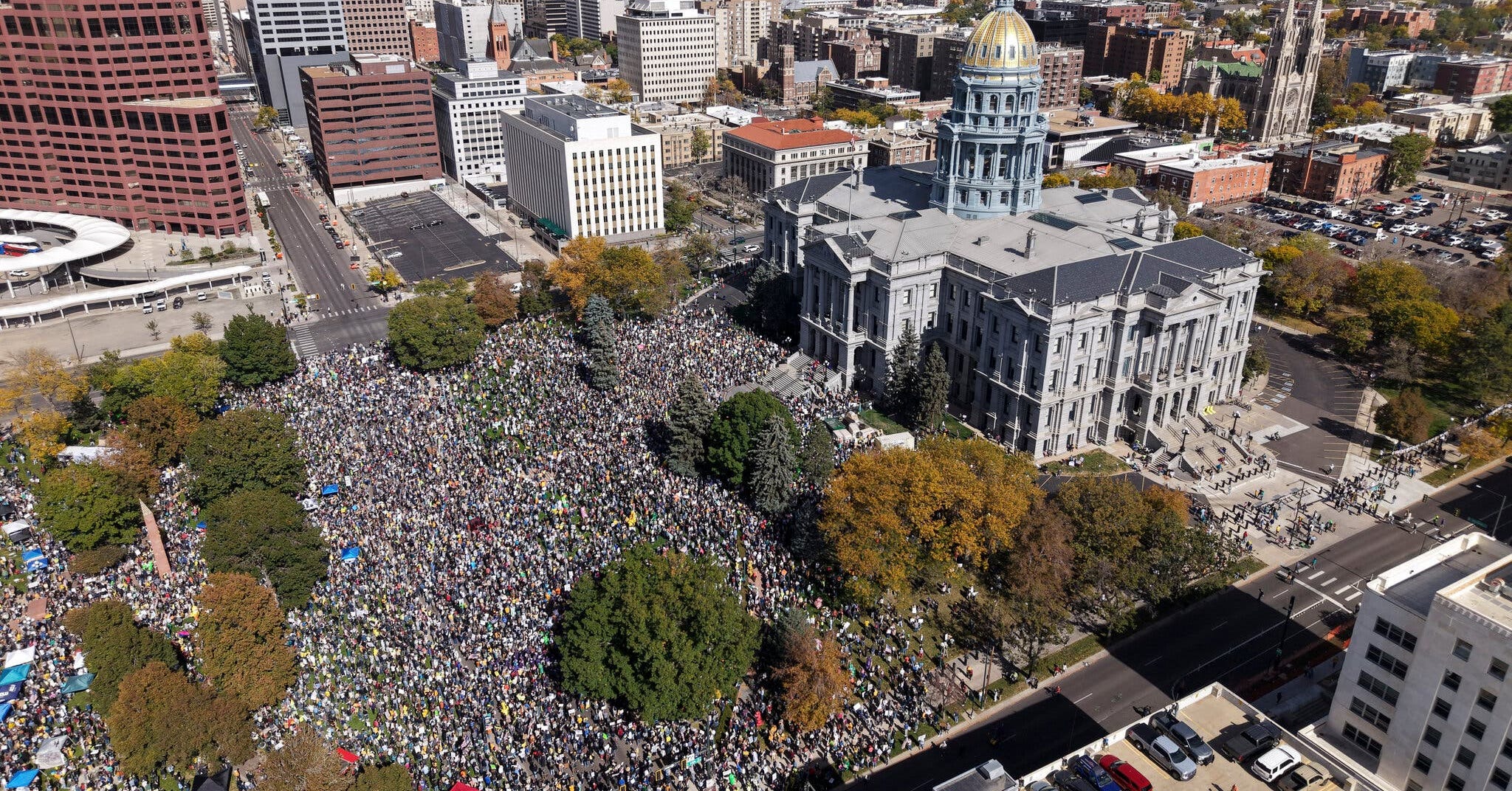
The United States has entered a major social crisis. Violence against public figures has increased since 2020; the government was “shut down” for 45 days; and politics is increasingly polarized. At times it seems that open conflict is “just a shot away.”
On the other hand, at the nationwide October 18 rallies protesting the slide to authoritarianism, numerous large crowds assembled peacefully in what the Associated Press called a “street party vibe.”
Peter Turchin thinks there is definitely a danger of increasing violence. We can’t ignore Turchin; he is paying attention to objective data. He and his colleagues helped to establish the field of cliodynamics (using scientific data to understand history). Students of degrowth (or anyone else interested in social change) could doubtless learn from this analysis even if they don’t completely agree with it.
Some degrowth advocates have already written about cliodynamics. Matt Orsagh has written an excellent review of Turchin’s latest book, End Times, and I also have contributed reviews of Turchin’s previous books Secular Cycles and Ages of Discord.
Social crises
In Turchin’s thinking, societies are often very stable for long periods of time, but then enter unpredictable and often violent social crises. Why? Turchin argues that social instability is driven by structural and demographic factors — specifically, at least these three, all of which can be objectively measured, and all of which are manifesting in the United States right now:
1. Popular well-being. Average workers are not doing that well.
2. The “wealth pump”: the rich get richer and more numerous, the poor stay poor or decline. This leads to “elite overproduction”: there are too many elites and elite aspirants relative to the elite positions available (CEOs of major corporations, Supreme Court Justices, or whatever).
3. The government struggles to fund itself, and its operations are widely viewed as illegitimate.
For cliodynamics, these factors are the makings of a social crisis: a “top-heavy” society (“heavy” with too many elites at the top) in which social instability is the rule rather than the exception. This does not guarantee conflict, but makes conflict more likely.
In Turchin’s data on past social crises, about 80% of societies entering such a structural-demographic crisis only get out of it after major social violence, such as civil war or revolution. But Turchin adds (at about 25:45 of this video) that in the case of the United States, the odds for violence are less, closer to 50%. Over the past 5000 years, the severity of such crises has been declining — societies seem to be getting better at avoiding violence. Still, it would be nice to have better odds than that of the flip of a coin.
Current economic conditions in the USA (low cost of labor, tax policies, etc.) favor the elites, but this results in too many people wanting to become elites — greater than the actual available elite opportunities. (Turchin uses the term “elite” in a sociological sense to refer to those with “social power,” though in the USA this often comes down to money. ) Inevitably, someone will be disappointed, and will be tempted to bend or break the rules to get ahead.
Consider Donald Trump, a failed businessman — who now, as President, targets scientific institutions, universities, and political leaders who displease him. The rich and super-rich are increasing in number and power; but they also can’t agree on a budget, with the government shut down due to disagreements on funding. In the meantime, costs increase and wages for average workers stagnate.
For cliodynamics, instability is typically (but not always!) driven by the elites. Ordinary workers, as a rule, do NOT rise up in revolution. Organizing a successful revolution requires know-how and resources. And who has the resources? The elites. It is more likely that dissident “counter-elites” will take it upon themselves to make use of popular discontent to organize popular action.
Organizing a successful revolution requires resources and organizing skills in order to get people out to rallies, create propaganda, and the like. This does not need to be for selfish reasons; they can be idealistic elites with a social vision. Lenin was a lawyer; Gandhi was a lawyer; and both helped organize people to promote their own versions of social change. Ordinary workers do play a role in social unrest, but they represent “mobilization potential” — unhappy people who could be persuaded to take action. Typically the origin of unrest comes from these disappointed “elite aspirants.”
In 2010, Turchin wrote a letter published in Nature warning about the possibility of increasing political instability in the United States. This letter now seems marvelously prescient — it was written during President Obama’s FIRST term as President. “MAGA” didn’t exist, and there was scarcely a glimmer of any of the chaos that we now see.
Why is this a problem?
So what’s wrong with a little instability? Doesn’t this make social change or revolution more likely? Certainly we need to be rethinking the basic assumptions of our culture. But while there is some (limited!) awareness of social injustice in the United States, there is approximately zero consciousness of limits to growth. Climate activists tend to paint a rosy picture of an “energy transition” to renewable energy that will enable us to do everything we’re doing now — only it will all be wonderfully “renewable.”
Our problems with climate change, resource depletion, and the environment are already extraordinarily difficult. Most Americans have only the dimmest glimmer of how serious they are or the level of social effort required to address them. These problems require careful analysis and public education.
Violence will not help careful analysis and public education. It will leave a lot of people unhappy and resentful. The violence of the American Civil War of 1861-1865 killed hundreds of thousands of people. Even though it formally ended slavery, it made the South resentful, the North forgetful, and delayed even the semblance of racial or political equality for a century. We do not need another such civil war.
What should we do?
The American structural crisis represents both opportunity and danger. Opportunity, because the time for major social changes may be at hand. But there’s also danger, because violence will make these changes much harder to achieve.
This definitely requires overthrowing capitalism, but, as Jean-Baptiste Fressoz points out, it’s likely that “getting out of carbon will be far more difficult than getting out of capitalism” (More and More and More, p. 8). We have a lot of work to do.
However, the immediate task is to shut down the “wealth pump” that’s making the elites ever richer. Do something like what Franklin Roosevelt did in the 1930s: a steep progressive income tax, strengthened labor unions, and strengthened social services (like Social Security). This actually worked well for nearly fifty years. If we can do this nonviolently, we have a good chance of establishing a framework for a discussion of our environmental crisis, without getting constantly interrupted by misinformed and powerful billionaires insisting that we need economic growth.
We may be “just a shot away” from open conflict, but there is also a good chance to create the framework for achieving both social justice and environmental sanity.
 | A guest post by
|
Thanks so much for this important article. I'd add that another immediate task (i.e. whenever non-fascists can get back in political power) is to restructure our laws to protect democratic institutions: ex. overturn Citizens United, introduce proportional representation and/or ranked-choice voting, mandate term limits for Supreme Court Justices, rewrite anti-trust laws to be much more sweeping, etc.