
From GDP to what? The call to change how countries measure wellbeing

Almost 20 years ago a few small countries on opposite sides of the world made history by formally prioritizing wellbeing in their national governments. One of the most notable examples was Bhutan; they became known world-wide as the first country to include Gross National Happiness (GNH) in their constitution. Bhutan has become a world leader by moving away from Gross Domestic Product (GDP) as the primary measure of development and wellbeing. Although, Bhutan has not stopped using GDP, they have included GNH as a holistic complement that is taken into consideration in government decision-making. GNH is a composition of 33 indicators that assess people’s health, education, cultural diversity, and ecological resilience, among many other things, which go beyond subjective measures of happiness. By paying attention to wellbeing, Bhutan has seen their GNH rise; between 2010 to 2022 Bhutan reported over a 7% increase in the percentage of “happy people”.
Around the same time that Bhutan enshrined GNH into their constitution, Ecuador and Bolivia also prioritized wellbeing by incorporating Buen Vivir in their constitutions. Buen Vivir is an Indigenous cultural philosophy that emerged in Ecuador and Bolivia in the early 2000s. Buen Vivir brings humans in relation with the natural world by emphasizing physical and spiritual connections. In 2008, Ecuador enshrined Buen Vivir in their constitution, having it appear 25 times in multiple sections, including giving rights to Buen Vivir and nature. One year later Bolivia enshrined Buen Vivir in their constitution as a guiding principle for their national government. Although both countries have not stopped using GDP as a measure of economic progress, they have changed how policy-decisions and national development occur in their borders as a result of incorporating Buen Vivir.
A few years later, Bhutan called on other countries around the world to move beyond GDP. Sixty-eight United Nations (UN) member states supported this resolution, yet tracking percentage increases in GDP remains the standard for measuring progress.
In May 2023, the Secretary General of the UN produced a policy brief, calling on member states to move beyond GDP. The brief aimed to build upon the long-standing ask of replacing GDP with alternative metrics. It specifically called for greater use of the UN Sustainable Development Goals (SDGs) as an alternative to GDP. Yet even though the SDGs have become known world-wide, questions remain if it is the framework that countries should use to broaden away from GDP. The SDGs are fraught with limitations, because they do not provide robust and specific enough metrics for countries to follow. For instance, countries have been known to cherry-pick the goals they adhere to since the goals a country pursues is not regulated. It becomes a step further than greenwashing – rainbow washing – because countries maintain little progress while plastering the brightly coloured boxes everywhere for people to see.
Since these calls at the global level to prioritize wellbeing and move away from GDP, it still remains to be determined what framework and metrics countries should use. Two countries that are often noted as making progress are Canada and New Zealand.
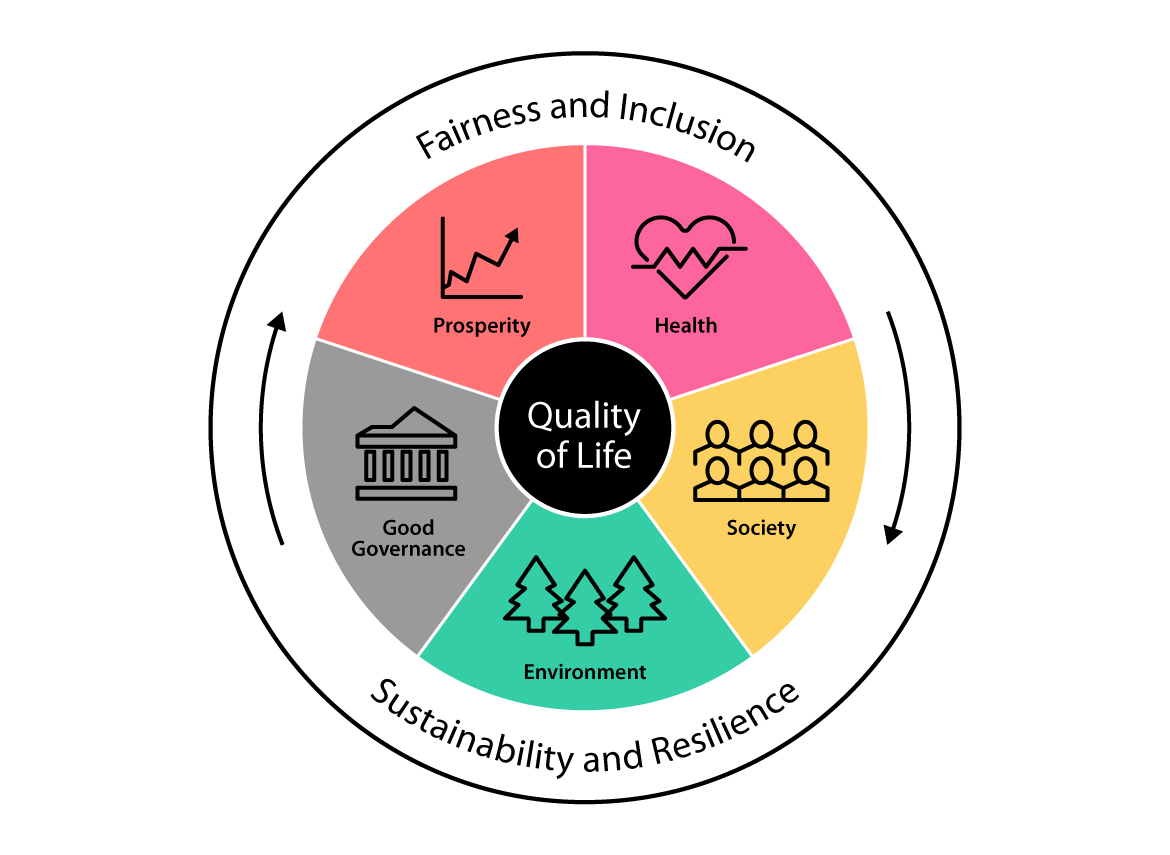
Canada is attempting to implement a wellbeing framework to shift how progress is measured. In 2021, the Department of Finance in the Government of Canada published “Measuring what Matters: Toward a Quality of Life Strategy for Canada” that aims to measure and track quality of life among Canadians to broaden, but not replace, the use of GDP. Unlike some other national approaches, this one is data driven so there is evidence to support government decision-making. Since the establishment of this framework, Statistics Canada, the national statistical agency, has created a Quality-of-Life data hub that tracks progress on 91 indicators split into five domains of prosperity, health, good governance, environment, and society (Image 1). This data can be disaggregated by geography (provincial and municipal levels), and by demographic characteristics (gender, age, etc.). Yet it is unclear whether this empirically grounded framework has influenced policies and government decision-making to move beyond GDP. This might not be the case. For instance, in the most recent Federal Budget released in November 2025 by the Liberal Party run by Prime Minister Mark Carney, GDP was mentioned 189 times while the Quality-of-Life Framework was mentioned only once. The evidence that Canada is adopting a broader perspective on assessing national progress remains to be seen.
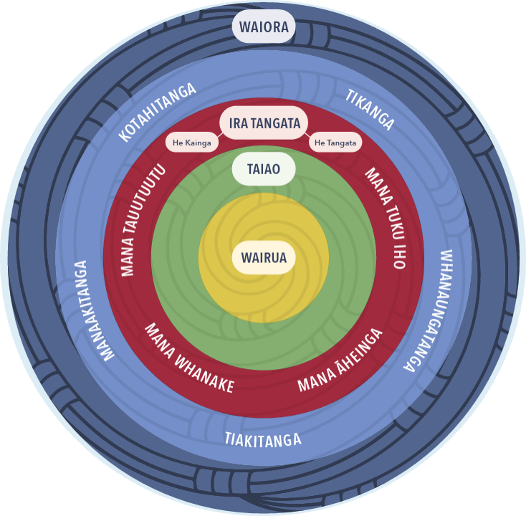
New Zealand is often noted as another country attempting to reduce the influence of GDP. In New Zealand, The Treasury - Te Tai Ōhanga, a central government department advising on economic and financial policy, has adopted a wellbeing framework. The framework, He Ara Waiora, emphasizes Māori approaches to a holistic and intergenerational conception of wellbeing. The framework encapsulates human wellbeing that is grounded in water (wai) as a source of life (ora). The Treasury - Te Tai Ōhanga believes that the Mātauranga Māori approach applies to all people across New Zealand. Somewhat similar to the Buen Vivir approaches in Ecuador and Bolivia, this framework includes a spiritual element in addition to a human and environmental domain (Image 2). Wairua, the spirit domain, is positioned at the centre to reflect beliefs and values. Te Taiao, the environmental domain, surrounds the spirit, since environmental wellbeing is inherently connected to human wellbeing. The third, outer domain, Te Ira Tangata, reflects human intergenerational relationships. During the early stages, The Treasury - Te Tai Ōhanga produced guidelines for implementing He Ara Waiora into the policy cycle, including the design of application tools.
Then an amendment was made to the New Zealand Public Finance Act that requires a wellbeing report to be produced at least once every four years. So far, New Zealand has only produced one such report, published in November 2022. New Zealand also created a Living Standards Framework data dashboard highlighting individual and collective wellbeing. The data dashboard covers 12 domains including cultural belonging, health, subjective wellbeing, with multiple indicators within each domain that can be disaggregated by demographic characteristics (e.g. age and gender). Although New Zealand has not adopted a specific measure into their constitution, they have created a robust framework that embeds Indigenous concepts and knowledge, provides policy guidance, and is data driven.
When the Russian-American economist, Simon Kuznets, invented GDP he warned that it was a deeply flawed metric. It cannot assess economic and social wellbeing alone because it excludes many aspects, such as environmental and social costs, unpaid labour, and more. If this tells us anything, it is that one metric alone is not sufficient to assess economic and social wellbeing. Yet GDP remains the most widely used metric to assess economic health and make assumptions about human wellbeing by countries, regions, and cities. Countries must move away from using a single metric to make policy and governance decisions. Instead, they must follow in the footsteps of these other countries to enshrine measures beyond GDP in their constitutions, work with Indigenous communities to embed Indigenous philosophies in national wellbeing frameworks, and provide empirical evidence to guide policy implementation.
 | A guest post by
|
Succinct and comprehensible as economics can be a minefield. Nice to know some countries are getting it! Considering the immoral and amoral carbon footprint of the wealthy and their continued obnoxious power, I think well-being is much more important for all of us and our sustainable futures than riches. Good piece; thank you.