


Donatella Gasparro is a PhD researcher in political ecology at the Scuola Normale Superiore and for the project “REAL – A post-growth deal” at the Autonomous University of Barcelona. Her research centers on non-monetized economies of self-provisioning and social arrangements of reciprocity as they persist in remote rural areas of Southern Italy. She researches, teaches and communicates to broader audiences themes at the intersection of degrowth, feminist economics, political ecology and critical agrarian studies. https://linktr.ee/donatellagasparro
Gisela Ruiseco (G.R.): Our present global food systems are highly destructive and are dominant drivers of the transgression of several of the planetary boundaries. There is some general awareness concerning this problem (especially the necessity to consume less meat). However, one is frequently confronted with the idea that there is no alternative, as ’there are too many of us’ who have to be fed. Global industrial agriculture is taken as inevitable.
Could you briefly expand on the possibilities of agriculture for societal transformation?
Donatella Gasparro (D.G.): ‘Feed the world’ narratives clog mainstream institutional and academic discourses, yet they have been long debunked by several critical scholars and movement activists. We already produce, globally, more than enough to ‘feed’ everybody, while millions are still undernourished and we waste more than 30% of food along the supply chain. And while 65% of global farmland is controlled by 1% of farmers in huge land estates, small-holders still feed at least 30% of the world - and I believe these to be conservative estimates, as much food self-provisioning is completely invisible to official statistics.
In brief, agricultural modernisation, globalisation and industrialisation have so far been not only one of the main causes of climate and ecological collapse, but also a grandiose failure at ‘feeding the world’. The only thing they have achieved successfully, is what they were made for: profit and accumulation for the few. It is not by chance that critical agrarian scholars talk about our contemporary food system as characterised by a corporate food regime - the total domination of transnational corporations at all stages of food production and distribution.
When we talk about agri-food systems we are usually talking about food production and distribution as they are fully embedded in the capitalist, growth- and profit-driven economic system we live in. Yet it is important to note that it is not agri-food systems per se that have catastrophic environmental impacts: it is capitalist agri-food systems. We must look for the root causes and re-embed discourses and strategies around food and agriculture into fighting the broader political-economic context in which they unfold.
It is thus high time to let go of the ‘feeding the world’ patronising language and start looking at agriculture and the agri-food system not as something that ‘has environmental impact’, but as a collective process of ‘environment-making’ (see Taylor, 2023) and co-production of people with nature (see van der Ploeg). For several decades, peasant movements all over the globe have tried to shift the discourse from ‘food security’ – a binome that goes hand in hand with ‘feeding the world’ - to ‘food sovereignty’. The latter stands as a radical attempt to politicise agri-food systems and to talk about agricultural sustainability from the social and political perspective, centering people and territories’ self-determination and social justice, rather than technological fixes that lubricate the gears of the extractive and exploitative status-quo.
At the same time, as transnational peasant movements have long argued, agriculture and peasant economies sit at an essential point of the political-economic system: the point of socio-ecological reproduction – that is, the act of keeping humans and non-humans alive and thriving. Agriculture, land and food provisioning then play a pivotal role in reshaping social metabolic relations and in starting to build a world beyond capitalism.
G.R.: What brought you to engage personally with these issues? Could you tell us more about your experiences with other modes of agriculture in Italy?
D.G.: My interest in agri-food and rural matters has deep roots in peasant family histories, and I actually first looked for answers in studying agronomy. But after the predictable disappointment with conventional agriculture education, I moved towards agroecology & sustainable food systems, and specialised in agroforestry systems design. Guess what? I was still dissatisfied: planting trees in successional, stratified agroforestry systems that resembled natural forests as much as possible turned out not to be enough to change our profoundly destructive political economy. That’s how I ended up studying and researching political ecology and degrowth, to then return to rural and agrarian matters through the lens of critical agrarian studies.
In my research I loop back somewhat to the origins of this story, and wonder what the transformative potential of persisting elements of peasant economies is within the peripheries of the Global North, and Southern Italy specifically. I look at non-monetised pockets of self-provisioning and self-sufficiency that are geared around social reciprocity and a specific kind of care for the land. With my collaboration with the REAL project, we’re looking at territories like these ones that could be read as “real-existing degrowth”: places where we can glimpse modes of living that resist growth and/or live well without it, in the here and now, despite being themselves ridden with the inevitable contradictions of living under the capitalist world order.
G.R.: Agriculture has not been a central theme in the Degrowth movement, despite its weight in the global economy and in the polycrisis. How do you see the intersection of agroecology with the degrowth movement? Many times taken on the local level in the Global North (like in consumer cooperatives, eco-villages, etc.), how could it live up to its significance in combating global injustices?
D.G.: Degrowth has a long and diversified history, part of which has deep roots in communalist and localist sources that have definitely engaged much with rural, small-scale agroecological alternatives - which nonetheless often remained rather escapist and failed at tackling a broader political-economic transition away from capitalism.
More recent developments in degrowth thinking have instead rightly recast degrowth as a lens for critiquing and redesigning the whole economy, and as an element in a larger ecosocialist struggle. Simultaneously, the ‘urban’ has steadily taken centre stage as the place, both politically and materially, where struggle and utopia have been envisioned. The unfortunate result of these tendencies is that the agrarian side of the spatial spectrum and of material production has largely been neglected.
As I’ve argued elsewhere, degrowth has tended recently to relegate food and agriculture in the Global North to urban gardens, food coops, and other small-scale initiatives – which are surely important, but are not enough if we rethink degrowth as an ecosocialist, collective endeavour of political-economic significance. And while we have sharpened our analytical tools that critique unbridled urbanisation as a pivotal node of resource concentration and unsustainability, a going “back to the land” cannot remain an individualist, heroic and at times elitist, endeavour.
We urgently need to re-insert the countryside into collective visions of degrowth futures in which our very economic and metabolic relations are deeply transformed. Degrowth scholarship has been doing very important work on non-reformist reforms for Europe, for instance, but has so far largely omitted the agrarian side of these reforms, while the European Common Agricultural Policy remains a deeply problematic subsidy scheme that urgently needs a post-growth reorientation.
Much can be learnt for degrowth transitions from what happens in the rural world, and it is high time to contrappose the corporate pushes for land grabs, land financialisation, and agricultural digitalisation with a thorough revitalisation and expansion of rural commons and of collective ways to use land and agricultural tools. And this effort cannot remain isolated from institutions; if the ‘public’ has been key in the privatisation and commodification of everything, public institutions can also play a pivotal role in putting the food system (and the whole economy) back in common, and some thought experiments have started sprouting with the idea of public-common partnerships, for example.
The people interested in recasting rurality and agrarian worlds into collective degrowth futures are many, and we’re starting to create dispersed scholar-activist communities that think about agrarian transitions multiscalarly and systemically. I have just started teaching the Degrowth Rural Futures online course, and the incredible group of international participants is already giving me much hope for future emancipatory countrysides.
G.R.: You have spoken here of an important concept which brings neglected realities into awareness: ‘the corporate food regime’. You also mention (further up) the “deeply problematic” European Common Agricultural Policy with its subsidy scheme. We have here two monsters working in synergy. How do you see the difficulties arising from dealing with European policies which favor industrial agriculture, favor corporate interests, but also favor industrial farmers in Europe generally, being a source for abyssal global injustices and inequality? In your work, have you seen possibilities of how European farmers could align with Global South struggles for food sovereignty ?
D.G.: As I mentioned earlier, capitalist, corporate agri-food systems display all the characteristics and intersecting oppressions of all other economic sectors under capitalism – thus also the colonial dimension of the imperial capitalist world order is reflected in them. Europe has historically been particularly prone to ‘exporting’ its problems to the majority world – and many of these ‘exports’ have a strong agrarian, land and environmental dimension. With structural adjustments of the neoliberalising pushes of the last century, entire Global South agrarian economies were wrecked to be transformed into cheap staples production sources for the global supply chains and for the Global North, and these are processes that continue today. Among the many critiques to the Eurocentric and class-blind “Anthropocene” concept, the “Plantationocene” is the one that centers these processes, for instance. But colonial oppression in the agri-food supply chain manifests also within Europe, with the vast majority of agricultural labourers being migrants, in illegalised, precarious and exploitative conditions.
There are a few elements then to keep in mind here. First, industrial agriculture in Europe is not much different from any other industry: it is geared around profit, growth, and competition; treats land as any other factory component; and exploits soil and people to squeeze as much surplus value as possible out of them, shifting the problems - as per usual in capitalism - to the most marginalised groups, far-away lands, or future generations. Second, not all European agriculture looks this terrible: in many European countries, it is still small to medium farms that dominate in numbers, but they struggle, because under capitalism, the rule is always the same: go big or go home; grow or perish. Third, much policy-making and many representative democratic institutions are completely blind and impermeable—by design—to those who actually work the land: illegalized, racialised migrant workers with no citizenship or unionising rights. Fourth, for as much as some far-right ministries are co-opting even food sovereignty, Europe is not quite food sovereign: we are fully embedded in the global food supply chains and depend on imports from many peripheries and semi-peripheries of the capitalist world-system.
What does this all mean? That agrarian struggles in the South are linked with agrarian struggles in the North. It means that it is more urgent than ever to redesign agri-food systems in Europe around principles of sufficiency, people’s sovereignty (as in: self-determination), and redistribution also because we urgently need to liberate the South from neocolonial oppression. Scholars such as Max Ajl have long argued for the urgency of a radical agrarian reform that is simultaneous in both North and South. And European examples of migrant workers’ organising along the food supply chain (like the Andalusian Workers’ Union or the Italian FuoroMercato) are tangible instances of the work that is already being done on the ground.
G.R.: Thank you Donatella
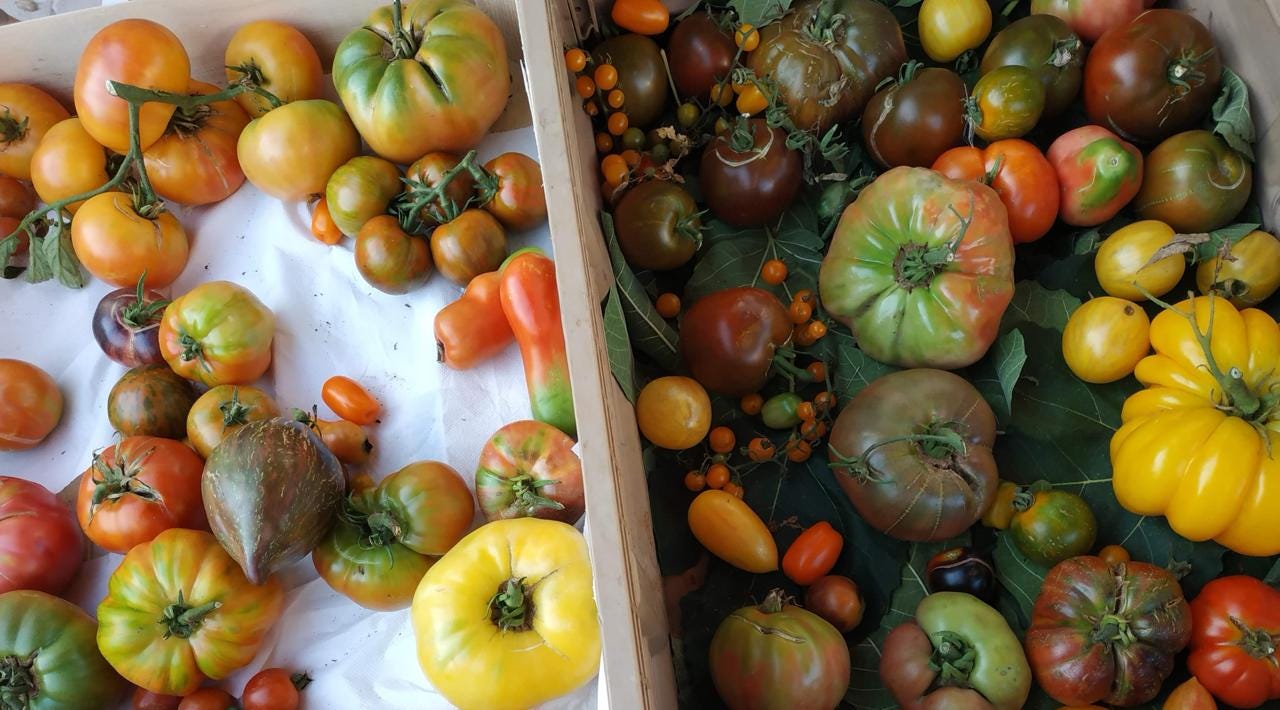
Photo from D. Gasparro: Farmer’s market META - Mercato della Terra e delle Arti in Apulia, Italy.


Congrats to both, great interview that tackle the need for a post capitalist approach to food systems.
Donatello’s research is vital and there is no doubt that either through gradual adoption or (more likely) through supply shocks food sovereignty will rise up the agenda for all states. The problem will be the response which, with current regimes, is likely to be capitalist in nature.
It will in my view be essential to bypass the state and that local cooperatives are formed well ahead of time and local distribution networks set up to counter the impact of failing global supply chains.
Agrarian economies will grow in importance as the luxury market collapses and it is a toss up as to whether this or AI will force labour back to the land. Perhaps both.
One potential benefit of some form of collapse could be the unavailability of agri-chemicals which leaves only regenerative systems as a viable alternative.
There are, of course, a plethora of possibilities as to how change will occur but this work is urgent and needs to be effected at all levels even if regime change appears unlikely!