
Engineered as Dependent Entities from the Outset
Arab Regimes: Colonial Formation and Functional Roles within the Imperial Order — Part 2

This article constitutes the second part of a three-part series. After exposing the true face of the Arab regimes during the Gaza genocide in the first part of this series, it became clear that these regimes are neither incapacitated nor acting in error. Rather, they perform a systematic function. But how did these regimes arise? How was the functional structure formed that makes them instruments of annihilation and vehicles of dependency? In this second part, we move from the contemporary scene to historical roots, highlighting the emergence of Arab regimes after colonialism and demonstrating how they were designed from the outset as dependent entities that protect the interests of ruling elites and imperial alliances rather than serving as tools of national liberation.
Egypt after Camp David
Modern Egypt, shaped by the 1952 revolution, was initially part of a broader national liberation project against British colonialism, with Palestine as a structural component of that project. The 1967 Six-Day War also known as Al-Naksa marked the decline of the Arab nationalist movement, a structural rupture in the legitimacy of liberation politics and the beginning of Arab regime dependency, while consolidating the strategic alliance between the United States and ‘Israel’, integrating the zionist entity as a militarily dominant regional power. The war resulted in the zionist entity occupying new significant territory, yet it gave birth to Palestinian resistance movements; the Fedayeen.
The decisive shift occurred with Camp David Accords, which led to the normalization of diplomatic relations between Egypt and the zionist entity in 1979. It redefined the function of the Egyptian state; Egypt was removed from the Arab resistance equation against Israeli occupation, and the regime was redirected from a national liberation project to a functional, dependent role within the Western imperial sphere. Following Camp David, the Egyptian army was strategically neutralized, and the logic of permanent “security coordination” with the zionist entity was entrenched, thereby making Egypt part of the blockade system imposed on Gaza. Thus, political confrontation with the occupation was replaced by the role of mediator, reinforcing occupation and siege rather than dismantling them.
Egypt’s transformation was not the result of weakness but of its reconstruction as a boundary state within the regional order: from a central state in a national liberation project to a functional entity guarding borders and controlling the southern front for the occupation.
Jordan as a Buffer State
The establishment of the Emirate of Transjordan occurred amid the collapse of the Ottoman state in 1920 and the redrawing of the Arab Levant under British and French colonial hegemony. At the Cairo Conference in 1921, Britain decided to establish a political entity in Transjordan under a British mandate. This would be governed indirectly, with sovereignty administered externally and authority exercised internally by local elites connected to the colonial centre.
Jordan did not emerge from a national liberation movement or an independent sovereignty project; it was formed from inception as a functional entity, a colonial decision intended to manage the political-geographical void surrounding Palestine. It served as a security buffer, providing strategic depth for the zionist entity and preventing the West Bank from becoming a military or popular resistance base. Simultaneously, it functioned as a separation zone, isolating Iraq and Syria on one side and Palestine and the Arabian Peninsula on the other, preventing the formation of a revolutionary sphere of unification. It also served as a strategic conduit for Western influence, securing transportation, energy lines, and military intervention routes.
After 1948, and especially after 1967, Jordan’s role included containing the Palestinian liberation movement within its borders to prevent the reopening of the liberation front from the East. Since Black September in 1970, the state’s function has been clear: prevent resistance within Jordan and turn Palestine into an external security file. The Wadi Araba normalization agreement cemented this role, making Jordan both a mediator and a buffer. Jordan functions as a control state, converting its security apparatus from national protection to tools for safeguarding the interests of the zionist occupation and the ruling bourgeoisie.
Gulf Protectorates
With the decline of the Ottoman state, Britain, through political and military agreements, imposed British hegemony over the region, a structure later inherited in part by the United States after World War II and reinforced through the regional role of the Zionist entity after its establishment. With the discovery of oil, these Gulf entities became a central node in the global system, forming rentier states with wealth concentrated in ruling families and comprador bourgeoisies tied to global markets.
Oil did not become a foundation for organized popular power, nor a tool for liberation; it was a mechanism integrating the Gulf more deeply into Western hegemony and maintaining their security dependencies to the West. This enabled the West, led by the Anglo-American alliance, to maintain lucrative arms sales to the oil-rich Gulf states, as well as political and military control over them. The zionist entity is viewed as a partner whose interests must be secured in this region.
After the Arab popular uprisings of 2011, the Gulf-Western alliance deepened its normalisation with the zionist entity, and the regimes redefined every resistance movement against it as a national security threat.
Saudi Arabia and Managed Chaos
The Saudi regime avoids direct confrontation or rupture of relations with the Israeli occupation or imperial powers. It treats the Palestinian cause as part of a broader negotiating policy tied to regional and international interests, not as a popular liberation cause. It balances regional interests while maintaining its position without direct confrontation with major powers. Simultaneously, Saudi Arabia has played a central role in “creative chaos” in the region, using political, media, and financial instruments to reshape balances in neighboring states such as Yemen, Syria, Lebanon, and Egypt, producing forms of externally manageable instability that serve a rentier regional system allied with the West, led by Washington, and with ‘Israel’ playing a central role.
Regionally, the Saudi regime has participated in containing any resistance axis, transforming the struggle from a liberation struggle against the Israeli occupation into intra-Arab disputes. Its official political discourse and media have redefined the enemy: instead of ‘Israel’ being the primary adversary, resistance movements are portrayed as “terrorist militias”. The regime thus acts not as a confrontational force but as a manager of chaos: exposing internal contradictions, redirecting the struggle, and demonizing every resistance movement, within a broader function of protecting a US-dominated regional order and Israeli security, while preventing any emancipatory dynamics that might threaten it.
Qatar as a Mediator under the US Umbrella
The Qatari regime provides humanitarian and political support, presenting itself as a provider of humanitarian assistance, while simultaneously mediating regional files. Its mediation operates strictly under American oversight and never exceeds the limits permitted by Washington. This occurs within a broader function: protecting ‘Israel’s’ security, the organic instrument of Western imperial interests. Any Qatari action, however humanitarian or political, is therefore governed by this function, managing the Palestinian struggle in a way that ensures “stability” in a structure reliant on US-Israeli military and political predominance.
UAE as a Model of Full Normalization
The UAE went far beyond limited diplomatic relations with the zionist entity, achieving full normalization through the Abraham Accords (2020), encompassing tourism, economic and technological cooperation, and opening joint channels for security and intelligence cooperation. In security terms, it partnered with the Israeli occupation forces in intelligence, military, and cyber surveillance, making it a direct ally in managing regional struggles, foremost among them Gaza. The UAE exemplifies how Arab regimes perform US-Israeli protective functions: managing balances, leveraging influence, and ensuring stability of the zionist entity at the expense of any Palestinian resistance project.
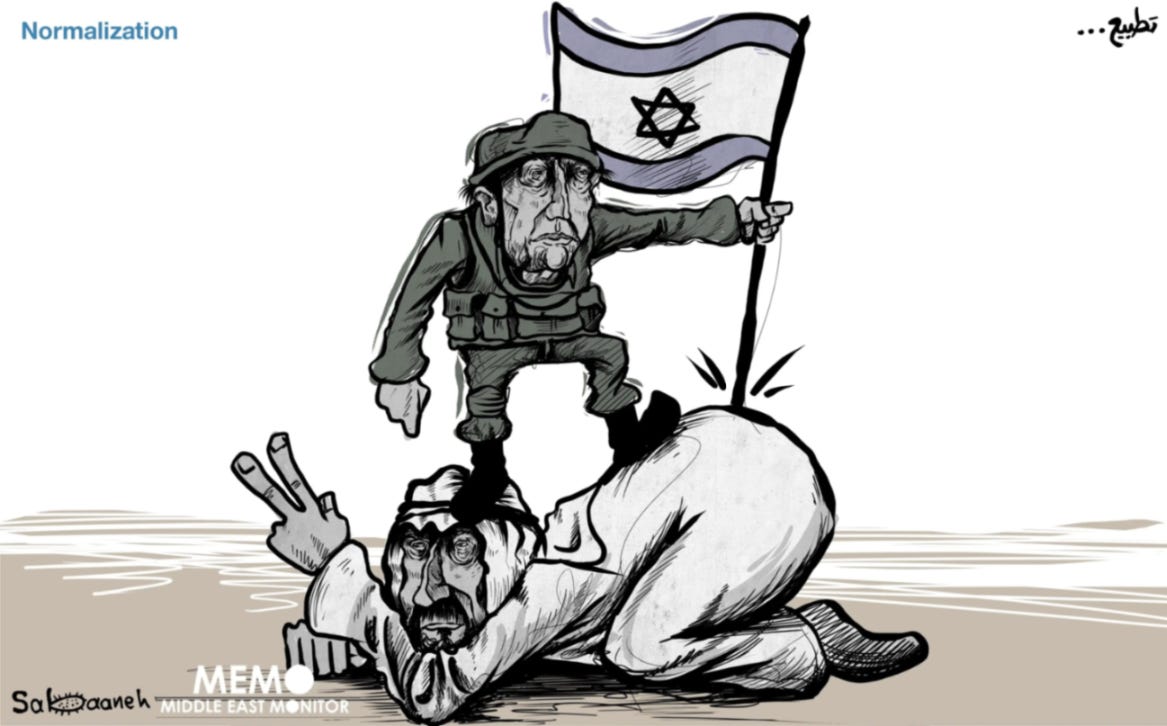
In conclusion, the idea of “purchasing security” that Gulf regimes believe they have secured is steadily unraveling. This assumption rests on a strategic illusion that reflects a shallow understanding of their position within the imperial order. Dependence on military agreements and normalization with the American-led imperial bloc has not produced genuine sovereign security; instead, it has deepened their structural incorporation into a broader system of external domination, where they function as dependent instruments within it.
The so-called imperialist, Zionist–American war against Iran has exposed the extent to which Arab states are already laid bare and fully embedded within the political, security, and strategic interests of Western imperial powers. These powers treat such states as subordinate functional structures and forward military platforms, deployed to safeguard the security of the Zionist entity and entrench American hegemony across the region. In this configuration, they are not independent actors but integral components of the Western imperial security system.
The Palestinian Authority as a Class-Control Apparatus
The Palestinian Authority emerged as a class intermediary with the Oslo capitulation Accords (1993), which did not constitute a peace project but a restructuring of Palestinian classes. Oslo dismantled the Palestinian national movement, turning the struggle into an “administrative dispute,” while creating a new class: a security-economic bureaucracy tied to donor-dependent governance and coordinated with the occupation, embedded in a rentier and aid-based economy, with interests aligned with the persistence of the occupation. The PLO leadership shifted from representing the people to managing “cantons,” producing class separation: leadership as a class, the population as controlled labor force.
Gaza: The Organic Threat to Dependent Arab Regimes
In this context, the practices of Arab regimes, as seen by the public are not matters of moral betrayal, political incapacity, or failure to fulfill a liberation role; rather, they represent strict adherence to the function for which these regimes were created. Arab regimes were not established as popular liberation projects or in response to collective national aspirations; they were functional entities serving specific objectives within a regional system dependent on the global imperial order.
They were not created to liberate land or protect peoples, but to safeguard elite interests, ensure continuity of governance systems and international imperial alliances, suppress internal dissent, and demonize any popular liberation movement. They were not established to liberate Palestine, but as colonial protectorates organically linked to the global imperial system, performing the function of protecting Imperial interests in the region, foremost among them ‘Israel’.
Hence, any hope for these regimes to intervene to save Gaza is illusory, and any expectation of a liberatory stance would only leave populations at the mercy of the machinery of annihilation. If this is the functional structure of dependent Arab regimes, a structure that is fully operational and capable of channelling genocidal action and redirecting it to serve its interests and imperial alliances, the central question emerges: why does Gaza represent an existential threat to this structure?
To be continued in Part III …
 | A guest post by
|